


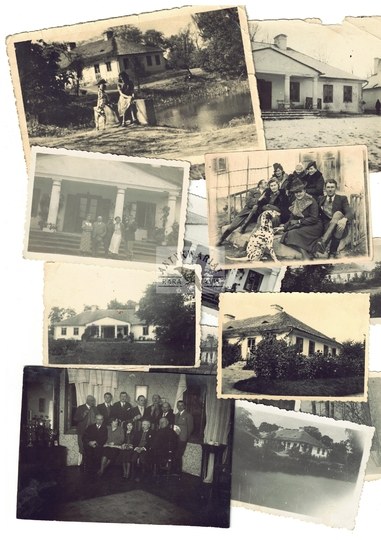
[NIECIESŁAWICE — the Bronikowski Manor— landscape and architectural photographs]. [1930s]. A set of 13 photographs measuring approximately 8.5x12 cm, 6x9 cm, 7x9 cm, and 5x6.5 cm.
The photographs depict, among others, the Oppeln-Bronikowski family and their guests at the manor, in front of the manor, and in the park. On the reverse, handwritten identifying inscriptions, including: “Nieciesławice. Bronikowski estate,” “Nieciesławice—the Bronikowskis’ residence,” “Nieciesławice 1933. Hunting,” “Nieciesławice. Owned by the Bronikowskis,” “Nieciesławice, November 6, 1937,” “Nieciesławice, Kielce Province, owned by the Bronikowskis: Helena and Maria Bronikowska, Janusz Zdzitkowski.” The backs show traces of having been removed from an album; the edges are worn and creased in places.
Nieciesławice —a village located in the Świętokrzyskie Voivodeship, in the Busko County, in the municipality of Tuczępy. From 1975 to 1998, the village belonged administratively to the Kielce Voivodeship. Nieciesławice is a village mentioned by Jan Długosz in *Liber Beneficiorum* as“Naczasslawicze.” According to his description, there were peasant fields here from which a tithe was paid to Tuczępy. Hugo Kołłątaj, an outstanding statesman and publicist of the era of the Four-Year Sejm and the Kościuszko Uprising of 1794, grew up here. In the 19th century, the village was located in the Stopnica County, within the municipality and parish of Tuczępy, on the left side of the dirt road from Stopnica to Staszów, 8 versts from Stopnica. In 1827, there were 23 houses and 207 residents. In 1883, the Nieciesławice farmstead and village covered an area of 625 morgas. A 6- and 8-field crop rotation system was used.According to data from the 1921 census, the Nieciesławice farmstead had 5 buildings and 48 residents, while the village of Nieciesławice had 43 buildings inhabited by 234 residents, including 6 of Jewish descent. Today, remnants of the 19th-century manor park remain and are listed in the register of immovable monuments. (Wikipedia).
The village was home to a manor house built in the 19th century on the site of a wooden manor for the Oppeln-Bronikowski family. Stefan Żeromski was a frequent visitor there and described his visits in his “Diaries.” The manor house housed an excellent library. For more information about the manor and the family of owners, visit: http://www.polskiezabytki.pl/m/obiekt/5460/Niecieslawice/.











Последно разглеждани позиции
Влезте, за да се запознаете със списъка с артикулите
Любими
Влезте, за да се запознаете със списъка с артикулите