


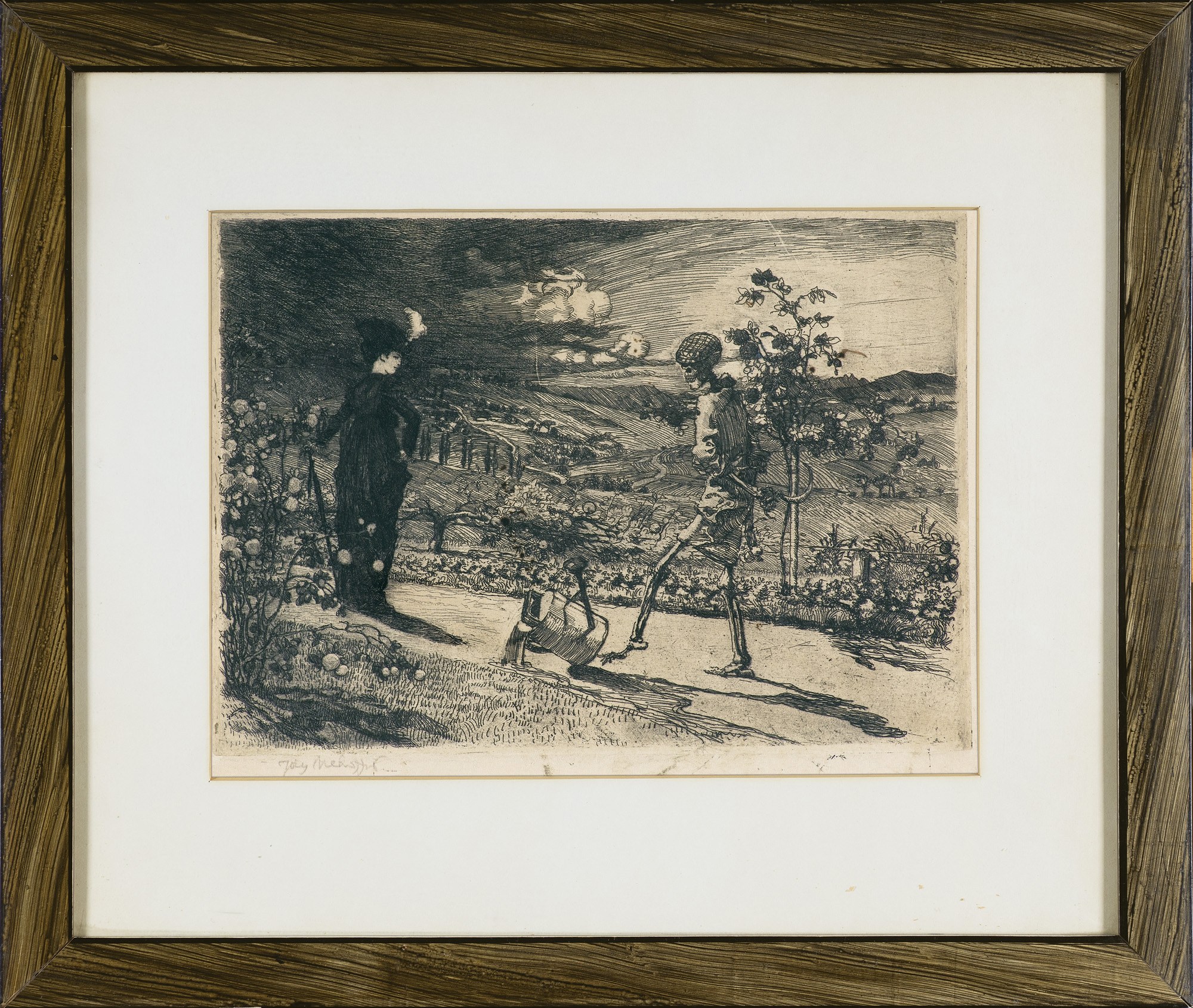

22,5 x 30,5cm - etching, paper
22.5 x 30.5 cm (in light of passe-partout)
signed in pencil under the composition l.d.: Jozef Mehoffer
The Bold Gardener II is one of Józef Mehoffer's most famous prints, mentioned in numerous publications, in which, as Maria Poprzęcka writes, the artist demonstrates a mastery of technique and a characteristic visual language, combining symbolism, Art Nouveau decorativeness and personal mythology. Aiming for the best expression of his concept, he chose the etching technique, departing from the original soft varnish version of The Bold Gardener I. The scene, maintained in the spirit of Young Poland decadence with a touch of humor, is set in the Mehoffer family garden in Jankówka. It depicts the artist's wife, whose carefree stroll is interrupted by Death. Depicted as a "daring gardener" with a hidden sickle, she knocks over a watering can from which water - a symbol of life - pours out. As Mateusz Salwa notes, the garden in Mehoffer's work, as in the culture of the early 20th century, is a space of transformation and spiritual search, gaining a metaphysical dimension - it becomes a place of tensions, hidden desires and alchemical transformations.
In turn, Elżbieta Wichrowska writes that the figure of the "bold gardener" itself remains ambivalent: it can be read as an alter ego of the artist, the creator, or as an allegory on the border between sacrum and profanum, as Jan Białostocki, in turn, emphasizes - deliberately set by Mehoffer in the space of dream and myth. Formally, The Bold Gardener II is distinguished by its subtle line, detail, refined decorativeness and rhythmic composition, writes Bozena Petrić. The etching exudes a strong mood, built by contrasts and symbolic elements of nature. As Andrzej Szczerski writes, it was created in 1912, during the period of Mehoffer's artistic maturity, when his art was directed towards existential questions. The work aptly captures the atmosphere of fin de siecle and the premonition of the coming changes of modernity, being an enigmatic example of his understanding of art as a path of cognition and spiritual reflection.
Selected bibliography:
- M. Poprzęcka, Józef Mehoffer, Artistic and Film Publishers, Warsaw 1980, pp. 56-59.
- J. Białostocki, Iconography and iconology. Studies in the history of art, PWN, Warsaw 1982, p. 214.
- E. Wichrowska, Symbol and Form. Młodopolska grafika i jej znaczenia, National Museum in Cracow, Cracow 2003, pp. 101-103.
- A. Szczerski, Modernizations. Art and Modernism in Central and Eastern Europe 1900-1920, Universitas, Krakow 2010, p. 112.
- M. Salwa, Garden as a symbolic and aesthetic space in art at the turn of the century, "Bulletin of Art History," 2011, no. 3, p. 297.
- B. Petrić, Artistic graphics in Poland at the turn of the 20th century, Sztuka.pl, 2017, no. 2, p. 51.
Jozef Mehoffer (Ropczyce 1869-Wadowice 1946) - painter, graphic artist, stage designer and educator; next to Stanislaw Wyspianski, he was the most outstanding Polish creator of stained glass and polychromy. A student of Jan Matejko and the Paris academies - Ecolé des Beaux Arts and Accadémie Colarossi - his creative path began in 1889-1891 with work on the polychrome of St. Mary's Church in Cracow (under Matejko's direction). In 1895, he was awarded first prize at an international competition for stained glass windows for the collegiate church in Fribourg, Switzerland (their realization lasted until 1934). In the following years, he received various other commissions for stained glass and polychromes, including for Wawel Cathedral and Plock, the Armenian Cathedral in Lviv, churches in Opava, Onnes in Switzerland, Jutrosin, Włocławek or Przemyśl (not all completed). He was an outstanding representative of Art Nouveau. He created decoratively treated portraits, including self-portraits and portraits of his wife, as well as paintings with genre overtones, which in 1895-1917 gained the meaning of symbolic compositions. He also painted landscapes combining Art Nouveau decorativeness with the achievements of Impressionism. With masterful mastery of various techniques - oil, tempera, watercolor and gouache - he also worked in printmaking. The last major exhibition of the artist's works, entitled Opus magnum, was held in 2000 at the National Museum in Cracow.













Последно разглеждани позиции
Влезте, за да се запознаете със списъка с артикулите
Любими
Влезте, за да се запознаете със списъка с артикулите