


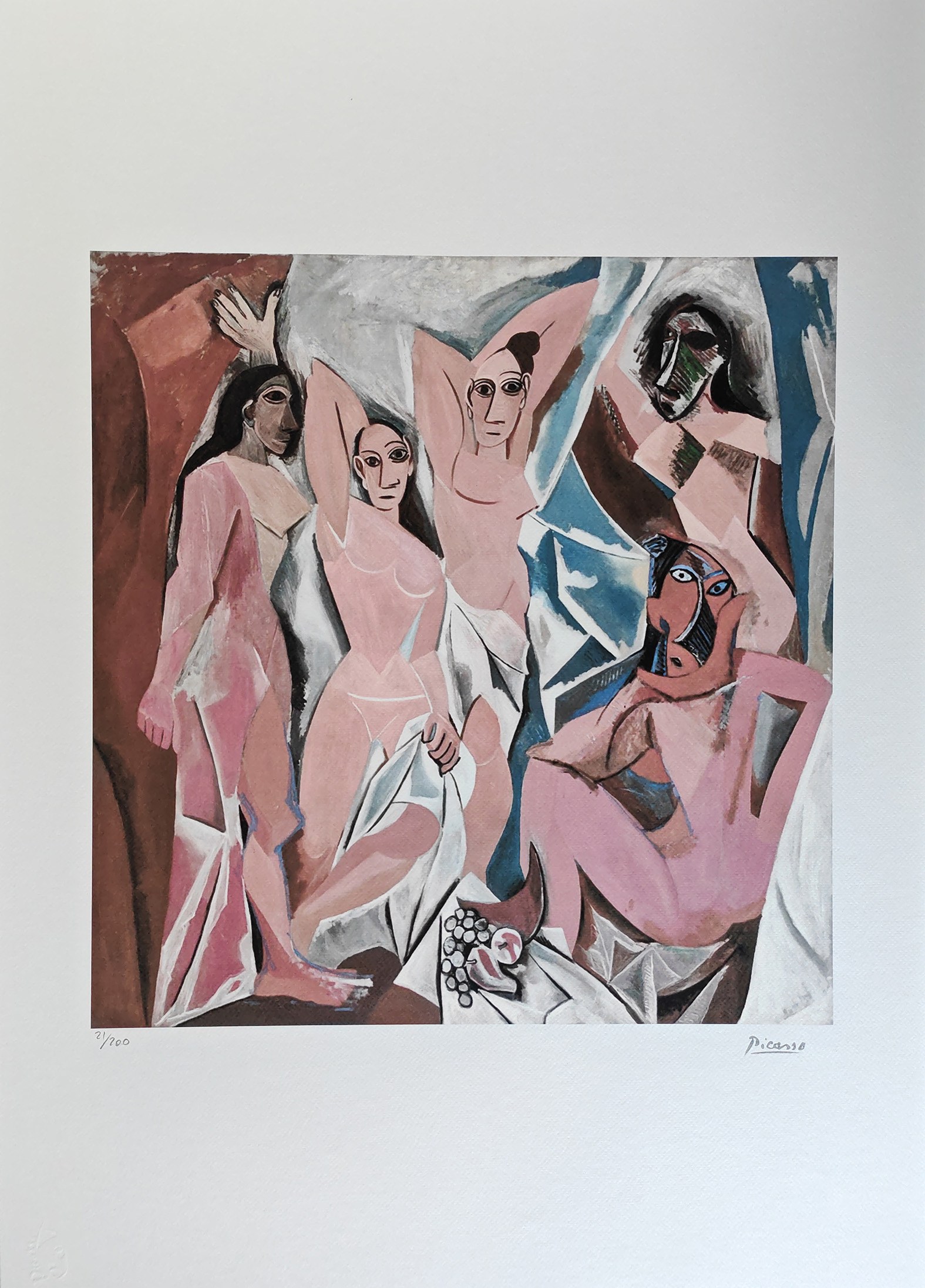

Print, limited edition of 200 pieces, on French paper.
Dimensions: 50 x 70 cm (full sheet)
Each print is individually numbered.
Inscription in pencil, top left: 21/200; bottom right: facsimile “Picasso.”
Bottom left: publisher’s dry stamp
On the reverse: typographic description and hologram
Condition: very good
Pablo Picasso was born in Málaga in 1881. His father was an illustrator; it was he who gave him his first lessons and recognized his talent. At the age of fourteen, Pablo enrolled at the Royal Academy of Fine Arts of St. Ferdinand. Soon after, he found himself in Paris, where he became part of the French artistic bohemian scene. He then spent time in Italy during World War I, and spent the 1930s, among other places, in Spain. Picasso spent the first half of the 1940s in Paris, and after becoming a communist, he lived out his days there, near Cannes, in the south of France. He was the creator of such unforgettable works as, for example, his “Longchamp,” which combines expressive forms with vivid colors. Next came Picasso’s Blue Period, in which the color blue was intended to convey feelings of compassion, sadness, or emotion. It suffices here to mention his work titled “The Call: The Funeral of Casagemas” from 1901, or the painting “The Old Guitarist,” created in 1903. Later came his Rose Period, exemplified by the painting “The Harlequin’s Family.” However, this period, too, gave way to something new—Picasso was, in a sense, experiencing the world anew, and thus began his pre-Cubist period, resulting in works such as “Portrait of Kahnweiler” and “Harlequin” from 1915. This was by no means the end of his evolution. He went through a return to classicism, evident in the work “Women at the Fountain.” Finally, his prewar surrealism emerged, as seen in “The Dance” and “The Red Armchair.” Paintings such as “Massacre in Korea” from 1951 or “War and Peace,” on the other hand, date from the postwar period. Some even see traces of Mannerism in his work from that time. Let’s take a look at his reinterpretations of Velázquez’s *Las Meninas* and the famous *Breakfast on the Grass*. Meanwhile, Picasso was also engaged in creating artistic ceramics, which marked his final creative period. He died on April 8, 1973, in Mougins. During his lifetime, Pablo Picasso was in seven long-term relationships. He had four children: Paul (with Olga Kokhlova, his first wife), Maya (with María Teresa Walter), Claude, and Paloma (with Françoise Gilot, his second wife). (source: www.zyciorysy.info)










