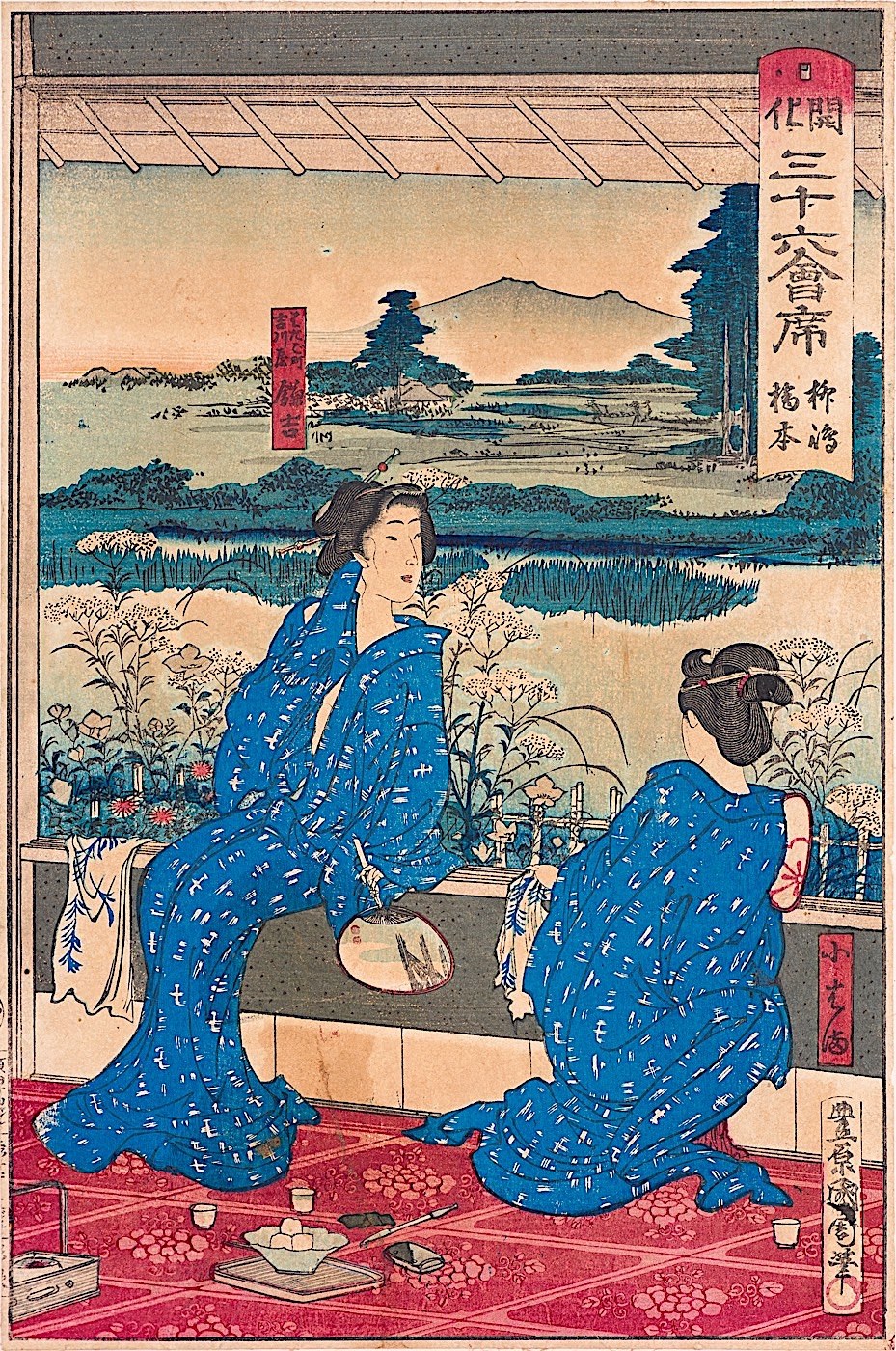
color woodcut, paper, 34.5x22.5 cm, artist's signature, this is a woodcut from the first edition published in 1878.
"Thirty-six Modern Restaurants" is a series of Kunichika woodcuts from 1877-1878 that depict beauties in popular restaurants in various locations. The women are serving a meal, relaxing in a garden or on a veranda, and coming or going from a tea room. These colorful works are rich in detail, showing beautiful interiors as well as outdoor scenery, nature, surroundings.
Born in 1835, Toyohara Kunichika grew up in the Kyobashi district of Edo among merchants and artisans. In 1848, at the age of 13, he was accepted as an apprentice in the studio of Utagawa Kunisada I (Toyokuni III 1786-1865). He was known as one of the "Three Great Creators of Meiji Ukiyo-e," along with Yoshitoshi Tsukioka (1839-1892) and Kiyochika Kobayashi (1847-1915). In 1869, he began publishing a series of portraits of kabuki actors. As a graphic designer creating yakusha-e (prints of actors), Kunichika was a regular visitor backstage at the Kabuki Theater. He made sketches of actors before and during performances and rehearsals. He had an in-depth knowledge of every aspect of the theater, being well versed in plays, playwrights, actors and their acting styles.
Unlike most artists of the time, he used strong reds and dark purples, often as background colors, instead of the softer colors that had been used previously. These new colors were made from aniline dyes imported from Germany during the Meiji period. Kunichika's work contrasts with that of many of his contemporaries because he stubbornly adhered to the traditional style and subject matter of classical Japanese woodblock prints, without being influenced by new Western art forms. His love of kabuki inspired him to depict actors in their various roles and with different facial expressions. His skillful use of color and ability to translate the depth of an actor's emotions onto the page makes his works some of the most dramatic ever created. Later in his career, Kunichika turned primarily to the triptych format, as the increased size gave him the space to fully depict the drama and action of the characters depicted.
Kunichika died at his home in Honjo on July 1, 1900 at the age of 65 due to ill health and fits of heavy drinking caused by the death of his daughter Hana in 1899. He was buried at the Shingon Honryuji Buddhist Temple in Imado, Asakusa. His tombstone was destroyed in the 1923 earthquake, but family members erected a new one in 1974. In ancient Japan, it was a common custom for people of high cultural standing to write a poem before they died. Kunichika's grave bears his poem: Since I am tired of painting portraits of people of this world, I will paint portraits of Enma (king of hell) and devils.