


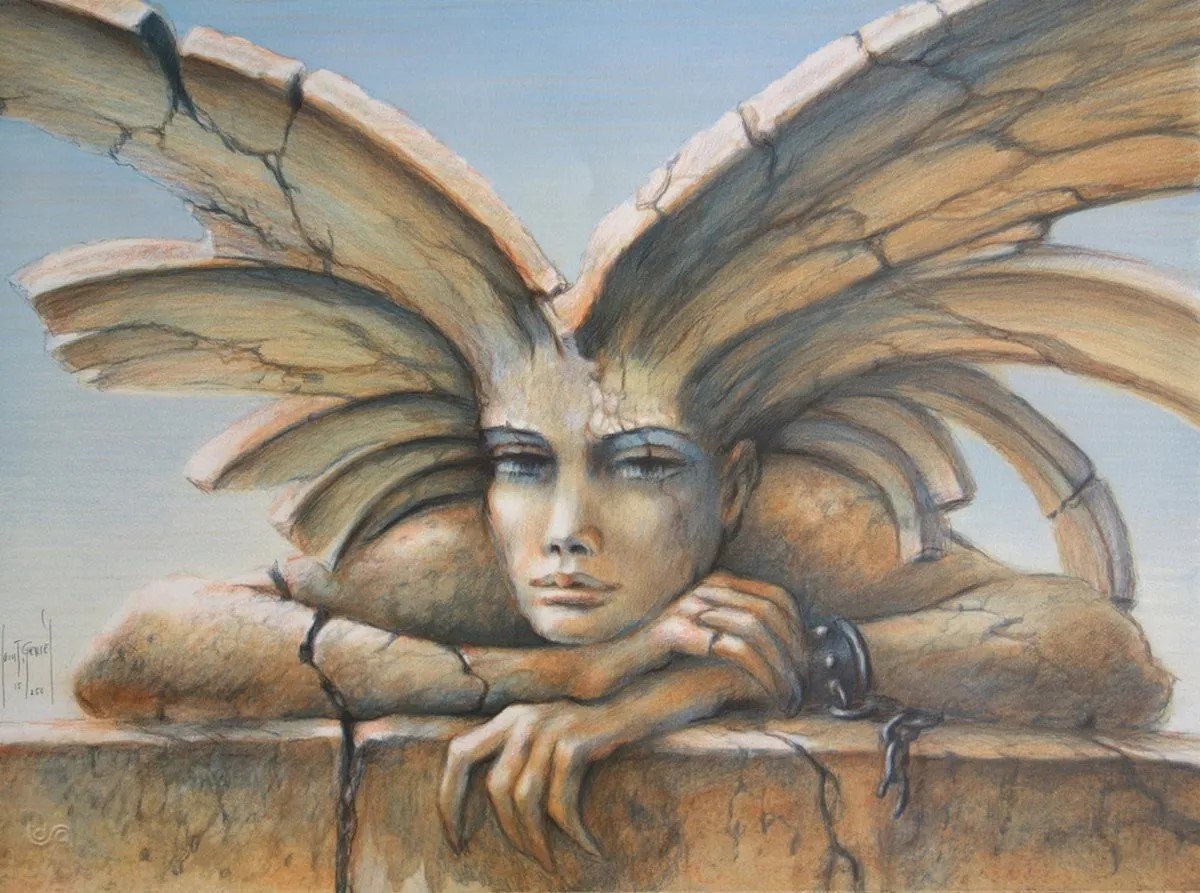
Color lithograph on luxury Vellum paper, 56 x 76 cm (composition);
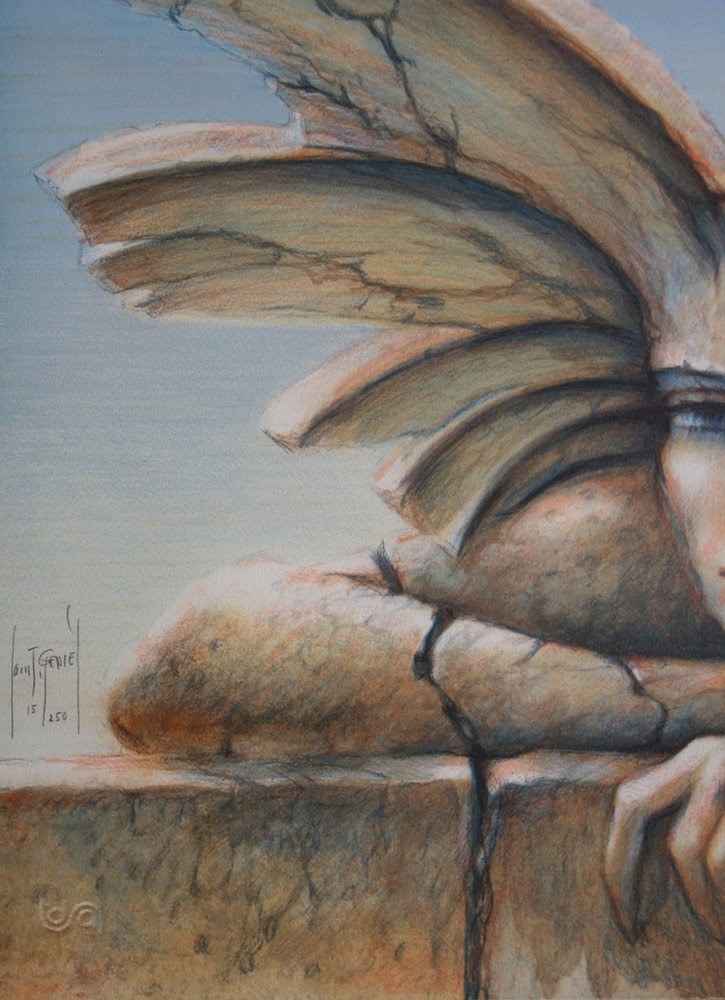
Limited edition, numbered in pencil by the artist 15/250 lower left;
Signed by the artist in pencil on the lower left, with a dry seal—the artist’s own monogram—Francis de Lassus Saint-Geniès (tampon d’artiste / timbre à sec de l’artiste) on the lower left;
Publisher: G. Monnet & G. Petrie Éditeurs (Paris) in collaboration with the Paris gallery Vision Nouvelle; production: Atelier Jobin Paris (technical preparation of lithographic stones/plates and printing of the artwork on a flatbed press on Arches paper).
Francis de Lassus Saint-Geniès created in the spirit of Romantic surrealism and the fantastique.
Saint-Geniès was one of those French masters of graphic art and fantastique painting who paved the way for contemporary, commercial magical realism. Today’s Polish artists in this circle will develop the same themes, adding only more elements of horology, steampunk, or architectural cities. Francis de Lassus Saint-Geniès laid the groundwork for this movement long before Polish magical realism experienced its boom in the 1990s and after the year 2000. His work revolved around mythological femininity, mystery, and metamorphosis—he very often depicted hybrid women, sphinxes, mermaids, or figures fused with rocks and architecture. Painters such as Tomasz Sętowski, Jarosław Jaśnikowski, and Rafał Olbiński drew heavily on the legacy of 20th-century surrealism and fantasy—including the works of Saint-Geniès.
Here are the direct connections and defining features of this style, which Lassus Saint-Geniès had already been developing in the 1970s and which became the hallmark of Sętowski and his generation:
Woman-Sculpture / Hybrid: The combination of an idealized, beautiful female face with architecture, cracked stone, wings, or armor is the absolute foundation of both artists’ work. Illusionistic Technique: Both Saint-Geniès and Sętowski rely on a perfect, almost academic technique—smooth tonal transitions, realistic chiaroscuro, and a masterful rendering of the texture of cracked stone or metal. Fairy-tale and mythological elements: Motifs of imprisonment, chains, masks, sphinxes, and the theme of being “frozen in time” create a dreamlike, fairy-tale atmosphere for adult viewers.
Saint-Geniès is internationally recognized; he has regularly exhibited his works in renowned galleries in Paris (including prestigious art salons), as well as in the U.S., Switzerland, Japan, and Germany. His works quickly found their way into important private art collections in Europe and North America.







Последно разглеждани позиции
Влезте, за да се запознаете със списъка с артикулите
Любими
Влезте, за да се запознаете със списъка с артикулите