


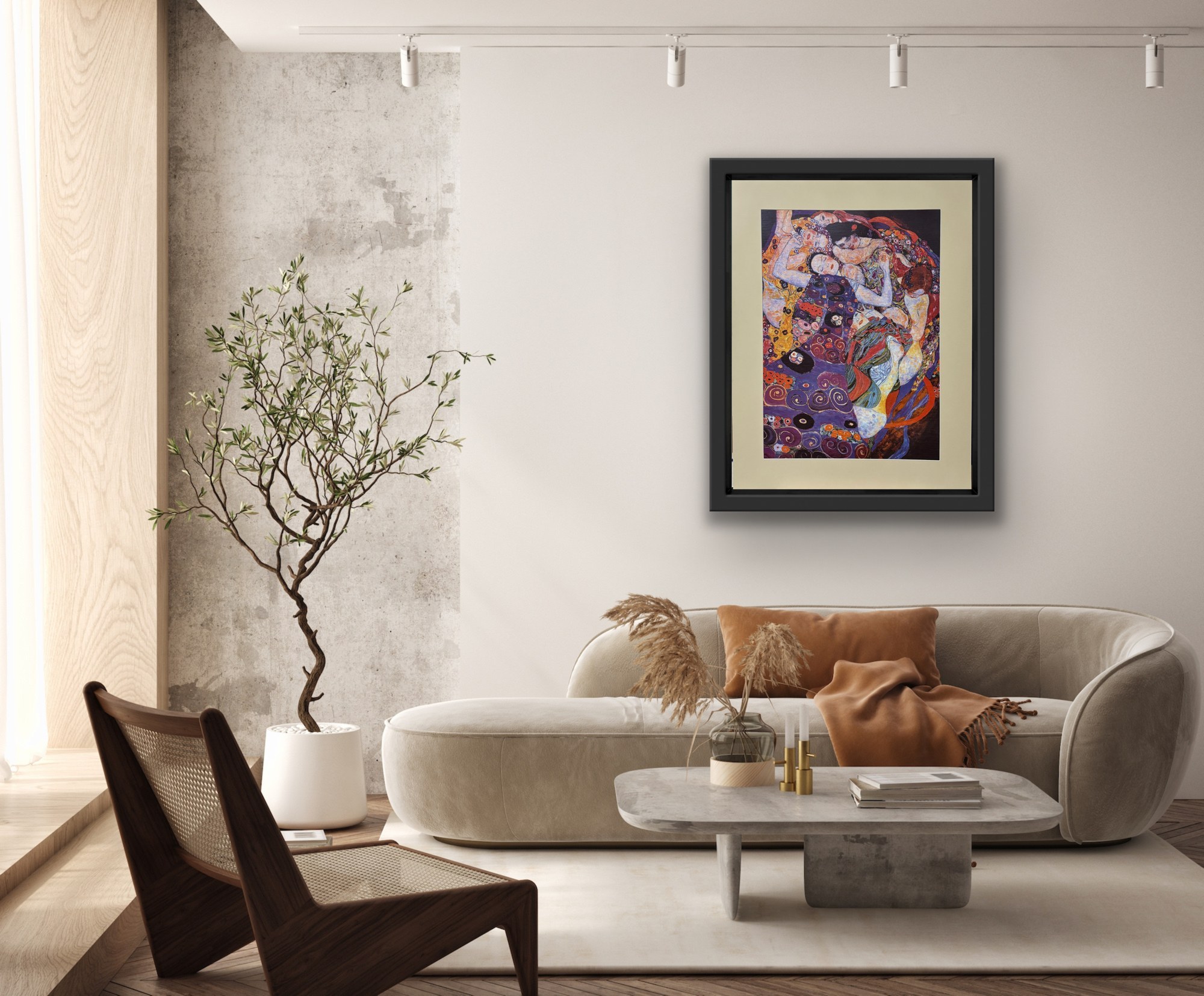
Artist-printed lithograph, ribbed paper, 69 x 49 cm within a passe-partout measuring 86 x 66 cm;
The lithograph comes from an exclusive portfolio published in the mid-20th century by Akademische Druck- u. Verlagsanstalt in Graz, Austria.
Gustav Klimt received a classical education, yet he sought a style of his own that would transcend prevailing patterns and artistic conventions. The austere, academic style did not suit him, as Klimt believed that art should be perceived solely in aesthetic terms. The Viennese artist’s work gradually moved away from history, thereby establishing a new trend in modernism. The revolution brought about by Gustav Klimt made him the greatest of all Austrian artists. In creating his paintings, he focused on aesthetic experiences, brimming with ornamentation and radiance.
The lithograph “The Virgin” is based on one of Gustav Klimt’s most fascinating and colorful works —a leading representative of the Vienna Secession—painted in 1913, that is, during the later period of his career, when he was gradually moving away from his famous “golden style” (known from “The Kiss”) in favor of a richer color palette and floral motifs.
Klimt was a master of symbolism and an explorer of the female psyche. “The Virgin” is a visual metaphor for a girl’s transformation into a woman. The central figure is a sleeping young woman in a joyful, almost ecstatic pose. Her sleep symbolizes innocence, but also awakening sexuality. Other female figures in various poses swirl around her. They suggest different stages of life, moods, and aspects of femininity—from melancholy to desire. Klimt’s characteristic spirals, flowers, and geometric patterns (here mainly circles and ovals) create a kind of “safe cocoon” or island on which the figures drift.
The artist never created a self-portrait. He was fascinated by women and devoted most of his work to them. The Viennese bourgeoisie did not accept his portrayal of women: often nude and as dominant “femme fatales.” The artist’s works are filled with sensuality and eroticism. The painter never married, yet he shared deep relationships with many inspiring women. As he himself stated, he feared love and held it in awe.
The original is housed at the National Gallery in Prague.











Последно разглеждани позиции
Влезте, за да се запознаете със списъка с артикулите
Любими
Влезте, за да се запознаете със списъка с артикулите