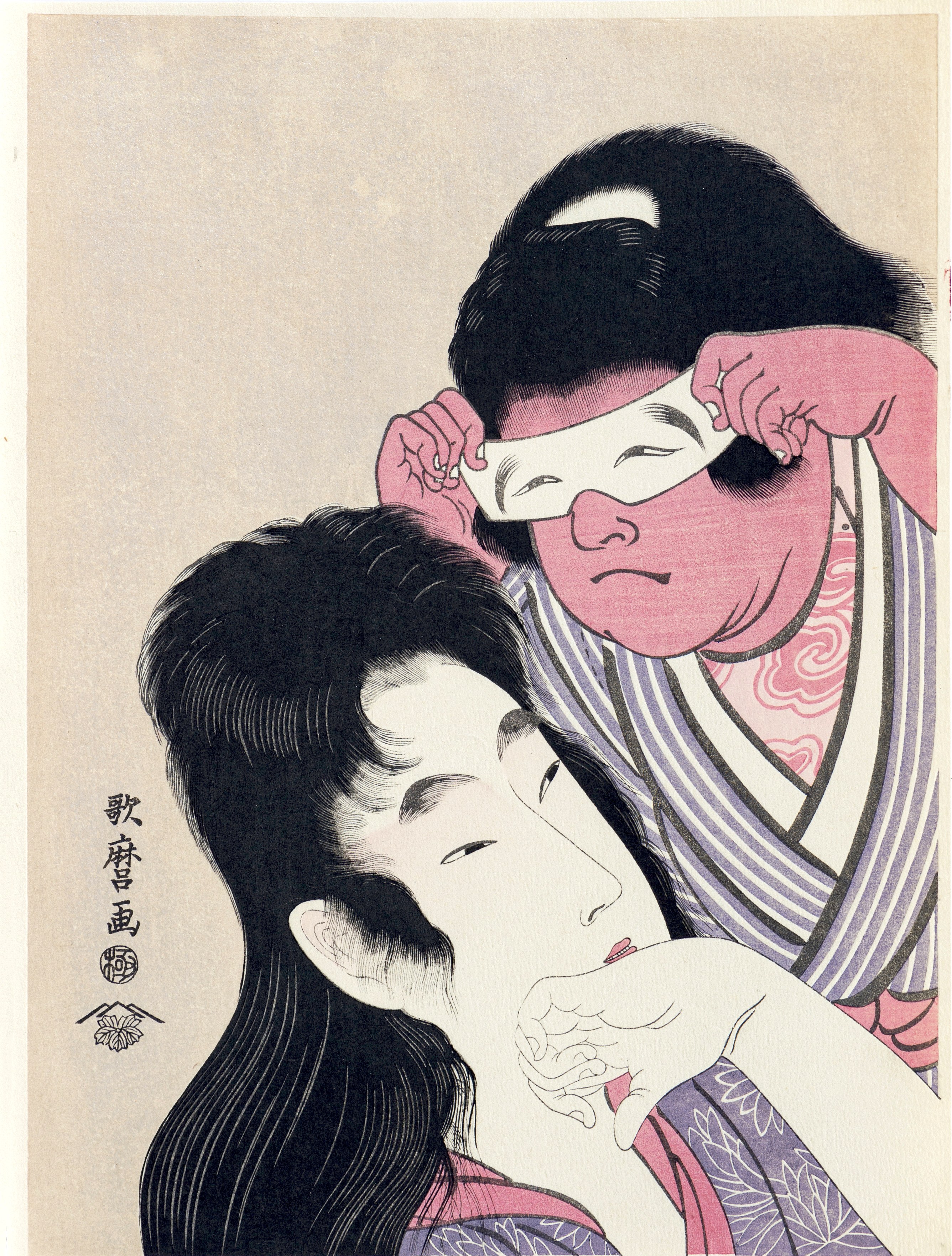
Color woodcut, ink, paper, 29x22 cm, artist's signature, pearl-gloss background
Lovely double portrait of Kintaro with his mother Yamauba by Utamaro. A wonderful scene of maternal love as Yamauba plays with her little son, with her long hair falling over her shoulders. An attractive design with beautiful, delicate hairlines and eyebrows.
Kintaro and Yamauba are characters from Japanese folklore. Kintaro is a folk hero, a child with superhuman strength, and Yamauba is the "mountain hag" who raised him. This is a popular tale of extraordinary strength and the relationship between mother and child, and Kintaro has become a symbol of courage and strength.All legends agree that Kintarō as a young child was active and tireless, plump and flushed, wearing only a bib with a kanji sign meaning "gold." He was incredibly strong, smashing rocks to pieces, uprooting trees and crushing trunks like twigs.
This beautiful reissue of the design comes from the famous Tokyo publisher Adachi, one of the most respected publishers of the 20th century. Adachi's woodcuts were printed to the highest quality standards, with excellent color and fine detail. Adachi's woodblock printers were known as the best in the industry. The Adachi Group also chose interesting and diverse subjects for its prints and was the sole publisher of many famous old ukiyo-e paintings.
Utamaro has been called an artist without a biography. The best source of information about his life is his work and his rich artistic output, for he left behind some three thousand woodcuts. Utamaro was associated with the artistic and literary circles of Yoshiwara, a popular pleasure district in Edo. He revolved in the company of the greatest writers, poets, artists and publishers of his time. He was born in 1753 and began taking lessons at the studio of Toriyama Sekien as early as 17, while creating his first works. In 1780 he met publisher Tsutaya Yuzaburo, one of the most influential people in Edo at the time. He took up residence in his house, at the entrance to Yoshiwara, and met Tori Kiyonaga there, who was a fundamental influence on the young Utamaro's maturing style. During this time, he began to successfully design books, primarily erotic books. In 1789, a ban on the publication of illustrated books and criticism of the establishment was brought out, causing his artistic interests to be strongly directed toward the ukiyo-e woodcut. Between 1791 and 1797, he created a famous series of woodcuts with portrait studies of women, scenes from the lives of Yoshiwara courtesans, and works with love themes drawn from classical poetry. In 1804. Utamaro broke the law and the ban on publication for which he was sentenced to three days in the dungeon and two months of wearing shackles. He died in 1806.
By the end of the 18th century. Utamaro became one of the most prominent woodcut artists in Edo. He created the ideal of a Japanese woman, primarily a courtesan, a prostitute, and elevated her to the status of a goddess. He developed an easily recognizable style, specific only to himself, of depicting the female figure, dressed in an ornate kimono, with her hair elaborately pinned up. He is widely considered to be the one who most fully expressed the essence of femininity in Japanese culture. His art is a great praise of intimacy.