


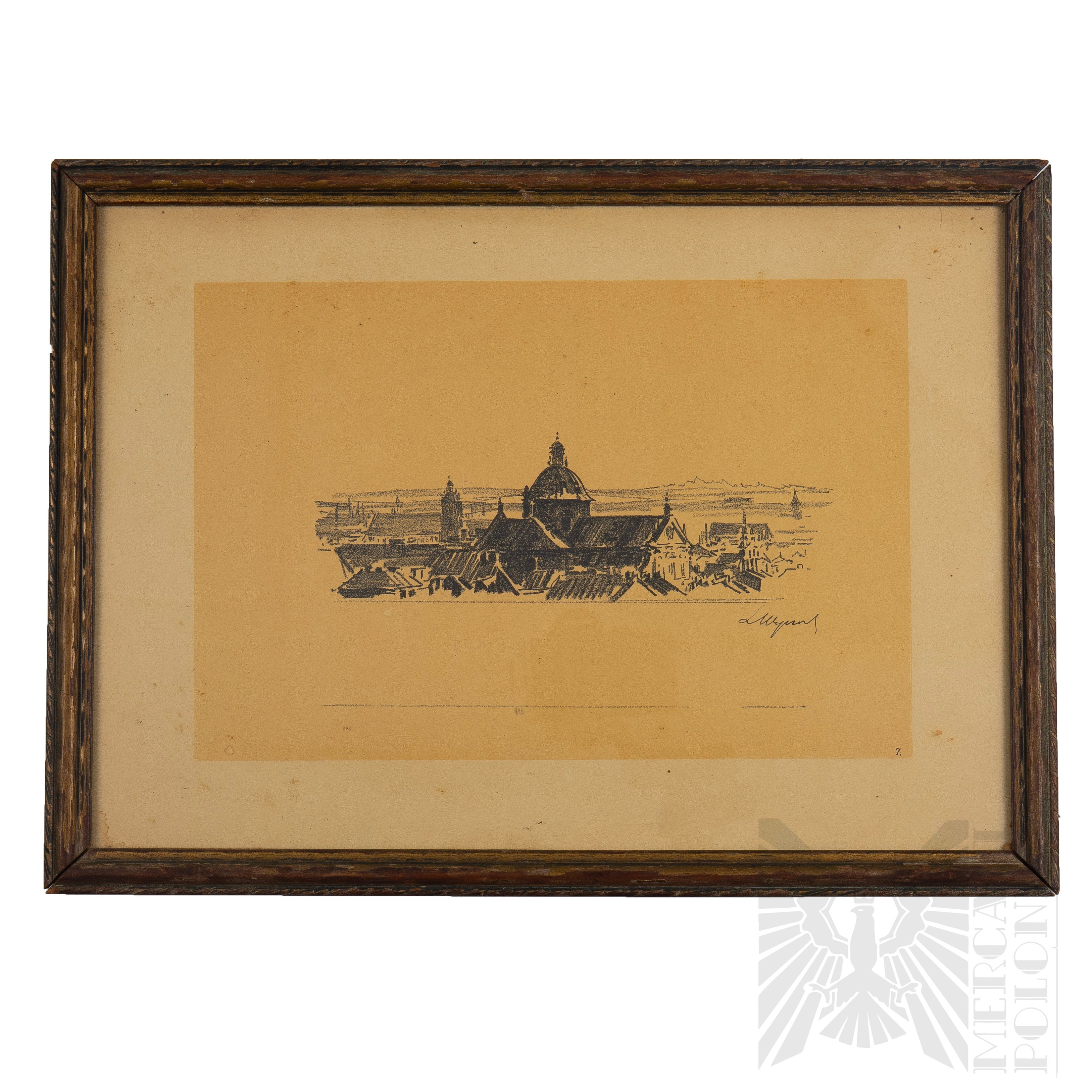

Leon Wyczółkowski (1852-1936)
St. Peter's Church in Cracow, 1915
Lithograph on paper
Size: in frame 41.6 × 30.5 cm
Subtle and atmospheric lithograph by Leon Wyczółkowski, one of the most prominent representatives of Young Poland and a master of graphic techniques. The work shows a panorama of Cracow with the dominant silhouette of the Church of St. Peter and St. Paul, seen from the perspective of the roofs of the Old Town, against the background of a distant, calm horizon line.
The work was created in 1915, at a time when the artist was intensely developing his graphic activity, creating series devoted to the architecture and landscape of Krakow. It is characterized by Wyczółkowski's characteristic synthetic line, masterful play of light and shadow and elegant, almost meditative simplicity of composition.
This graphic belongs to the classic trend of the artist's Krakow views, showing his deep attachment to the city and its cultural heritage.
Leon Jan Wyczółkowski (April 24, 1852 in Huta Miastkowska - December 27, 1936 in Warsaw) - Polish painter, draughtsman and graphic artist, representative of the Young Poland trend. A pupil of Wojciech Gerson in 1872-1873; as early as 1873 his painting Jan Długosz was exhibited at the Society for the Encouragement of Fine Arts in Warsaw. From the autumn of 1875 he studied at the Munich Academy of Fine Arts, and in 1877-79 at the Academy of Fine Arts in Cracow, under the direction of Jan Matejko. Since 1878, that is, since visiting the Universal Exhibition in Paris, he was influenced by Impressionism, having abandoned academism in its favor. A lecturer at the Academy of Fine Arts in Cracow since 1895, he held the position of rector from 1909 until his retirement in 1911. He also developed graphic art during this period, especially lithography and etching; he also gradually abandoned oil technique in favor of pastel, watercolor and ink. In addition to Krakow and Warsaw, he was also associated with Greater Poland and Pomerania.
He was an extremely versatile artist, both technically and in terms of his creative interests: his stays in Ukraine or the Tatra Mountains resulted in a special sensitivity to seemingly simple outdoor motifs and a combination of realistic and impressionistic approaches. In later years he was inspired by Oriental art. He was also known as an accomplished portraitist and panoramic painter of cities.
He died on December 27, 1936 in Warsaw; according to his last will, several hundred works and studio equipment were donated to the city of Bydgoszcz.
Condition as in the photos.











Последно разглеждани позиции
Влезте, за да се запознаете със списъка с артикулите
Любими
Влезте, за да се запознаете със списъка с артикулите