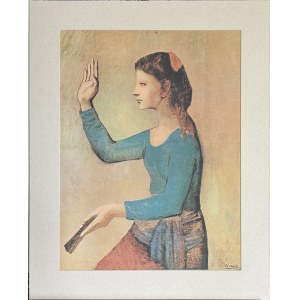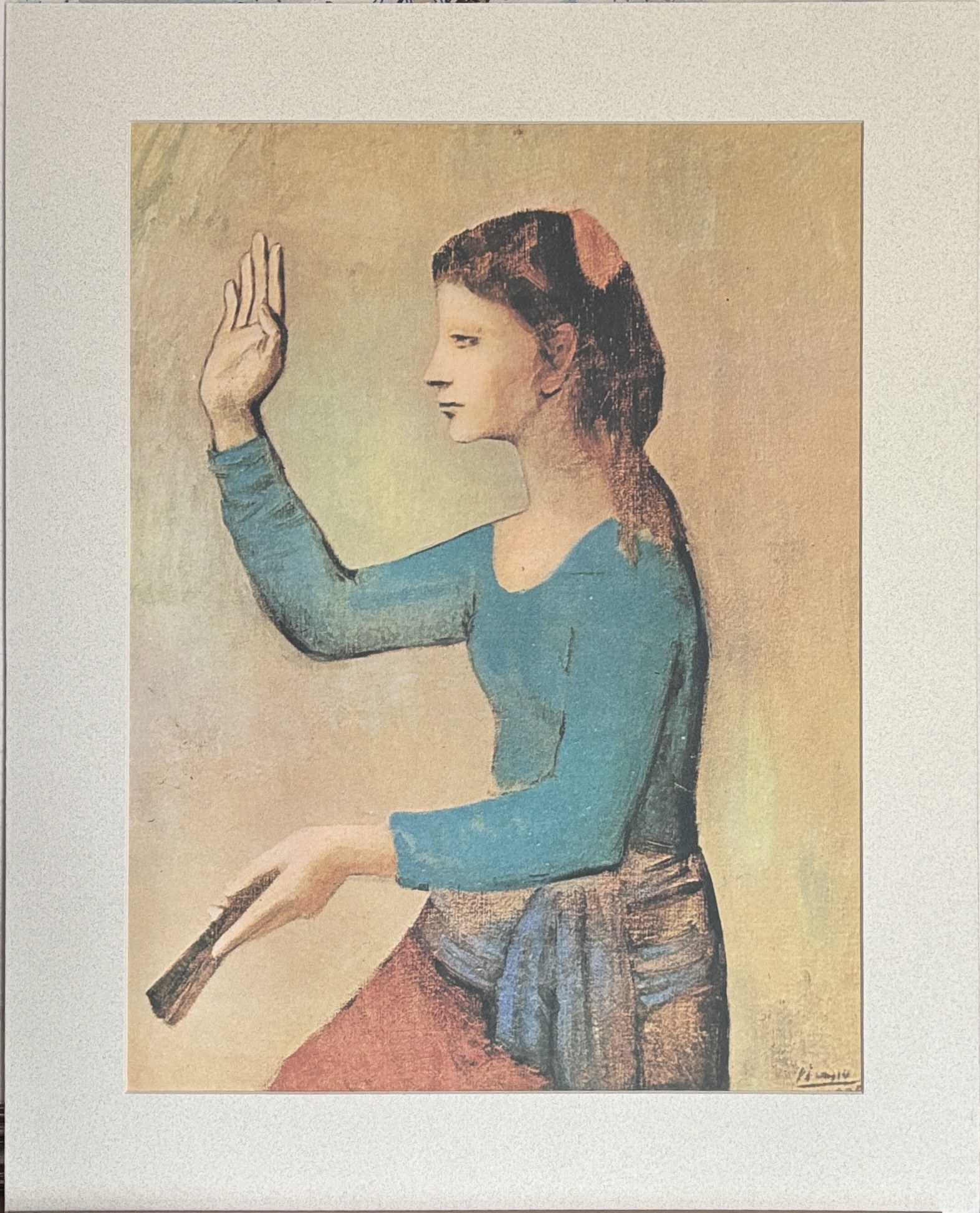

Lithograph, satin paper, 47 x 32 cm, mounted in a passe-partout measuring 57 x 42 cm.
Published by Centro Diffusione Cultura Milano.This prestigious work is part of a limited monographic edition published in 1976–1977 in Milan titled “Picasso Periodo Blu e Rosa” (Picasso: The Blue and Rose Periods), edited and critically annotated by Elda Fezzi and Bruno Rosa. The publication featured 24 selected works from the artist’s most famous creative period (1901–1906).
On the reverse, a stamp reads: Succ. Pablo Picasso Coll. Marina Picasso
Paper specially produced for this edition by Cartier Sterzi; print run of 1,000 copies; the lithographic plates were destroyed to prevent unauthorized reprints.
Accompanied by a certificate of authenticity from the gallery.
This work fits perfectly into Picasso’s so-called Rose Period (ca. 1904–1906). It marks a fascinating moment when the artist was slowly emerging from the deep depression and coldness of the Blue Period.
“Woman with a Fan” (Femme à l’éventail) was created by Pablo Picasso in 1905, toward the end of his Rose Period.
The woman depicted in the painting is most likely Madeleine —a young model and Picasso’s lover from 1904–1905.
Picasso’s relationship with Madeleine took place at the transition between his Blue and Rose periods, just before the artist began a relationship with Fernande Olivier.Madeleine became pregnant with Picasso’s child but decided to have an abortion, which stirred up intense emotions in the artist and was reflected in his work at the time (hence the frequent motifs of motherhood and young women during this period). She appears in several other famous works from 1904 and 1905, including the painting *Girl in a Shirt * (*Woman in a Shirt*)The work is distinguished by the model’s unusual, relief-like and hieratic pose—reminiscent of Egyptian reliefs—depicted in profile with one hand raised in a gestural, almost ritualistic gesture and a fan in the other hand. It is in this work that we see the first signs of the simplification of form that, a few years later, would lead Picasso to Cubism.
Picasso knew the taste of true hunger and poverty, but thanks to his talent and business acumen, he became a living symbol of artistic and financial success.
The frame shown in the images is for illustrative purposes only and does not constitute a commercial offer.