


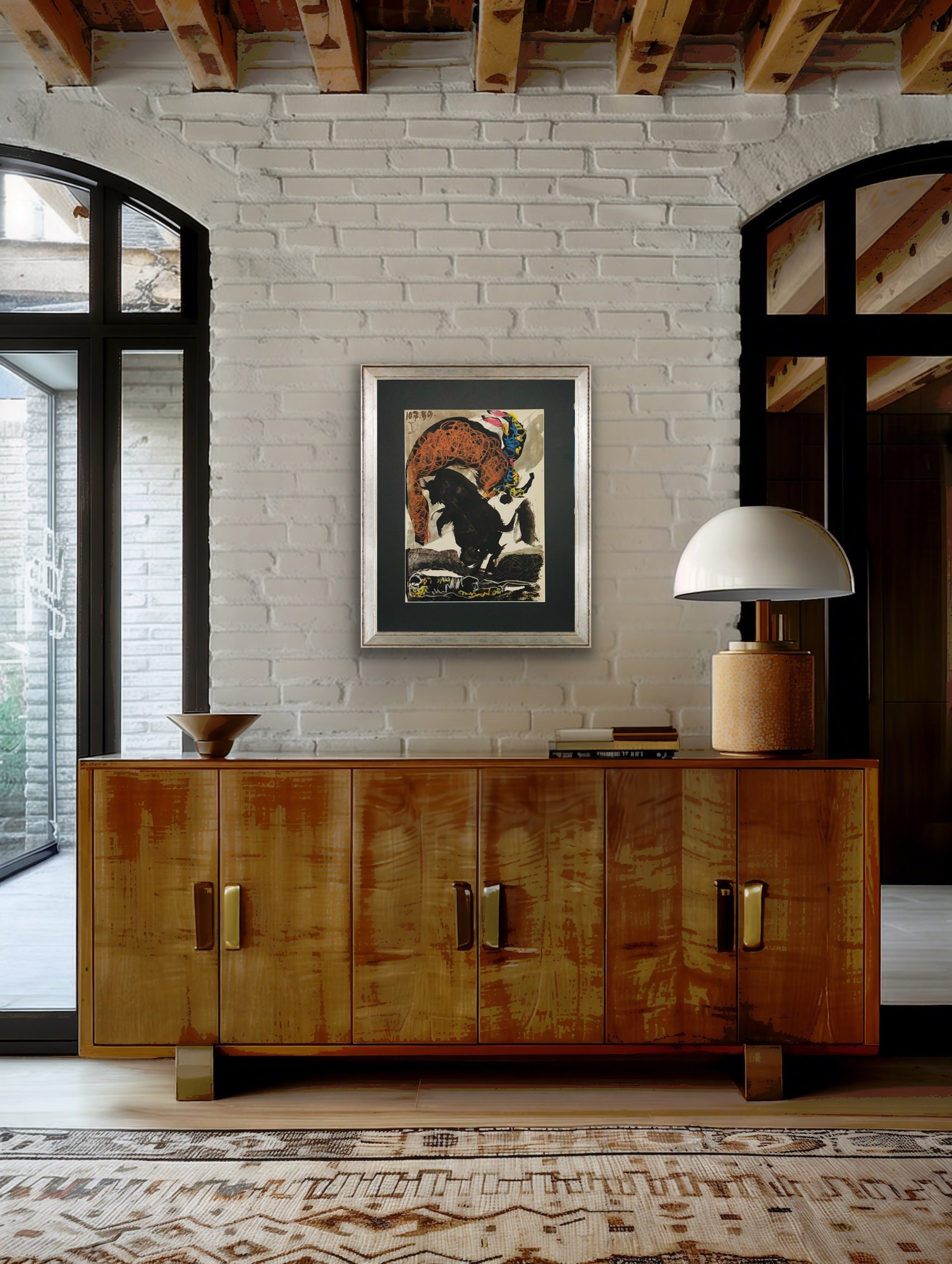
Original lithograph from the rare first edition of the Toros y Toreros (Bulls and Torreadors) series in 1961 on Arches Wove paper, 36 x 26 cm in light passe-partout, 47 x 37 cm, dated on the plate "10.7.59".
Publisher and copyright: Cercle D'Arts - Paris in collaboration with Atelier Fernand Mourlot.
Gallery certificate of authenticity included.
The series from which the print comes was first published in 1961 with Picasso's permission and supervision - on the 80th anniversary of his birth.
The "Toros y Toreros" series is not just a set of drawings - it is proof that Pablo Picasso, despite his years in France, remained Spanish to the marrow of his bones. Picasso did not paint these scenes slowly at the easel. Most of the works in this series are dynamic ink drawings, made using the lavis (blurring) technique. The artist used his brush like a reporter - noting the movement, the momentum of the bull and the elegance of the matador in a split second.
Minimalism-a few black lines are enough to feel the weight of the animal and the tension in the arena. Movement-images almost "vibrate." Picasso was able to render the swirling costume of the traje de luces (costume of lights) with just a few ink blots.
The series is inextricably linked to the great friendship between Picasso and Luis Miguel Dominguín - a corrida superstar of the time (and, incidentally, the father of singer Miguel Bosé). Picasso spent days with him, watching the fights from the front row. This relationship gave the drawings an intimate feel. This was not just a view from the stands; it was the insight of someone who understood the fear, pride and technical precision of this brutal ballet.
In 1961, the series was published in album form. Picasso designed the album to resemble his personal sketchbooks. The text was written by Dominguín himself (telling the story of the bulls) and Georges Boudaille. For collectors, it is the "Holy Grail" - the first editions contain lithographs that perfectly capture the texture of the paper and the saturation of Picasso's ink.
Even if the corrida is controversial today, Toros y Toreros defends itself as a brilliant study of energy. Picasso did not judge - he celebrated the atavistic struggle between life and death. He showed that a line can be as sharp and dangerous as a bull's horn.
In addition to the fighting bullfighters, the series includes numerous drawings by Picasso's second wife Jacqueline, 46 years his junior.
"Painting is just another way of keeping a diary." - Pablo Picasso
The framing shown in the visuals is for illustrative purposes only and does not constitute a commercial offer.










