


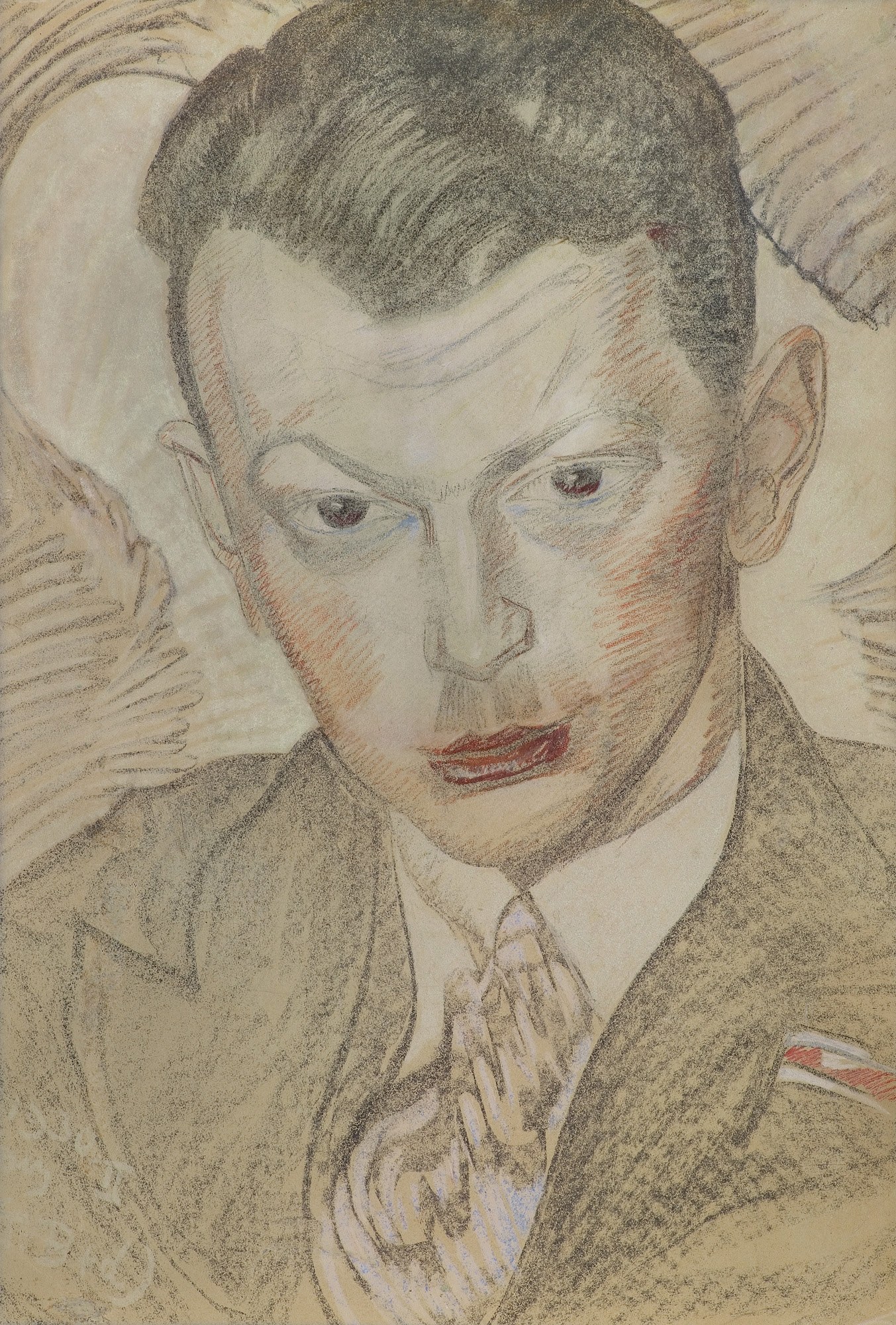
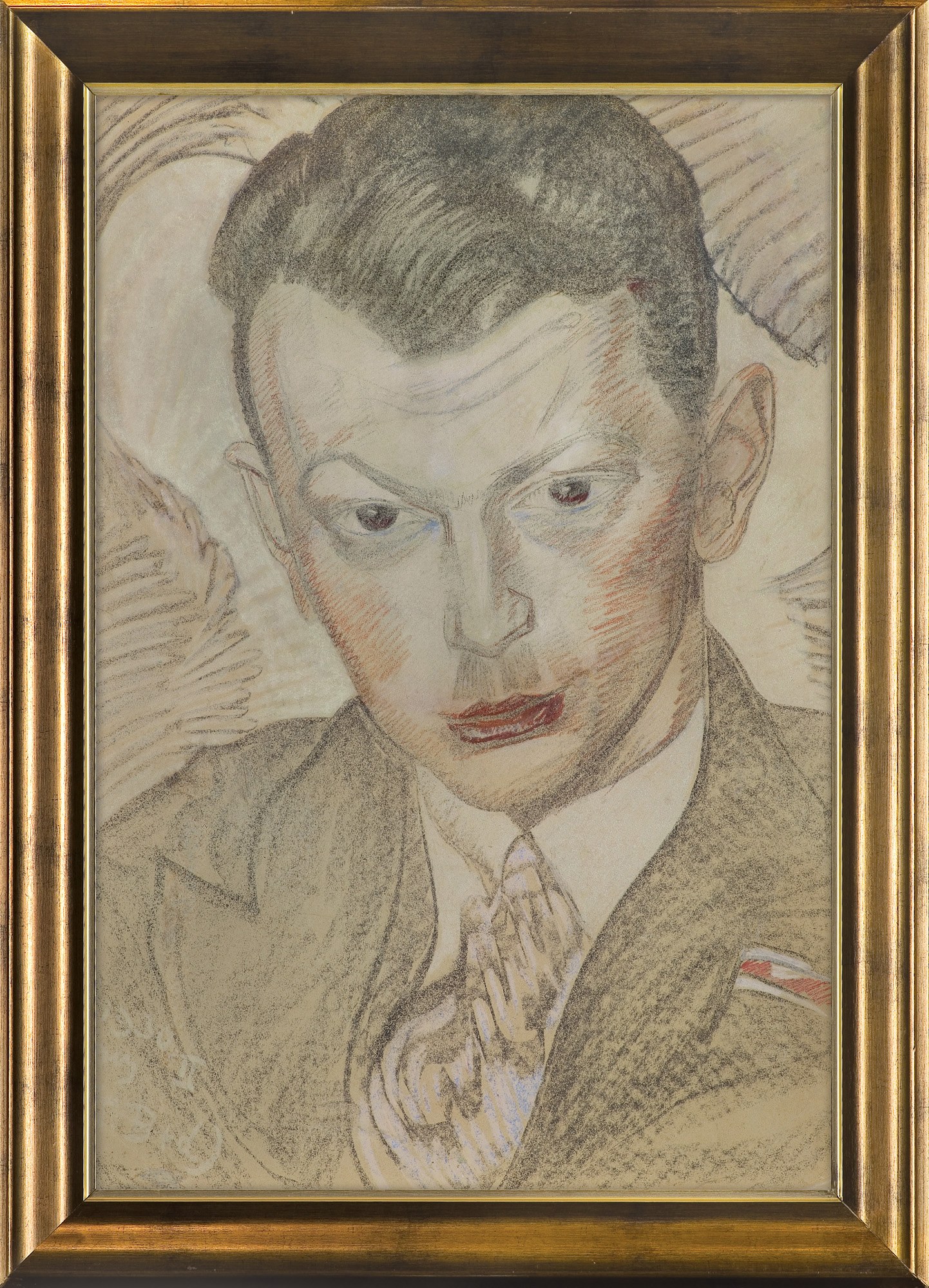
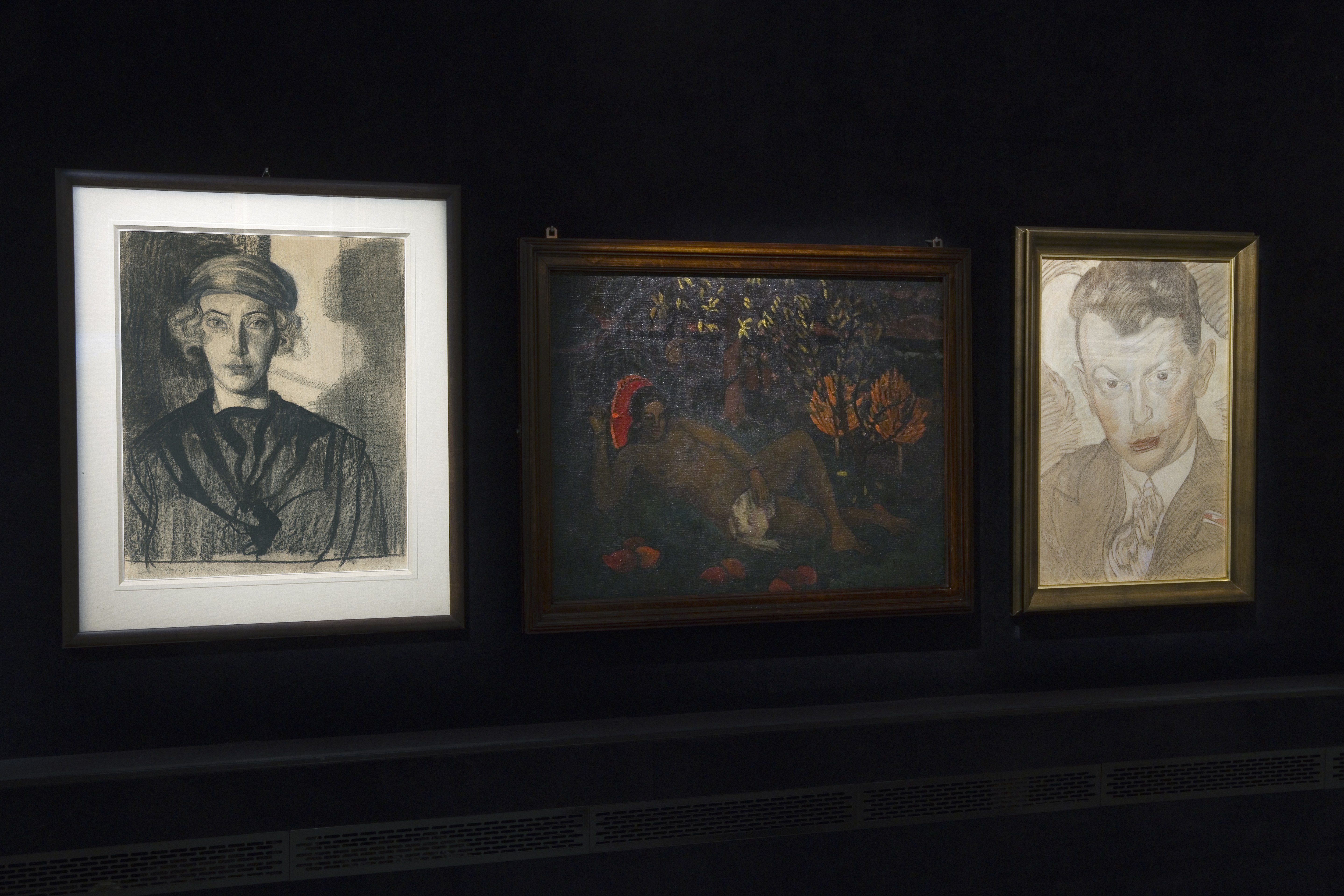
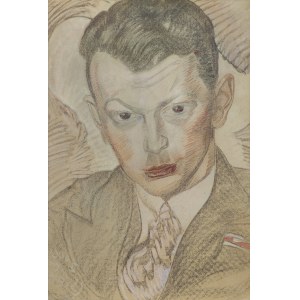
64 x 42.3 cm - pastel on cream-colored paper mounted on cardboard
signed lower left: 1930 | Witkacy II | (T.B + d)
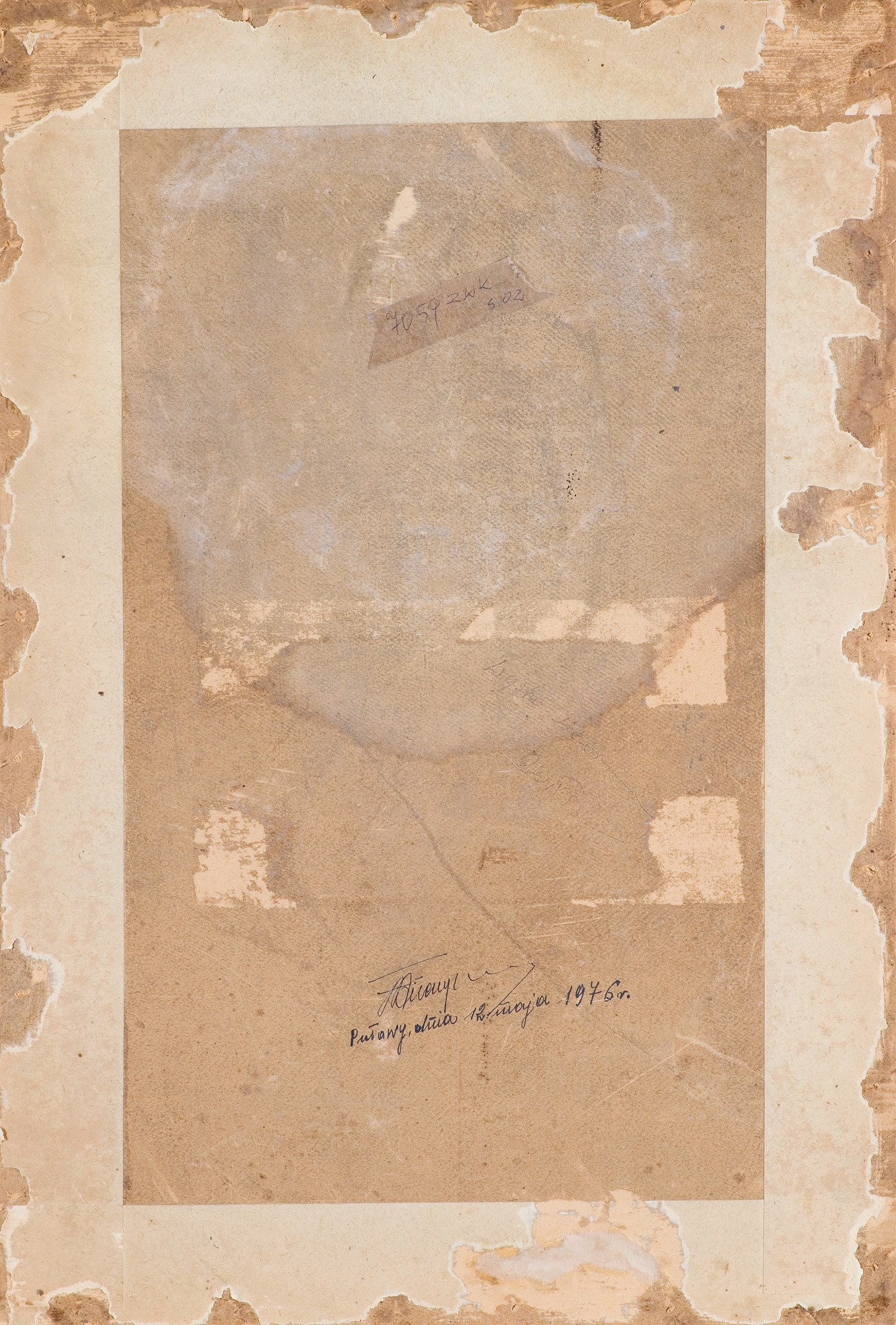
On the so-called back panel, in the upper part, a piece of tape with the inscription (in ballpoint pen): 7059 zk/k [...] | 502;
at the bottom: F. Anczykowski | Puławy, May 12, 1976; above: after [...] silver | September 20, 1992.
Attached to the painting is an expert report by Dr. Anna Żakiewicz dated September 2026.
Portrait of Michał Bercholec (1899–1944), a wealthy owner of a Warsaw-based factory producing automobile parts (FSO since 1948), has been classified as Type B, but is accompanied by the added letter “d,” which denotes a portrait with demonic features. Bercholc likely commissioned a standard portrait, but while working on it, Witkacy became close enough with the client to modify the image slightly, as evidenced by the fact that he signed it with his artistic pseudonym.
In February 1930, the artist painted at least 30 portraits, mainly during a period of intense experimentation with drugs. Furthermore, it was in February 1930 that Witkacy began to summarize his experiences to date with psychoactive substances by writing a treatise on the subject, published in 1932, titled *Nicotine – Alcohol – Cocaine – Peyote, Morphine – Ether + Appendix. He also worked on his major philosophical treatise titled *Concepts and Propositions Implied by the Concept of Existence* (the so-called *Główniak*, published in 1934). At the same time, however, he painted portraits without the use of psychoactive substances, as this provided him with a livelihood. His clients were generally affluent members of the middle class of the time, who typically expected portraits in the realistic style, to which the artist conformed. Sometimes, however, he saw something more in a casual client of his Portrait Firm, and in those cases he would slightly modify the portrait in accordance with his own vision. That is why Michał Bercholc gazes at the viewer with palpable tension from beneath his furrowed brow, and his tie is slightly twisted, which slightly disrupts the appearance of a neatly dressed man. The artist masterfully adapted the chosen style to the model’s striking good looks (and perhaps also to his demeanor), though at the same time he did not stray beyond the bounds of realistic depiction.
This portrait thus showcases Witkacy’s extraordinary skill in portraiture, as well as his flawless artistic intuition, thanks to which—like many of his portraits — the portrait of Michał Bercholt not only reflects the model’s outward appearance but is also a successful attempt to reveal his character traits, even those that might not have been apparent to those around him in everyday life. It is, therefore, a very interesting example of the work of the “S.I. Witkiewicz” Portrait Studio.
Based on an expert opinion by Dr. Anna Żakiewicz
Provenance: The painting comes from the family of Michał Bercholtz.
Stanisław Ignacy Witkiewicz (Warsaw 1885 – Jeziory in Volhynia 1939) was educated at home under the guidance of his father, Stanisław Witkiewicz. In 1903, he passed his high school graduation exam in Lviv. In 1904, he began traveling, visiting, among other places, Vienna, Italy, Munich, Paris, and London. From 1904 to 1910, he studied at the Academy of Fine Arts in Kraków under Prof. Józef Mehoffer, with intermittent periods of study under Władysław Ślewiński. In 1914, he left for Australia as part of Bronisław Malinowski’s expedition; from there, he traveled directly to St. Petersburg, where, following the outbreak of World War I, he enlisted in the Russian army. In Russia, he witnessed the Bolshevik Revolution.
Upon his return to Poland in 1918, he became a member of the “Formists” group, with which he exhibited from 1918 to 1922. In his paintings from this period, he came closest to putting into practice his own theory of Pure Form, formulated during the war (which also applied to drama). Alongside Leon Chwistek, he was the group’s leading theorist. After 1924, he operated as a one-man business, the “S. I. Witkiewicz Portrait Firm,” creating portraits on commission. At the same time, he continued his literary (plays, novels) and philosophical work; above all, he practiced the “art of living”—which united all forms of his activity and was not fully appreciated until the end of the 20th century. He committed suicide at the beginning of World War II, the day after the Soviet invasion of Poland.













Последно разглеждани позиции
Влезте, за да се запознаете със списъка с артикулите
Любими
Влезте, за да се запознаете със списъка с артикулите