


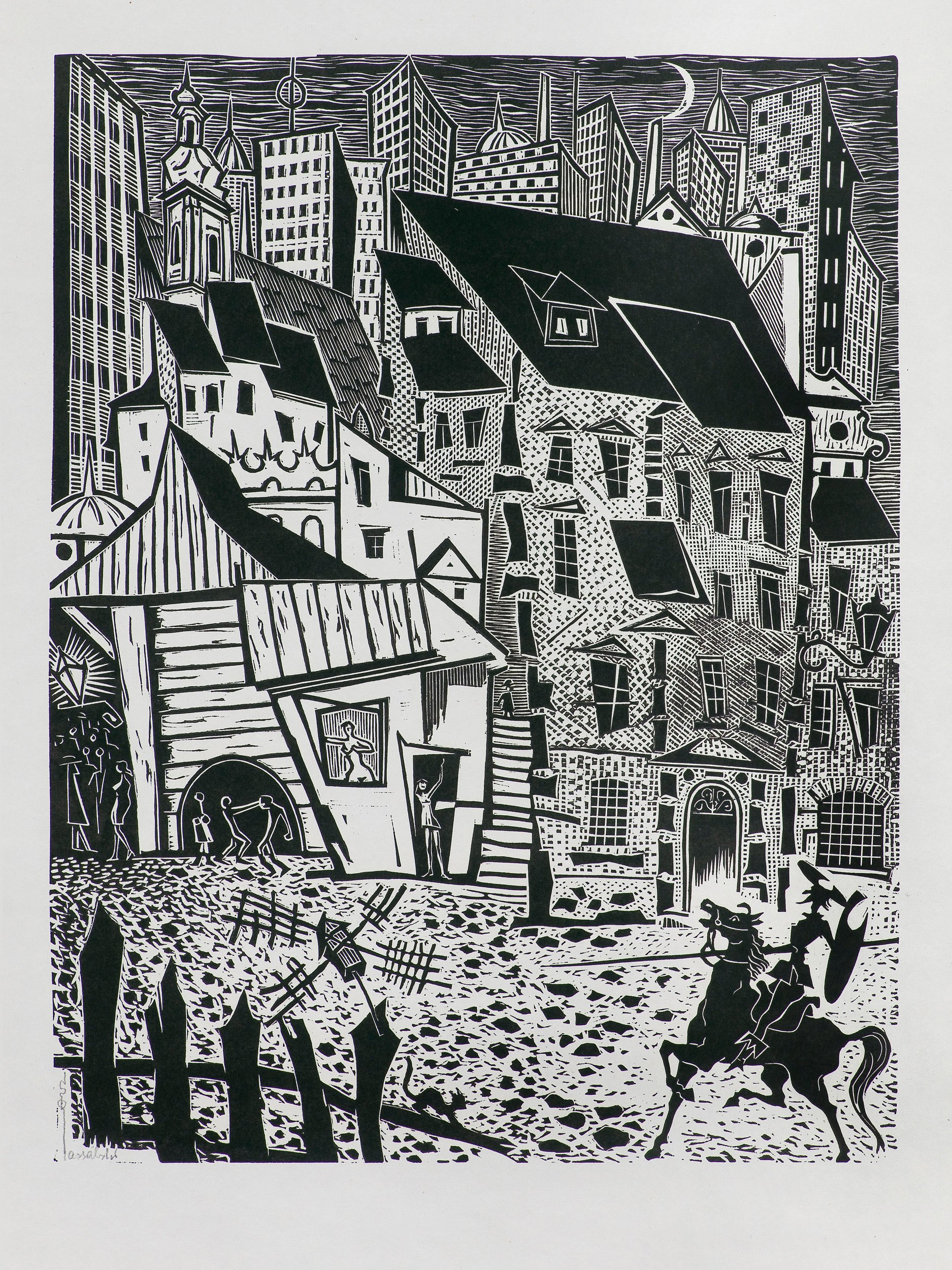
45,2 x 34,5cm - linocut, paper
Signed in pencil in the l.d. corner of the composition: SRassalski
Stefan Rassalski (1910 - 1972) - painter, graphic artist, art historian, publicist. Studied in Lublin, received his diploma at the Warsaw Academy of Fine Arts. Since 1932 he practiced woodcut, initially under the strong influence of Tadeusz Kulisiewicz and folk art. With time, he developed symbolic and literary content in his works. His works are characterized by economy of texture and discipline of composition. At the beginning of his artistic activity, he was associated with Lublin, where in 1928-33 he studied at the Free Academy of Painting and Drawing, headed by Janina Milosova. It was then that he began to take an interest in woodcuts. He made his first prints in 1932, and a year later he published a portfolio of woodcuts "Lublin" at his own expense. One of the founders of the Circle art group, which was active in the city. Around 1936 he moved permanently to Warsaw. Initially he worked as a reporter and journalist. At that time he came into contact with Jerzy Hulewicz, whose influence can be seen especially in his two engravings entitled "Prayer", and dating from 1942 and 1947. During the war he wrote a work dedicated to Hulewicz, which unfortunately did not live to see publication. During the occupation, Stefan Rassalski, alias "Ster," worked in a secret photographic laboratory, which was located on the grounds of the Warsaw University of Technology. During the Warsaw Uprising, Rassalski was one of the Home Army's photojournalists, operating in the southern Śródmieście region. At that time he took several hundred photographs showing the insurgent fighting and burning Warsaw. After the war, he was one of the members of the Bureau for the Reconstruction of the Capital, where he headed the photographic studio. On several thousand negatives he recorded the destruction of the war and the daily life of the inhabitants in the completely ruined Warsaw. His photographs, which have primarily documentary value, are not devoid of artistic value. Rassalski also created photomontages, juxtaposing the appearance of well-known Warsaw buildings after war damage, with their earlier shape. In the pages of Stolica, where he was secretary of the editorial board, he contributed numerous articles on urban planning and projects for rebuilding the city. He also wrote for Nowiny Literackie, Warsaw and Tygodnik Kulturalny.











Последно разглеждани позиции
Влезте, за да се запознаете със списъка с артикулите
Любими
Влезте, за да се запознаете със списъка с артикулите