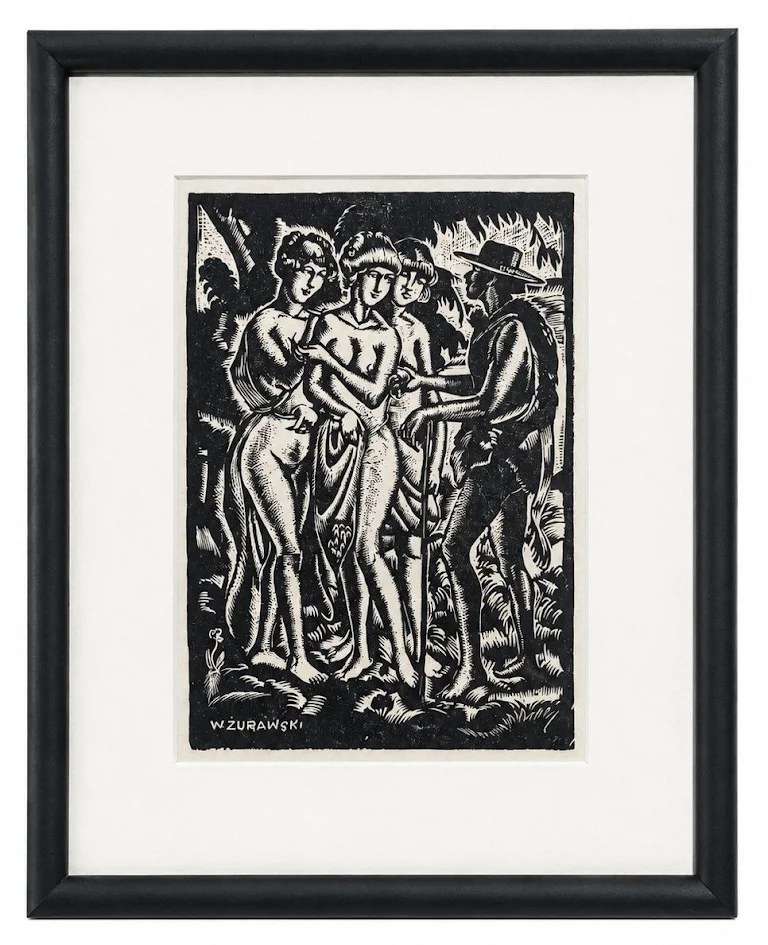
Woodcut on paper, signed “W. ŻURAWSKI” on the block at the lower left.
Dimensions in frame: 30x24 cm (20x14 cm)
Władysław Żurawski (Stryj 1888 – 1963 Mielec) – Polish painter, printmaker, illustrator, and teacher. He studied art from 1907 to 1912 at the Academy of Fine Arts in Kraków under Wojciech Weiss and Jacek Malczewski, as well as under Józef Pankiewicz, Julian Fałat, and Teodor Axentowicz. He graduated with a specialization in education. In 1912 and 1913, he lived in Paris. Upon his return to Poland, he settled in Sokal. In mid-1913, he became a substitute teacher at the Imperial-Royal Gymnasium in Sokal (after 1918, the Antoni Malczewski State Gymnasium), where he taught until 1939, and in 1938–1939 he also lectured at the State Pedagogical High School, serving as its principal from 1936–1937 through 1939. On December 31, 1931, he was promoted to full-time teacher at the gymnasium. After the Soviet invasion in 1939, he continued to work as an art teacher. From 1945 to 1951, he worked as an art teacher at the St. Konarski State Junior High School and High School in Mielec. In 1952, he moved to Zamość and began working as an art teacher at the State High School of Fine Arts. In 1959, he returned to Mielec, where, as a retiree, he taught art at the local high school and where he died in 1963. In addition to his teaching career, he was active as a visual artist. From 1928 onward, he focused primarily on woodcut prints, most often with folkloric themes. His works show certain influences from the style of Władysław Skoczylas. He often published his woodcut prints in the form of series compiled into albums.