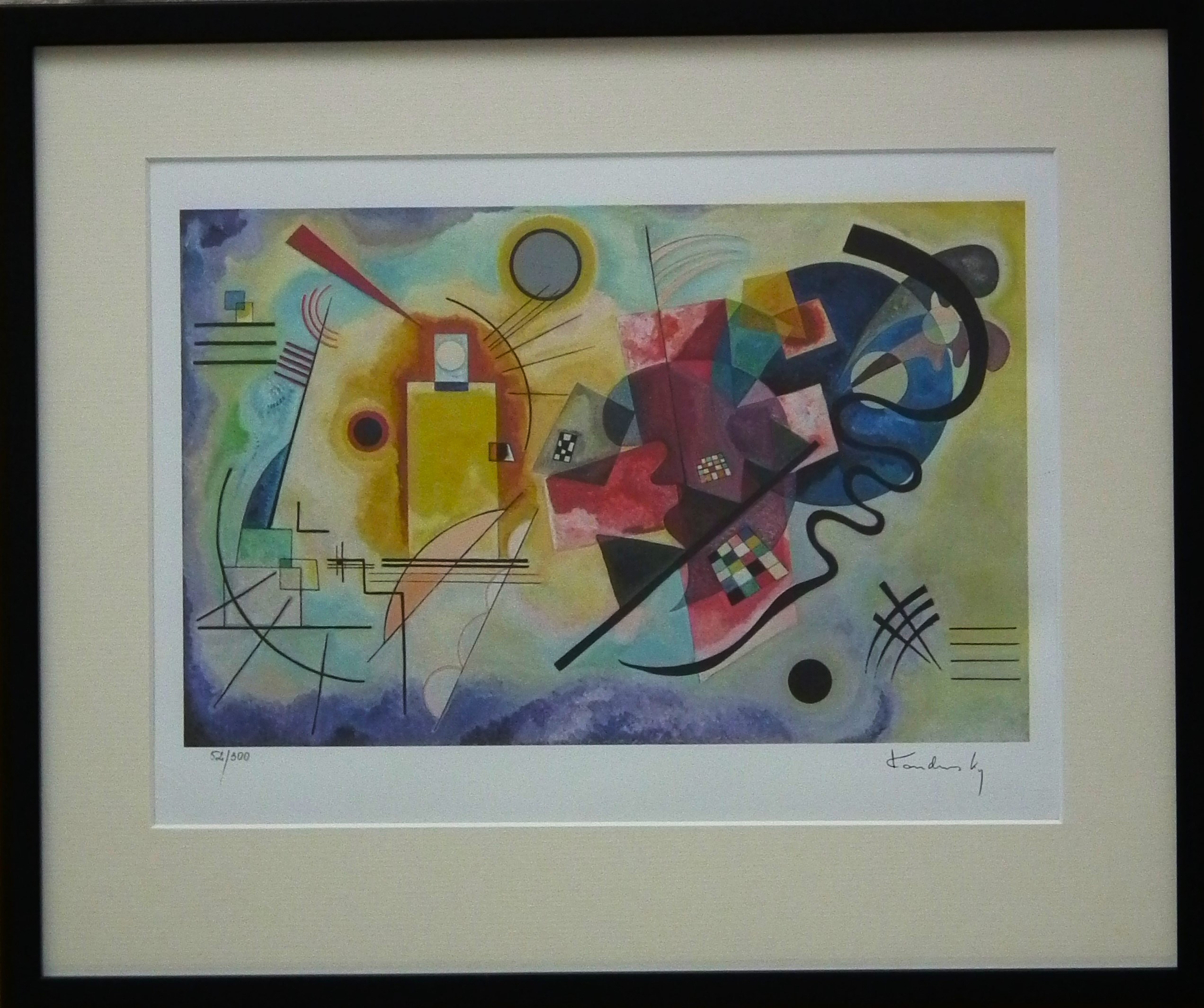
color heliogravure, Arches France velin paper with high weight watermark; 23 x 31 (plate imprint), 28 x 38 (sheet), numbered in pencil 52/300, signed from plate under composition "Kandinsky", publisher's dry stamp l.d. : letter K surrounded by the words "EDITION LIMITED CERTIFIED ARTS USA EUROPE SINCE 1998".
Heliogravure, which was widespread in the 19th century, was later supplanted by rotogravure, since heliogravure is an expensive and very time-consuming method.Nowadays it is sometimes used in artistic graphics.Plates obtained by heliogravure can be supplemented by other methods of intaglio techniques.Occasionally this technique is also used in the reproduction of works of art,when it is necessary to create a small number of copies of very high quality
Wassily Kandinsky, considered one of the pioneers of abstractionism, created the painting Yellow Red,Blue" (German: "Gelb Rot Blau") in 1925. The painting is often considered one of his most important works, representing a watershed moment in his career.
Kandinsky developed his style over the years, moving from Impressionism, through Fauvism and Expressionism to Abstractism. His work is characterized by geometric abstraction. After 1920, Kandinsky began experimenting with geometric forms, such as lines, circles, triangles and other figures: Color as the main means of expression-Kandinsky believed that colors have their own dynamics and emotional power. In his paintings, colors not only shape the composition, but also convey inner emotions and ideas: Synesthesia- Kandinsky was fascinated by the idea of synesthesia, or the ability to sense different senses simultaneously. He believed that colors could "sound" and that paintings could "sing."
Kandinsky often compared his paintings to music, calling them "compositions." Music, especially the works of Arnold Schönberg, was a great source of inspiration for him. He believed that art should affect the viewer as music does - directly and emotionally.
The painting "Yellow, Red, Blue" is a complex composition dominated by the use of three primary colors. Each color has its own symbolic meaning. Red can symbolize strength and passion, yellow - joy and energy, and blue - peace and spirituality. Kandinsky tried to capture a dynamic balance between the different elements of the painting. Geometric shapes and lines create a composition full of tension and movement, which attracts the eye and prompts reflection.
Kandinsky believed that art should transcend material boundaries and appeal to the spiritual aspects of life. In "Yellow, Red, Blue" one can see an attempt to capture the invisible forces and energies that affect our existence.
The painting "Yellow, Red, Blue" by Wassily Kandinsky is in the collection of the Musée National d'Art Moderne, which is part of the Centre Pompidou (Pompidou Center) in Paris, France.
To honor the painter, the Centre Pompidou, in cooperation with Google Arts & Culture, decided to "read" the sounds hidden on the canvas. Musicians Antoine Bertin and NSDOS, with the help of artificial intelligence, used Kandinsky's theoretical texts to translate the composition's components into melody. On the project's website, we can discover what the different parts of the painting would sound like and what emotions they carried for us according to Kandinsky.