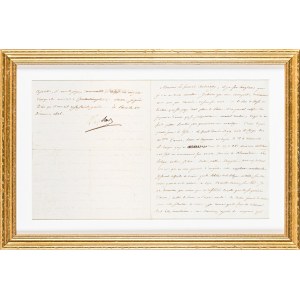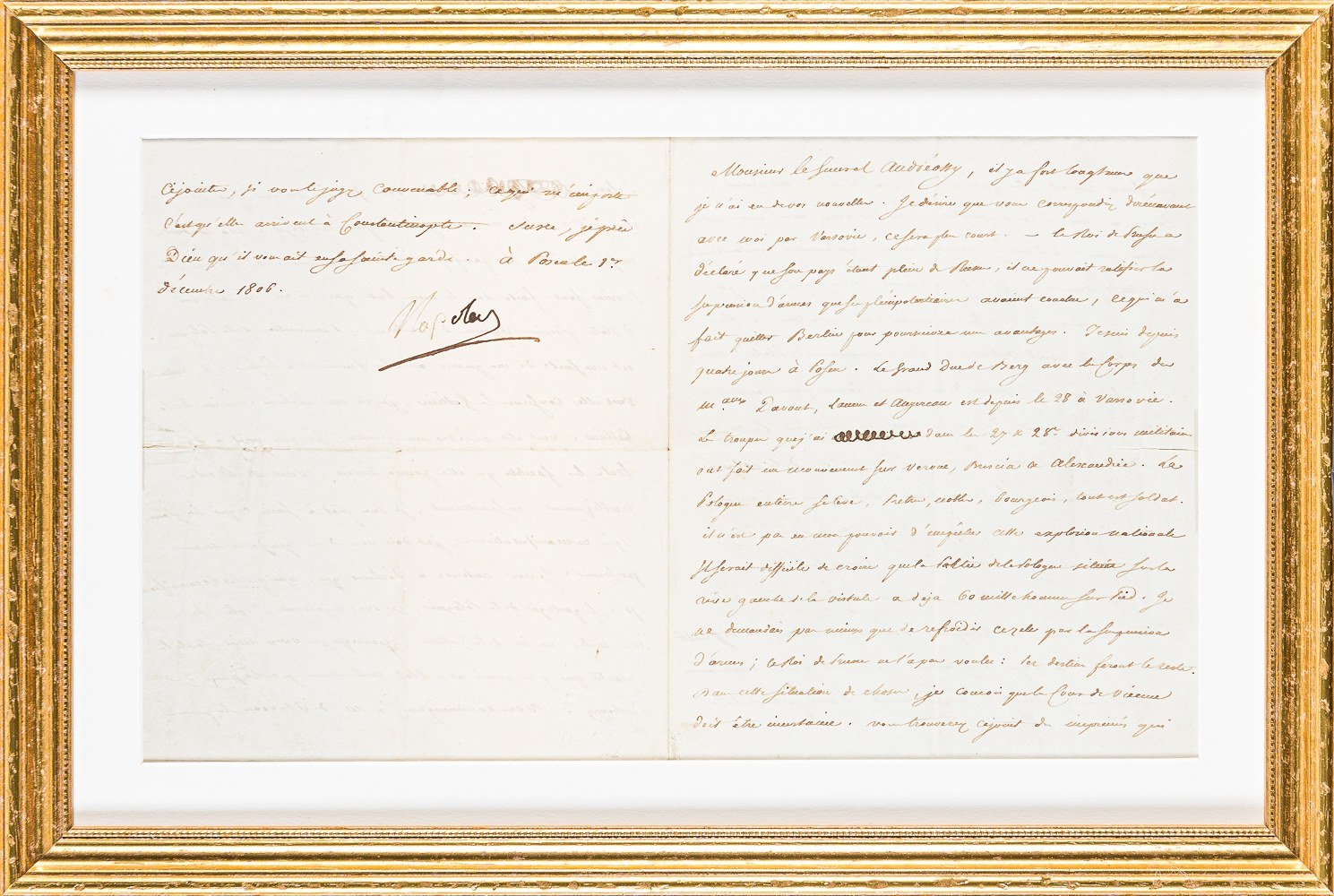
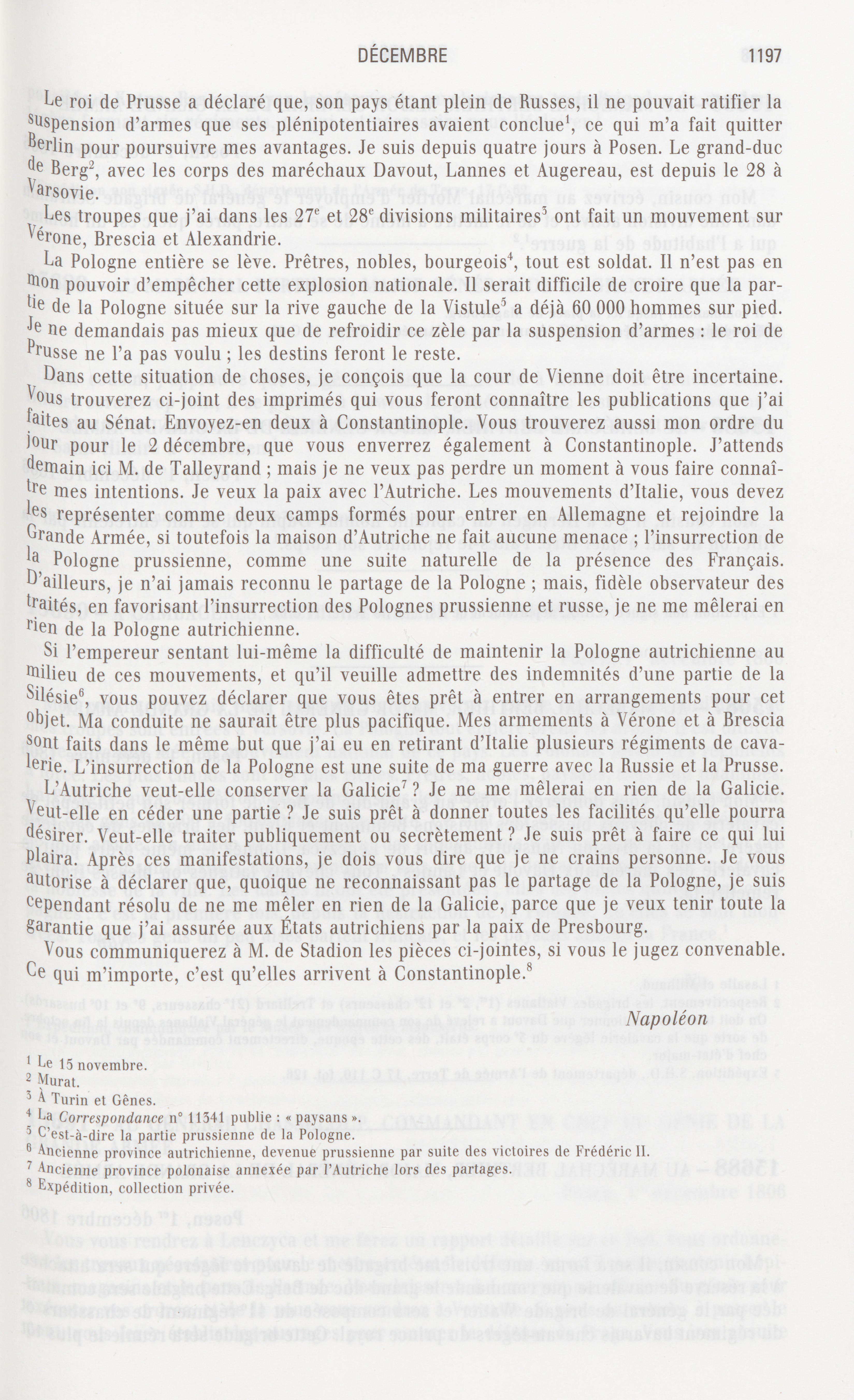
The fourth page bears Napoleon's handwritten signature along with an autograph of the place and date: "à Posen le 1er Decembre 1806 Napoleon".
The object is preserved in a double-sided display frame; the whole placed in an authentic frame of the period - gilded, carved, made of linden wood. Format: 24.5 × 20.5 cm. The document was presented to the public at the exhibition "Signatures of Napoleon Bonaparte" at the Pod Blachą Palace (Royal Castle in Warsaw) in 2022. The object was checked for provenance in databases:www.skradzionezabytki.pl; www.dzielautracone.gov.pl; www.interpol.int. No occurrence was found in the above databases. It is worth mentioning that in early 2021, a 74-page manuscript dictated by Napoleon and concerning the Battle of Austerlitz was exhibited in Paris during the ,,BRAFA in the Galleries" fair in the gallery "Arts et autographes" for 1 million euros.
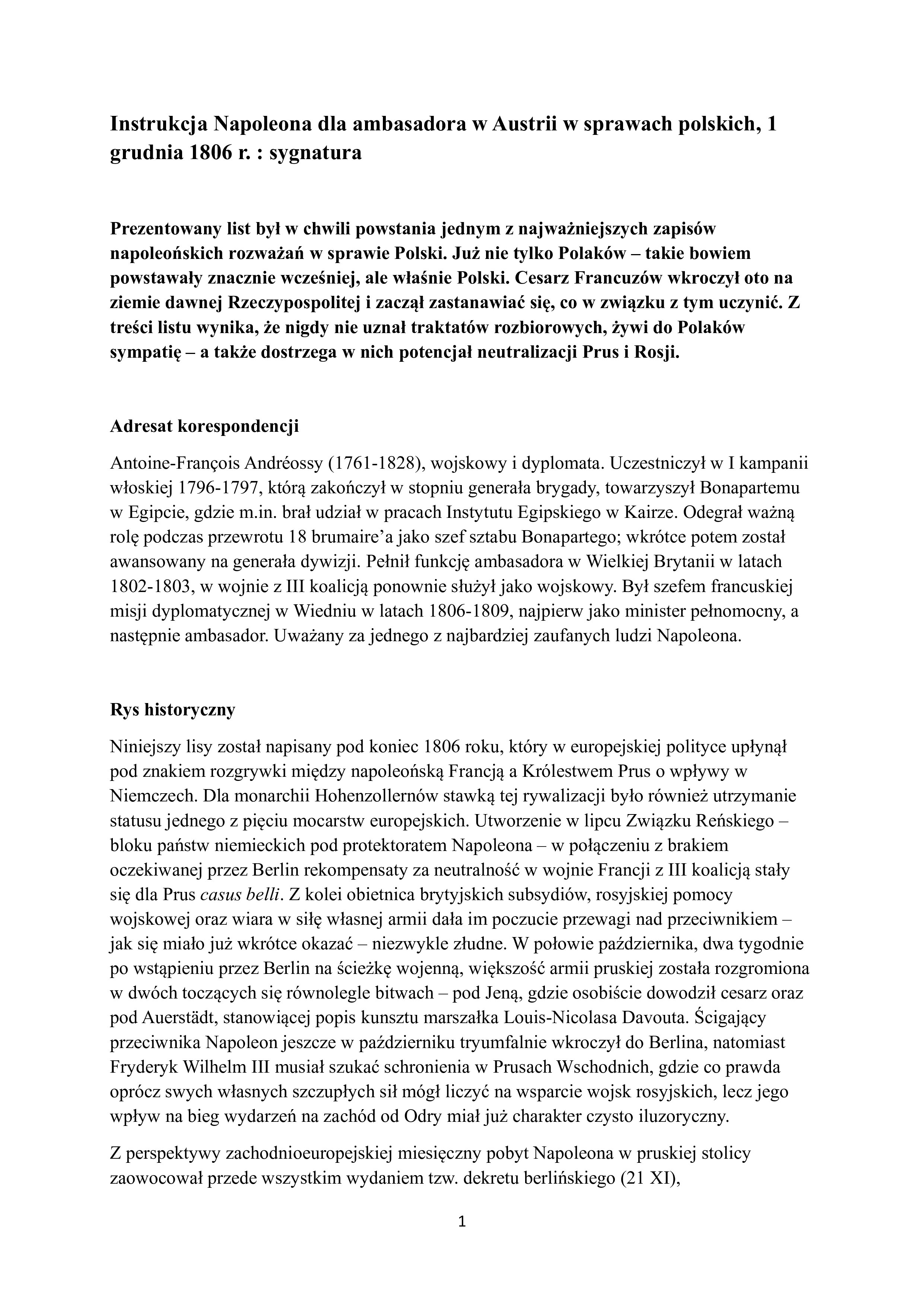
The letter on display was, at the time of its creation, one of the most important records of Napoleon's deliberations on Poland. Not only of the Poles anymore - for such had been created much earlier, but of Poland. Here the Emperor of the French entered the lands of the former Polish-Lithuanian Commonwealth and began to consider what to do about it. From the contents of the letter it is clear that he never recognized the Partition Treaties, he has a fondness for the Poles - and sees in them the potential to neutralize Prussia and Russia.
The addressee of the correspondence
Antoine-François Andréossy (1761-1828), military officer and diplomat. He participated in the First Italian Campaign of 1796-1797, which he finished with the rank of brigadier general, accompanied Bonaparte to Egypt, where, among other things, he took part in the work of the Egyptian Institute in Cairo. He played an important role during the coup of 18 brumaire as Bonaparte's chief of staff; shortly thereafter he was promoted to major general. He served as ambassador to Great Britain in 1802-1803, and again served as a military officer in the war against the Third Coalition. He was head of the French diplomatic mission in Vienna from 1806-1809, first as minister plenipotentiary and then as ambassador. Considered one of Napoleon's most trusted men.
Historical outline
This foxhole was written at the end of 1806, which in European politics was marked by the showdown between Napoleon's France and the Kingdom of Prussia for influence in Germany. For the Hohenzollern monarchy, the stakes of this rivalry also included maintaining its status as one of the five European powers. The creation of the Rhine Union - a bloc of German states under Napoleon's protectorate - in July, coupled with Berlin's failure to pay the expected compensation for its neutrality in France's war against the Third Coalition, became a casus belli for Prussia. In turn, the promise of British subsidies, Russian military aid and confidence in the strength of their own army gave them a sense of superiority over their opponent - as it was soon to turn out - extremely illusory. In mid-October, two weeks after Berlin entered the warpath, most of the Prussian army was crushed in two simultaneous battles - at Jena, where the Kaiser personally commanded, and at Auerstädt, a display of Marshal Louis-Nicolas Davout's artistry. Napoleon, who was still pursuing the enemy, triumphantly entered Berlin in October, while Frederick William III had to seek refuge in East Prussia, where, in addition to his own slender forces, he could count on the support of Russian troops, but his influence on the course of events west of the Oder was already purely illusory.
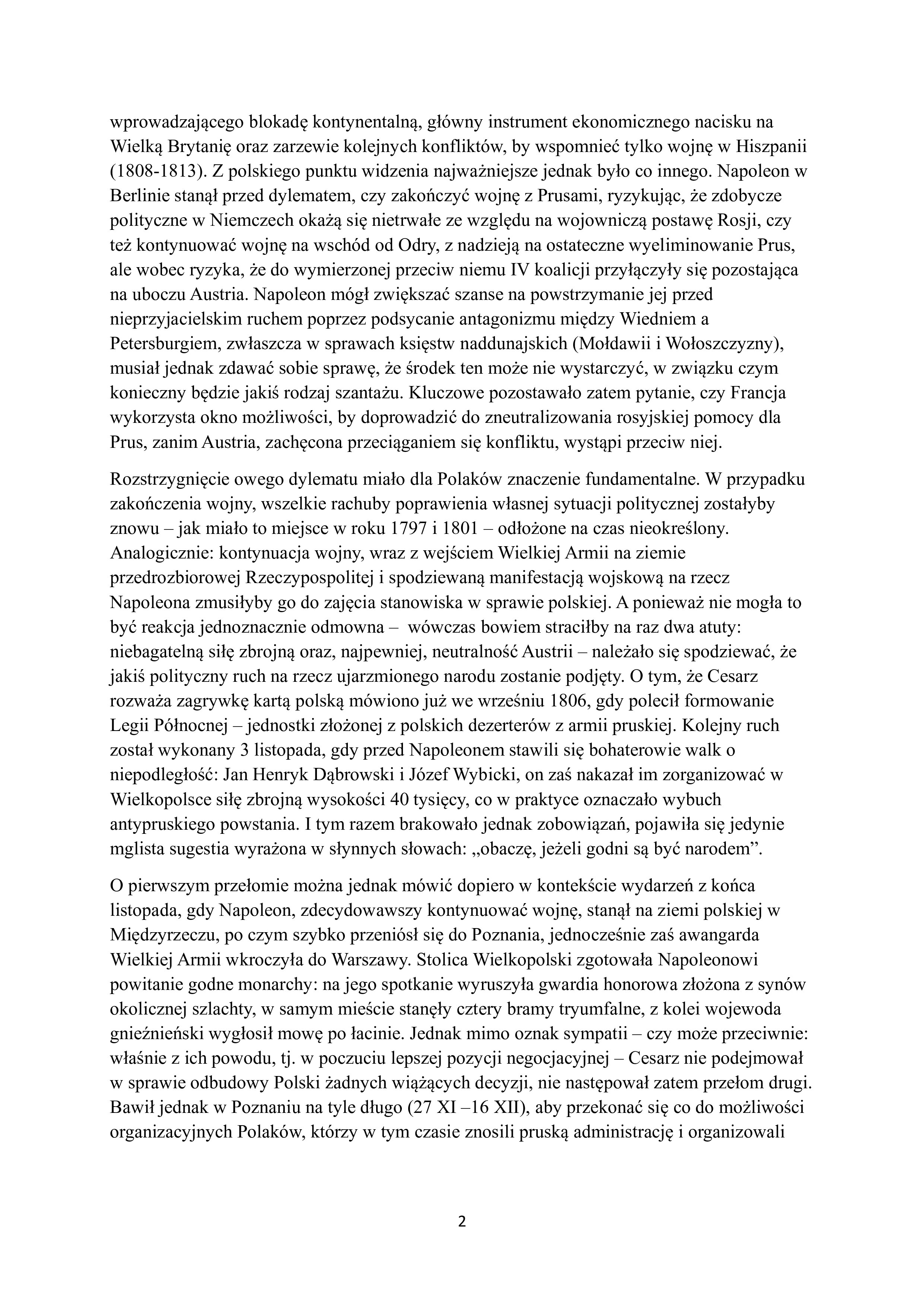
From a Western European perspective, Napoleon's month-long stay in the Prussian capital resulted primarily in the issuance of the so-called Berlin Decree (November 21), introducing the Continental Blockade, the main instrument of economic pressure on Great Britain and the trigger for further conflicts, just to mention the war in Spain (1808-1813). From the Polish point of view, however, the most important thing was different. Napoleon in Berlin faced the dilemma of whether to end the war with Prussia, risking that political gains in Germany would prove unsustainable due to Russia's bellicose attitude, or to continue the war east of the Oder River, hoping to eliminate Prussia once and for all, but facing the risk that the Fourth Coalition against him would be joined by the lagging Austria. Napoleon could have increased the chances of stopping it from moving against the enemy by stoking antagonism between Vienna and St. Petersburg, especially in matters of the Danube principalities (Moldavia and Wallachia), but he must have realized that this measure might not be enough, and some kind of blackmail would therefore be necessary. The key question therefore remained whether France would use the window of opportunity to bring about the neutralization of Russian aid to Prussia before Austria, encouraged by the protraction of the conflict, moved against it.
The resolution of this dilemma was of fundamental importance to the Poles. In the event of an end to the war, any reckoning to improve one's own political situation would again - as had been the case in 1797 and 1801 - be postponed indefinitely. Similarly: the continuation of the war, together with the entry of the Grand Army into the lands of the pre-partition Republic and the expected military demonstration in favor of Napoleon, would force him to take a stand on the Polish question. And since this could not have been an unequivocally negative reaction - for then he would have lost two assets at once: a not inconsiderable armed force and, most likely, Austria's neutrality - it was to be expected that some political move in favor of the subjugated nation would be made. That the Emperor was considering playing the Polish card was already hinted at in September 1806, when he ordered the formation of the Northern Legion, a unit composed of Polish deserters from the Prussian army. The next move was made on November 3, when the heroes of the struggle for independence, Jan Henryk Dabrowski and Jozef Wybicki, appeared before Napoleon, and he ordered them to organize an armed force of 40,000 in Greater Poland, which in practice meant the outbreak of an anti-Prussian uprising. And this time, however, commitments were lacking, there was only a vague suggestion expressed in the famous words: "I'll take a look if they are worthy to be a nation."
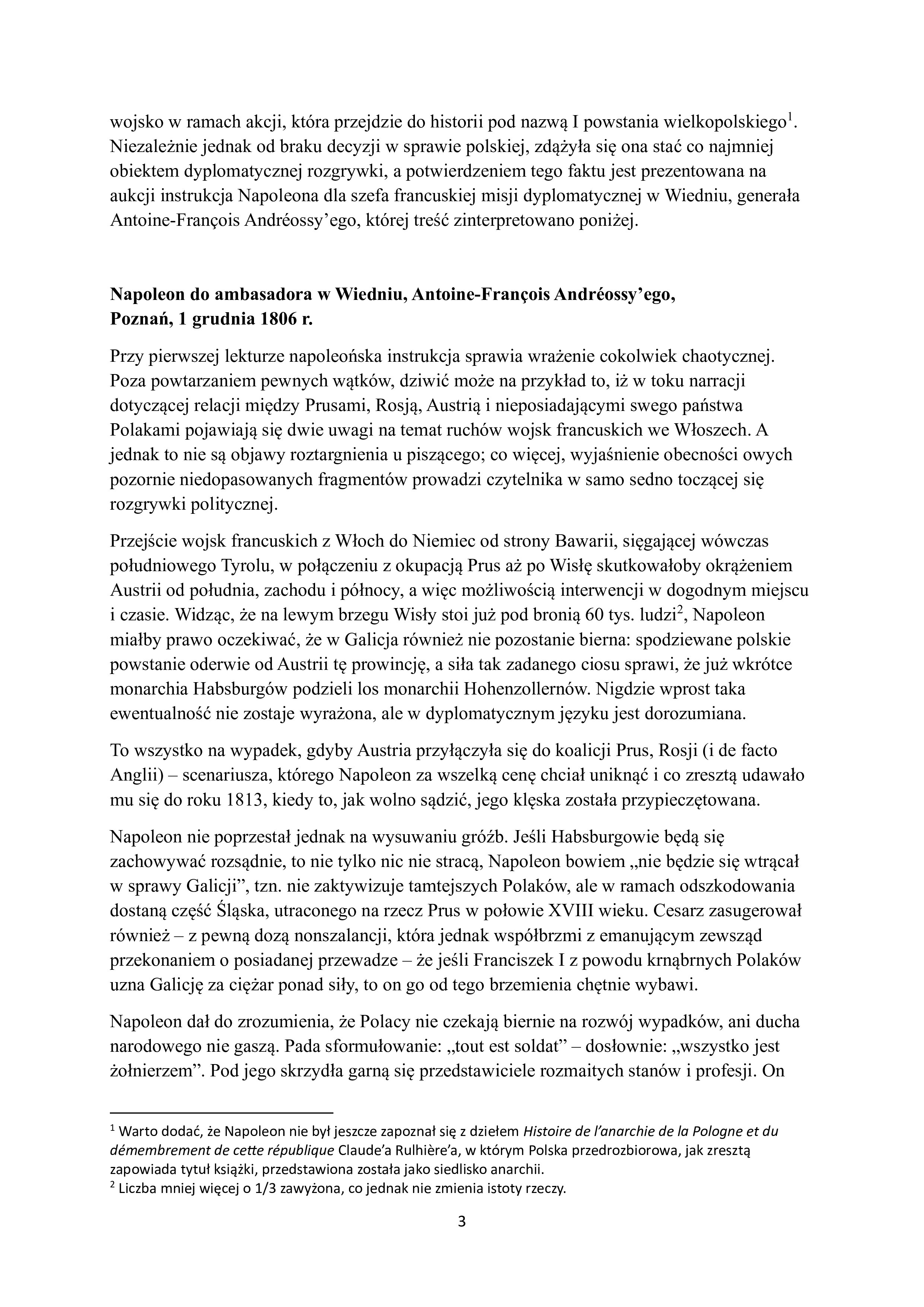
The first breakthrough, however, can be spoken of only in the context of the events of late November, when Napoleon, having decided to continue the war, stood on Polish soil in Miedzyrzecz, then quickly moved to Poznan, while at the same time the vanguard of the Grand Army entered Warsaw. The capital of Greater Poland gave Napoleon a welcome worthy of a monarch: an honor guard made up of the sons of the local nobility set out to meet him, four triumphal gates stood in the city itself, while the governor of Gniezno gave a speech in Latin. However, despite the signs of sympathy - or perhaps on the contrary: precisely because of them, i.e. in a sense of a better negotiating position - the Emperor did not make any binding decisions on the restoration of Poland, so there was no second breakthrough. He did, however, stay in Poznań long enough (27 XI -16 XII) to convince himself of the organizational capabilities of the Poles, who at that time were abolishing the Prussian administration and organizing the army in an action that will go down in history as the First Wielkopolska Uprising. However, regardless of the lack of a decision in the Polish case, it managed to become at least an object of diplomatic gamesmanship, and this fact is confirmed by Napoleon's instruction to the head of the French diplomatic mission in Vienna, General Antoine-François Andréossy, presented at the auction, the content of which is interpreted below.
Napoleon to the ambassador in Vienna, Antoine-François Andréossy,
Poznan, December 1, 1806.
On first reading, Napoleon's instructions give the impression of being somewhat chaotic. In addition to the repetition of certain themes, it is surprising, for example, that in the course of the narrative on the relations between Prussia, Russia, Austria and the stateless Poles, there are two comments on French troop movements in Italy. Yet these are not symptoms of absentmindedness on the part of the writer; moreover, the explanation of the presence of these seemingly mismatched passages leads the reader into the heart of the ongoing political game.
The passage of French troops from Italy into Germany from the side of Bavaria, reaching south Tyrol at the time, combined with the occupation of Prussia up to the Vistula River would result in the encirclement of Austria from the south, west and north, and thus the possibility of intervention at a convenient time and place. Seeing that on the left bank of the Vistula there are already 60,000 men under arms, Napoleon would have had the right to expect that Galicia would not remain passive either: the expected Polish uprising would tear this province from Austria, and the force of the blow so dealt would soon make the Habsburg monarchy share the fate of the Hohenzollern monarchy. Nowhere explicitly is such an eventuality expressed, but in diplomatic language it is implied.
This is all in case Austria joins the coalition of Prussia, Russia (and de facto England) - a scenario that Napoleon wanted to avoid at all costs and which he succeeded in doing until 1813, when, it is fair to believe, his defeat was sealed.
Napoleon did not stop at making threats, however. If the Habsburgs behaved sensibly, not only would they lose nothing, for Napoleon "would not interfere in the affairs of Galicia," i.e. he would not activate the Poles there, but as compensation they would get part of Silesia, lost to Prussia in the mid-18th century. The Emperor also suggested - with a degree of nonchalance that nevertheless resonates with the conviction of superiority emanating from everywhere - that if Francis I, because of the wayward Poles, considered Galicia a burden beyond his strength, he would gladly save him from that burden.
Napoleon made it clear that the Poles are not passively waiting for developments, nor are the national spirit extinguished. The phrase "tout est soldat" - literally: "everything is a soldier" - falls. Representatives of various states and professions come under his wing. He himself stressed that he never recognized the partition of Poland, although for Austrian conquest he is willing to make an exception - at the price indicated above.
The fact that in the political combination that was unfolding, the belonging of Galicia remained the subject of Austro-French negotiations conducted over the heads of the Poles, however unacceptable from today's point of view, did not automatically mean that the bargaining chip became Polish politics as such - but its scope.
The international game started with the elimination of the Prussian armies began anew with the invasion of Polish lands, and its effect was unknown. Consequently, Napoleon in early December 1806 did not yet know how far he could go in revising the partition treaties: it was impossible to rule out that he would rebuild Poland only to a very modest extent.
However, the Rubicon was crossed with the entry into Poznan and Warsaw - not because France decided to throw down the gauntlet to Russia, but because Russia interpreted this fact that way. Napoleon himself, by the way, half-heartedly expressed this truth when he wrote that he would most gladly have dissolved the Poles into their homes, but was no longer able to do so because of the attitude of Frederick William III. Yes, this monarch was now being instigated to continue fighting by Russia - among other things, by the onerous maintenance of troops in Prussia - rather than by his own bullheadedness, but in principle the conclusion of Napoleon's argument remains valid.
To sum up, the Poles here are primarily a pressure factor and a political tool with which Napoleon ties his hopes in this part of Europe. The false-sounding interjection about a desire to pacify them functions more as a potential argument for Andréossy to use in his talks with the Viennese court, rather than evidence of a real dislike for the inhabitants of the liberated lands. In the letter, Napoleon does not talk about resurrecting the Republic, it is true. It is also true that even from beyond the Rubicon one can retreat. But this is difficult if one wants to maintain credibility with both adversaries and allies.
Finally, it is impossible to pass over in silence the fact that the nucleus of the Polish government was formed just six weeks later in the form of the Governing Commission....
Regest
Napoleon complains about the prolonged lack of news from the addressee. He expects him to communicate with him through Warsaw from now on, as this will be faster.
He states that Frederick William III has refused to ratify the armistice signed by the intermediaries [on November 15] because his country is full of Russians. This refusal forced Napoleon to leave Berlin in pursuit of victory. He has been in Posen for four days. Marshal Murat, along with the corps of Marshals Davout, Lannes and Augereau, has been in Warsaw since November 28.
The troops located in the 27th and 28th military districts - in Turin and Genoa - have made a move toward Verona, Brescia and Alessandria.
All of Poland is rising ; priests, nobles, townspeople - all are soldiers. He says that it is not in his power to stop this outbreak of national emotion. It's hard to believe, but Poland west of the Vistula already has 60,000 men under arms. He could think of nothing better than to cool this fervor, but the Prussian king has not shown the will to do so, and as a result, everything will be decided by fate.
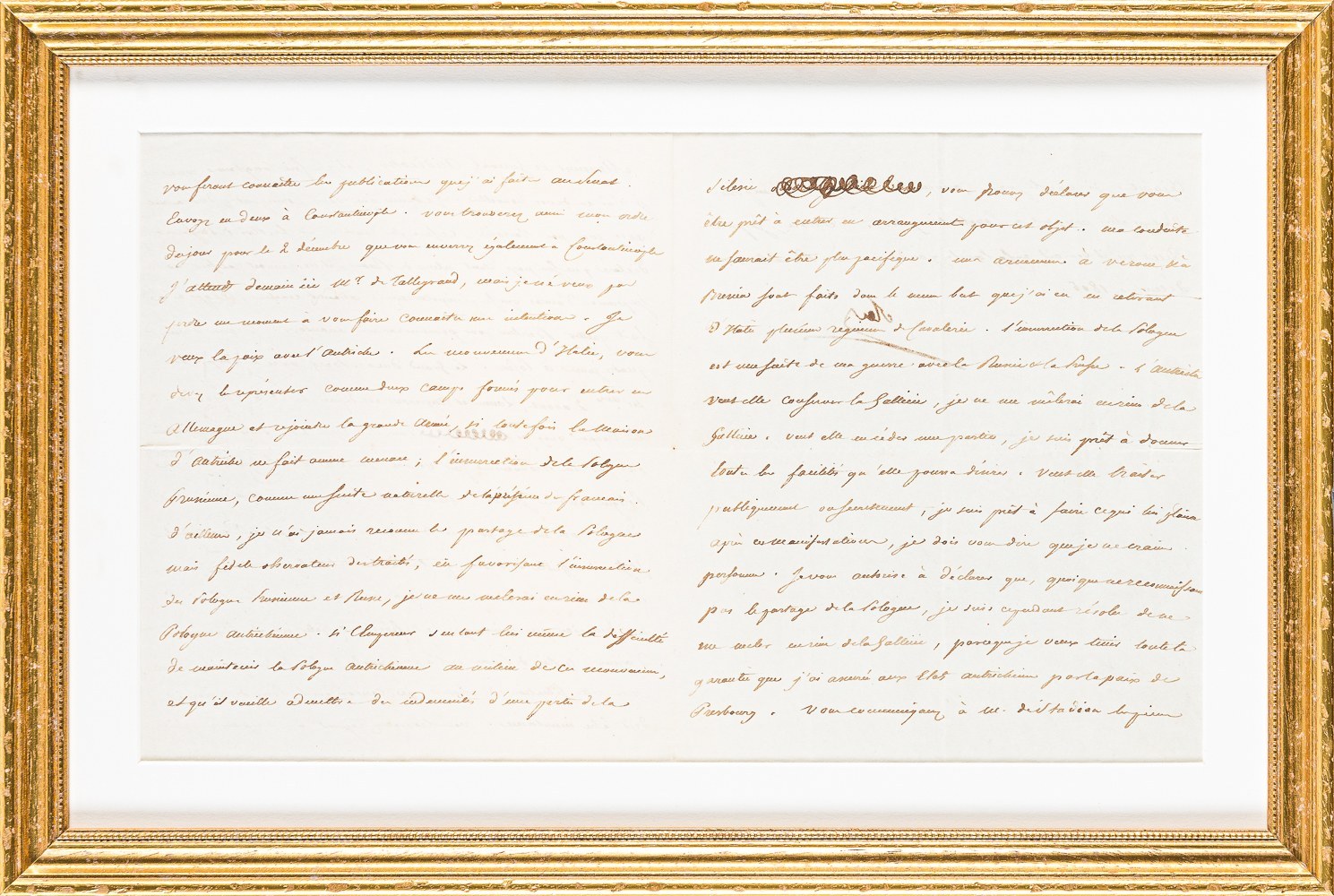
He guesses that in this situation the Viennese court is concerned. He lists the documents that the addressee will receive enclosed with the letter, including the daily order of December 2, and asks that they be sent back to Istanbul. The next day, he is expecting Talleyrand. He wishes for peace with Austria. He instructs Andréossy to present troop movements in Italy as a prelude to entering Germany if Austria makes no threat, and the Polish uprising as a natural consequence of the French presence - after all, he never recognized the partition of Poland. It favors insurrections in the Prussian and Russian partitions, but fully respecting the treaties, it will not interfere in any way in the affairs of "Austrian" Poland.
If Emperor Francis I, feeling the difficulty of maintaining Galicia in the midst of insurrectionary turmoil, wishes to accept compensation in the form of a part of Silesia, Andréossy is hereby authorized to enter into treaties in this matter. He stresses that his conduct toward Austria could not be more peaceful. His reinforcements in Verona and Brescia are being made for the same purpose as the withdrawal of many cavalry regiments from Italy. The uprising in Poland is a consequence of the war with Prussia and Russia.
If, on the other hand, Austria wishes to keep Galicia - Napoleon will not object. If he wants to give up part of that land - he will make it easier for her. She wants to pact openly or secretly - he is ready to do whatever she pleases. Having revealed all this, he states that he is not afraid of anyone. He authorizes Andréossy to assure Vienna that, however he does not recognize the partition of Poland, he is determined not to interfere in Galicia in any way, and this is because he wants to keep all the guarantees he gave to Austria when he signed the Peace of Prešburg.
Finally, he asks that the addressee forward the attached documents to Austrian Foreign Minister Jan Filip Stadion - if he sees fit. The most important thing for him, however, is that they reach Istanbul.
Bibliographical note
The letter was announced in print in 1863, in the fourteenth volume of the monumental source publication Correspondance de Napoléon Ier publiée par ordre de l'Empereur Napoléon III (No. 11339, pp. 5-6), which was published between 1858 and 1869. Calculated as an editio minor and comprising 32 volumes with some 22,000 letters written or dictated by Napoleon over the course of nearly three decades (1793-1821), the whole work was the first step in the creation of an epistolary (self-)portrait of the god of war. In the unanimous opinion of researchers, the main shortcoming of the first edition was its incompleteness, reaching up to 40-50%.
An extensive fragment of the document was used, among others, by Maciej Loret in his well-received work Between Jena and Tylża, 1806-1807 (Warsaw 1902) in the bibliographical section. Loret published his dissertation as the second volume of the series Monographs in Modern History, and thus under the auspices of his scientific master Szymon Askenazy - author, among other things, of the immortal biography of Prince Józef Poniatowski, at the same time one of the greatest spokesmen for Napoleon in Polish historiography.
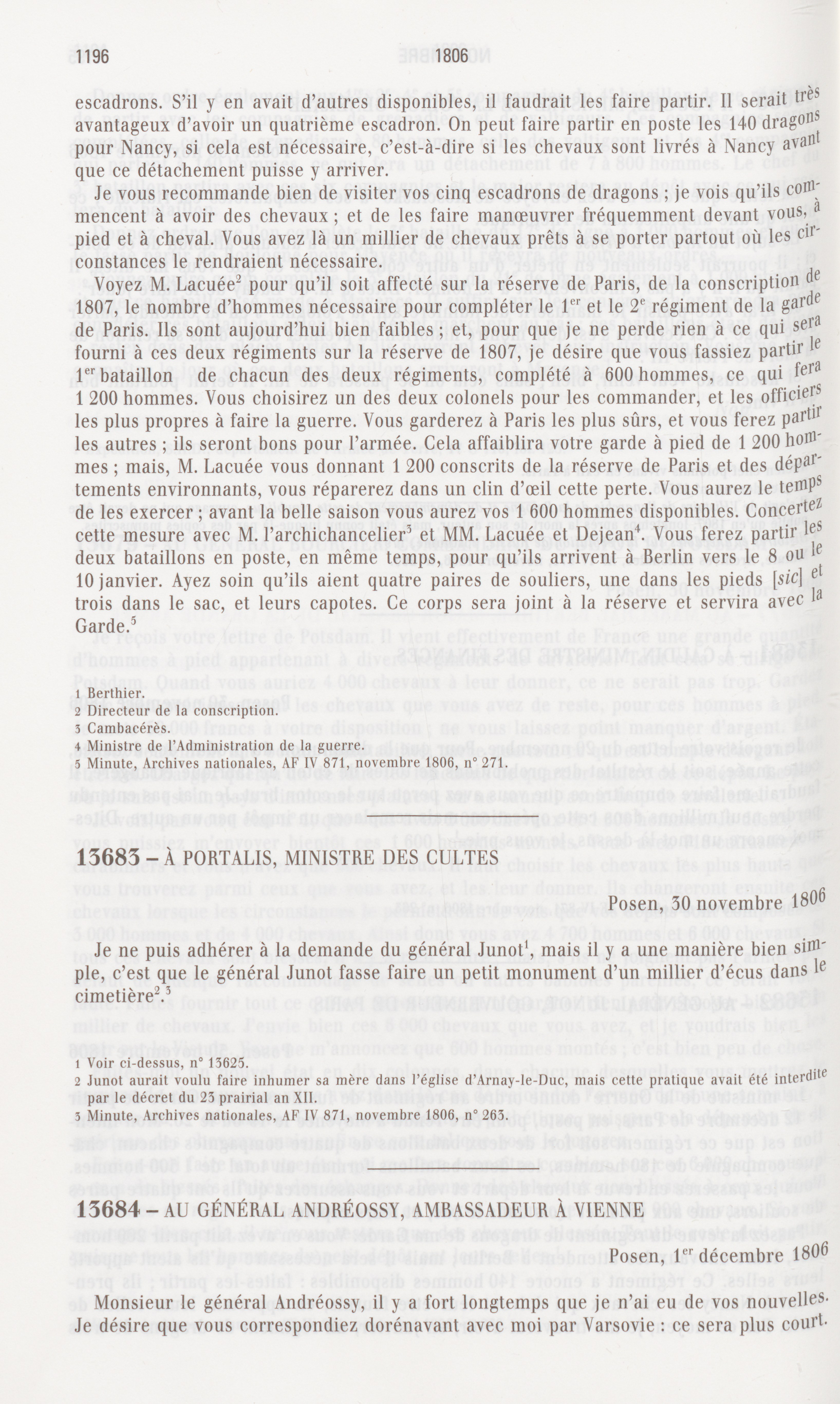
More recently, the instruction for Andréossy was published in 2009, in Volume VI (Vers le Grand Empire, pp. 1197-1198) of Correspondance générale. This superb 2004-2018 critical edition, published on the initiative of the Fondation Napoléon, covers 40,611 letters, providing the most accurate insight into the French emperor's epistolography today, and thus constituting one of the key sources for research into the era. It should also be mentioned that this edition is available in its entirety on the Foundation's website.
Bibliography
Correspondance de Napoléon Ier publiée par ordre de l'Empereur Napoléon III, vol. 14, Paris 1863.
Correspondance générale, vol. 6: Vers le Grand Empire, ed. M. Kerautret, Paris 2009.
Dictionnaire Napoléon, ed. by J. Tulard, vol. I, Paris 1999.
Bielecki R., Encyclopedia of Napoleonic Wars, Warsaw 2002.
Czubaty J., Księstwo Warszawskie (1807-1815), Warsaw 2011.
Jarosiewiczówna M., Galicya a sprawa polska (October 1806-July 1807), "Biblioteka Warszawska" 2, 1912, pp. 245-286.
Kukiel M., History of the Polish Arms in the Napoleonic Era 1799-1815, 2nd edition, Poznań 1912.
Loret M., Between Jena and Tylża : 1806-1807, Warsaw 1902.
Nieuważny A., We with Napoleon, Wrocław 2006.
Zahorski A., Napoleon, Warsaw 1985.
Dr. Dominik Szczęsny-Kostanecki