


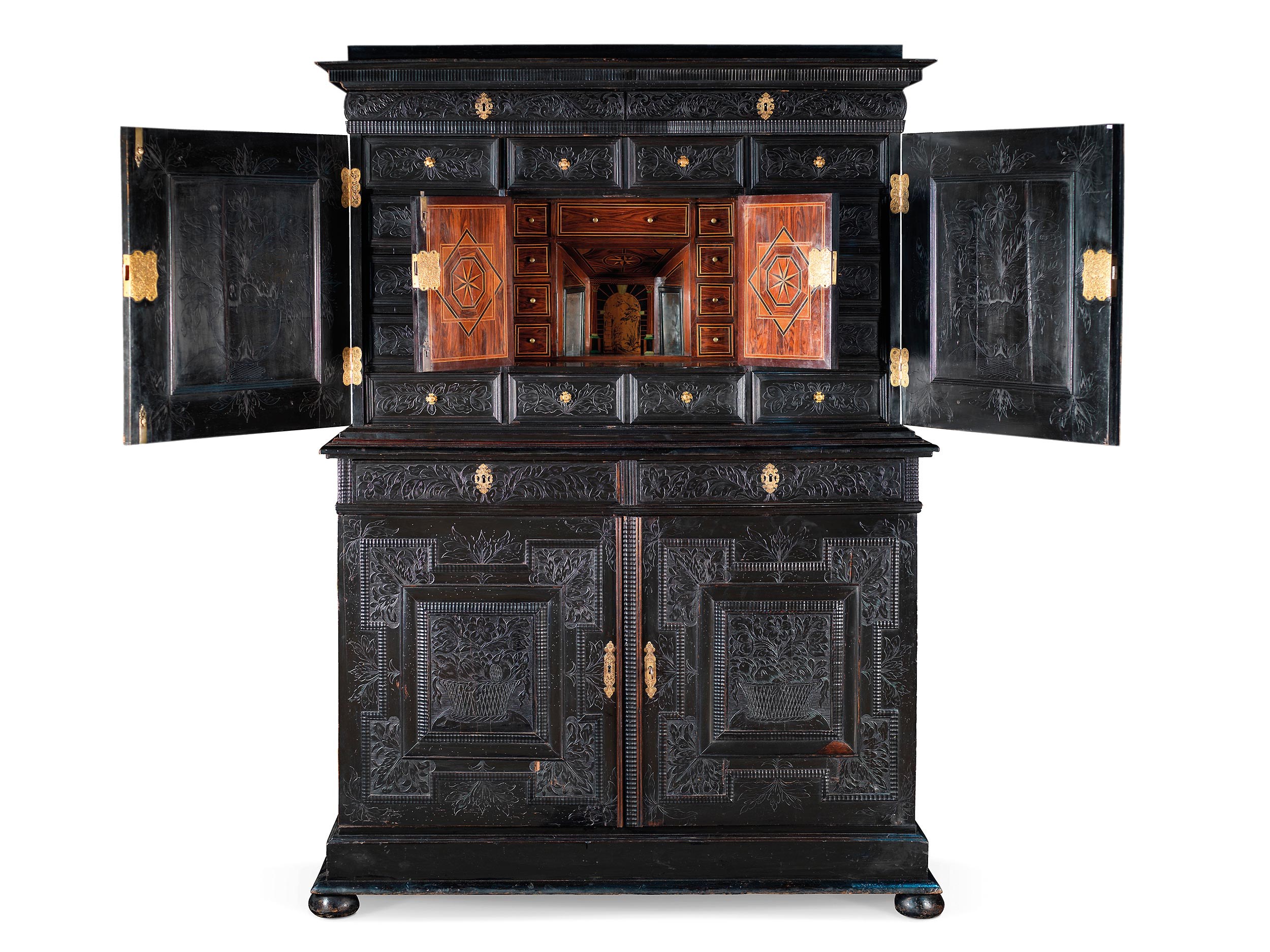
188 x 135 x 53.5 cm.
France, 17th century.
Crafted in amaranth with walnut and satinwood on oak. Two-part body on pressed ball feet with two hinged doors and several drawers. When closed, the upper part shows two scenes in bas-relief, which are worked into geometric medallions surrounded by geometric cartouches with finely engraved, leaf-like tendril patterns. The left wing depicts a scene that could represent a triumphal return of a king to a city. A royal entry is defined by historian Pascal Lardellier as an important political ritual in which a city officially welcomes a ruler or high dignitary in an architectural and theatrical setting prepared for the occasion. The scene shows a richly dressed Roman-style horseman carrying a sceptre, accompanied by two dancing musicians. In the background, two men can be seen watching the events from a window. The medallion opposite shows a scene that is more difficult to identify. We see a Roman soldier and two men talking. A ship can be seen on the left, which could indicate that the scene is taking place in a harbor. The silhouette of a city with a tower and dome can be seen in the distance. The figure on the right, richly dressed, carries a sword at his side, holds a sceptre in his left hand and points to the city with his right. The figure on the left is holding the same hat as the person described above in his right hand and appears to be pointing to the ship. In the middle stands the Roman soldier, recognizable by his armour, helmet and lance, listening to the first figure. This collection cabinet was not only itself part of a 17th-century cabinet that housed other objects of art and curiosities, but also contained a collection of possibly ancient archaeological fragments, exotic shells or pieces of jewelry and exquisite perfumes in its 27 drawers. (1410979) (1) (13)








Последно разглеждани позиции
Влезте, за да се запознаете със списъка с артикулите
Любими
Влезте, за да се запознаете със списъка с артикулите