


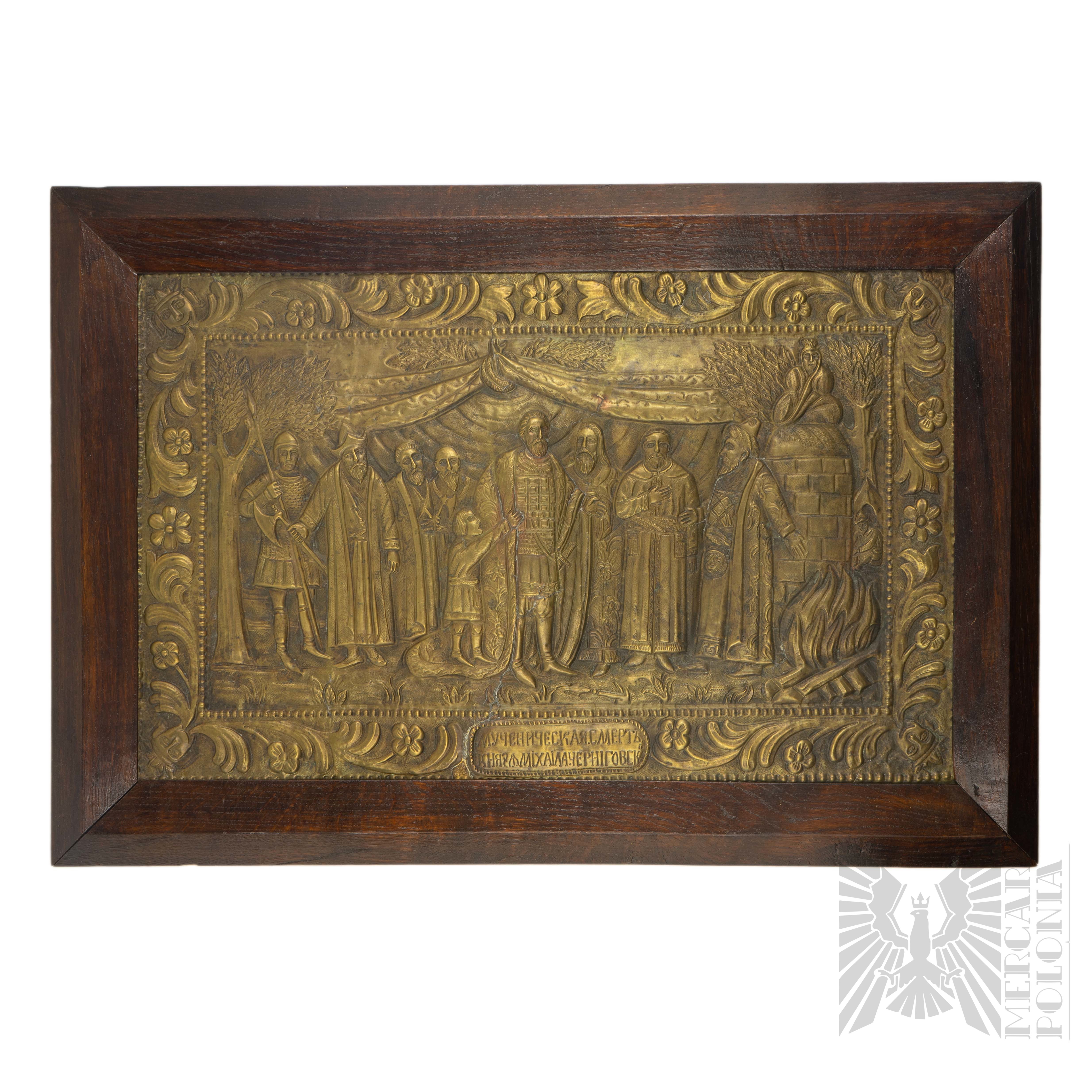
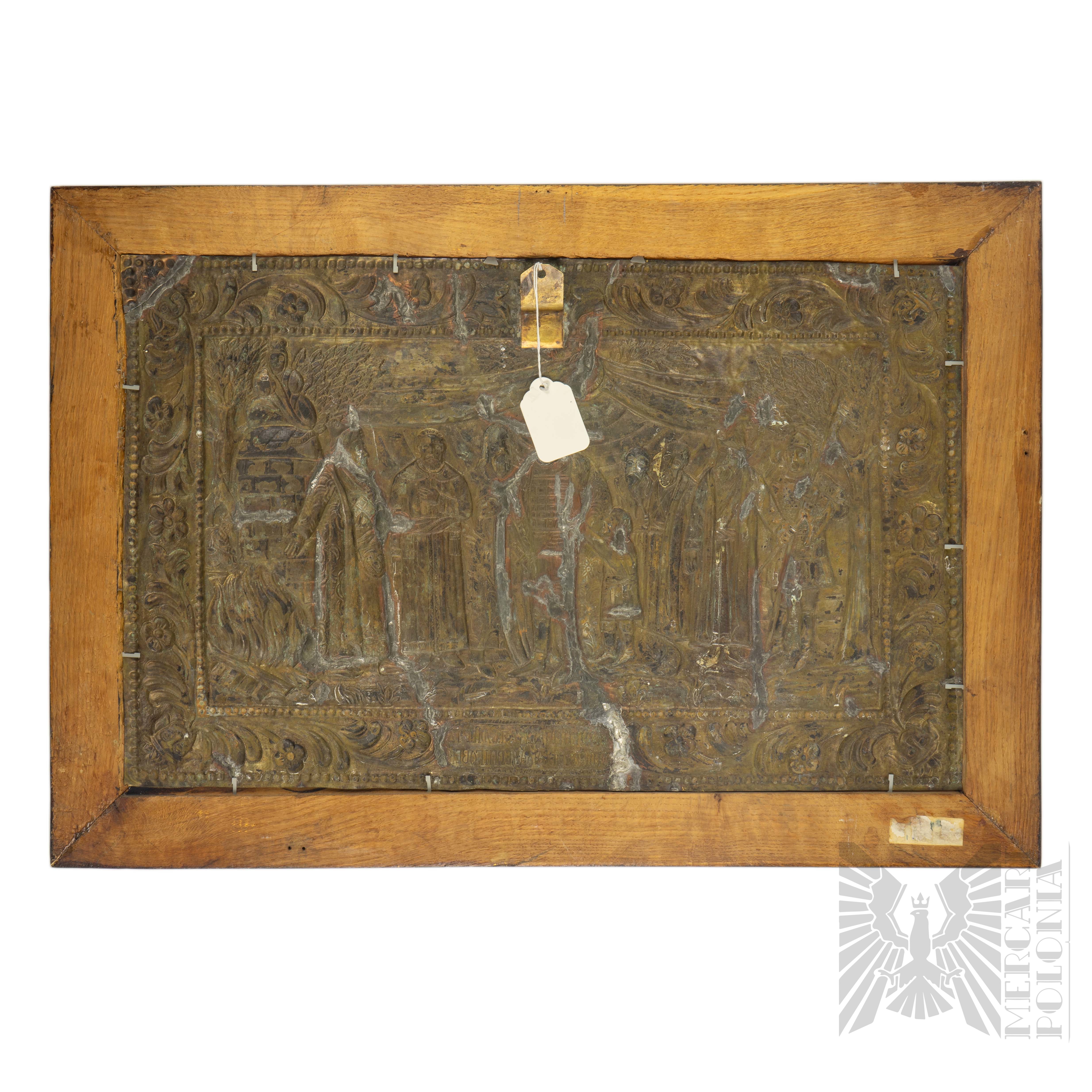
A large rectangular plaque of a historical and devotional nature, handcrafted from thin copper sheet using the technique of repoussé on the reverse side, followed by chiseling and engraving on the front. The relief is set in a simple, dark-stained wooden frame.
The composition depicts an elaborate figural scene taking place beneath the outstretched canopy of an Orda tent. In the central part, Prince Michał Czernihowski is depicted kneeling, clad in richly ornamented robes, turning toward the figure of Batu Khan standing before him. The scene is accompanied by numerous dignitaries, members of the prince’s retinue, and armed guards. On the right side is a pagan idol set on a high, brick pedestal, with a fire burning at its base—elements referring to the ritual that the prince was said to have refused to perform.
The figures are depicted in a hieratic style and subordinated to the rhythm of the entire composition. Their silhouettes are rendered in varied relief, while their facial features, beards, armor, and garment ornaments are executed through precise chiseling and engraving. The simplistically rendered background and limited spatial depth focus attention on the dramatic moment of confrontation.
The scene is surrounded by a wide decorative border filled with stylized plant tendrils, rosettes, and ornamental corner motifs. The field of the depiction is separated from the border by a regular pearl ornament. At the bottom is an elongated cartouche with an inscription written in archaic Cyrillic:
“The Martyrdom of Prince Mikhail of Chernigov”
(Muczeniczeskaja smiert’ kniazia Michaiła Czernigowskago)
meaning: “The Martyrdom of Prince Michael of Chernihiv.”
The depiction refers to Mikhail Vsevolodovich Chernihovsky—a Rus’ ruler, Prince of Chernihiv and Halych, and Grand Prince of Kyiv. In 1246, he was summoned to the court of Batu Khan. According to hagiographic tradition, he refused to walk between ritual bonfires and to worship pagan idols, for which he was murdered along with his accompanying boyar, Fyodor. In 1547, both were officially recognized by the Orthodox Church as holy martyrs. The relief thus combines historical narrative with a devotional message, depicting the ruler’s steadfastness and his fidelity to the Christian faith.
The metal plate has undergone professional conservation. Visible are localized restorations, reinforcements, and traces of past repairs, particularly on the reverse side, as well as a natural patina, wear, and minor surface deformations. The condition of the piece is consistent with the photographic documentation.
Dimensions of the relief: 44.5 × 55.5 cm
Dimensions with frame: 46.5 × 67.5 cm











Последно разглеждани позиции
Влезте, за да се запознаете със списъка с артикулите
Любими
Влезте, за да се запознаете със списъка с артикулите