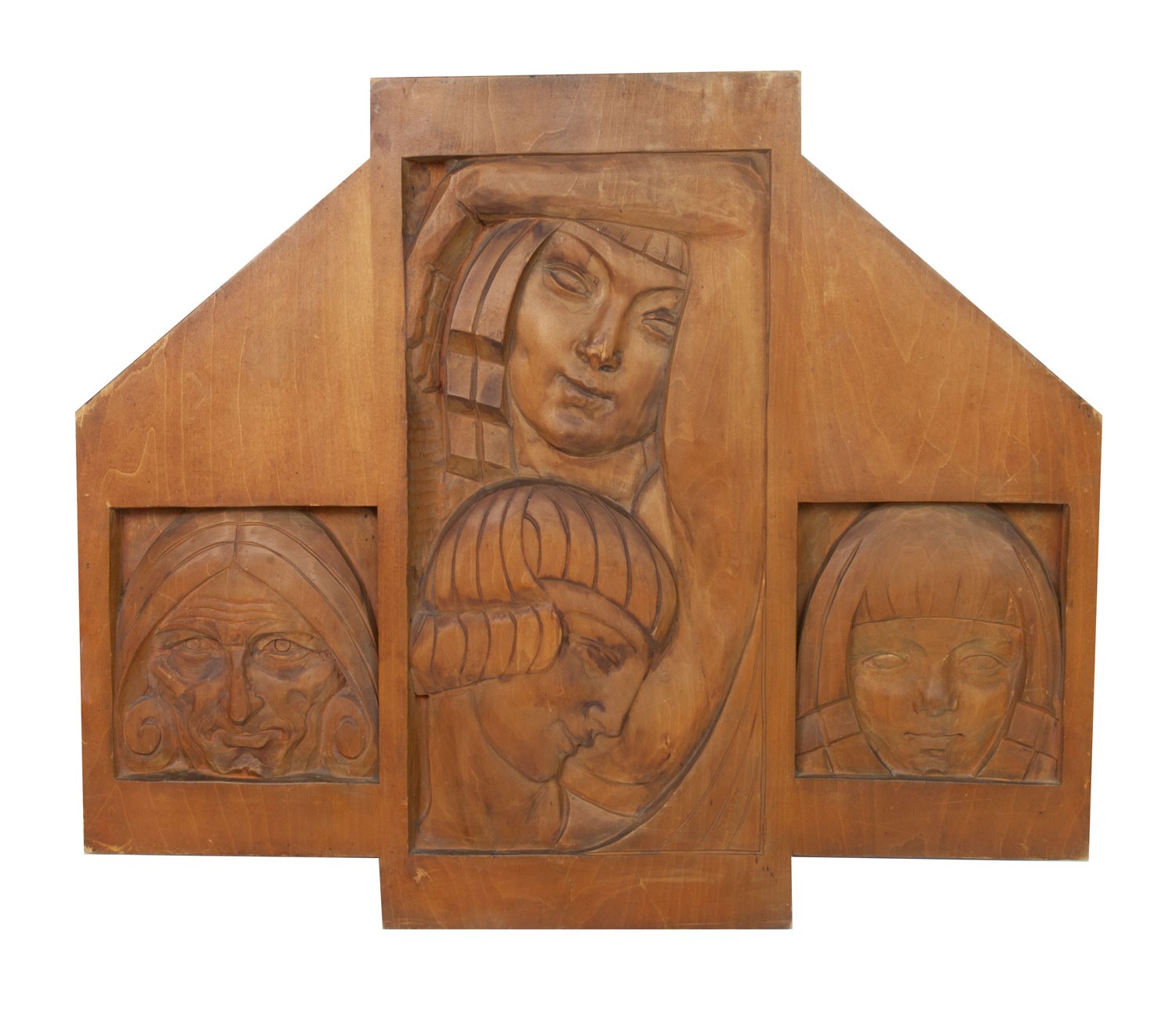
Wooden relief in art deco style, signed medr. d. "I. ZELEK."
Dimensions: 45x54x3 cm
Ignacy Zelek (Turaszówka 1894 - 1961 Torun) - attended the People's School in Gorlice in 1900-1905. In 1906-1908 he stayed with his family in Bustenaria in the Wallachian Lowlands in Romania, in the region of the oil basin. While in Romania, he attended the German Knaben und Madchen Volks Schule "Steaua Romana" in Bustenaria from 1906-1907. After returning to his hometown, he studied from 1908-1911 at the Imperial Royal School of Wood Industry in Kolomyia, where he was a student of the sculpture department. He then studied at the Academy of Fine Arts in Cracow in the studio of Konstanty Laszczka, where he was among the outstanding students from the beginning. Here he studied for seven semesters, with a break during the war and military service. During World War I he volunteered for the 2nd Infantry Regiment of the Polish Legions and served there from August 6, 1914 to March 15, 1917, being promoted to platoon sergeant. Among other things, he took part in battles on the Austro-Russian front. In 1916 he was hospitalized in Prague, as he was shot in the knee during hostilities. During this stay, he attended Josef Václav Myslbek's monumental sculpture studio at the Academy of Fine Arts there as an extern. After returning to Krakow, he continued his interrupted studies at the Academy of Fine Arts. In 1920 he decided to go to Toruń, and here he met the sculptor Wojciech Aleksander Durek, who also lived in Toruń for a short time, and who came from Malopolska. Together with him, he soon founded the studio "Rzeźba" located at 2+4 Sukiennicza St. In early 1921, both artists joined the Artists' Fraternity, which was founded by Julian Fałat. The studio on Sukiennicza Street, run jointly with Wojciech Durek, existed until 1923. In the 1920s he created family pastel portraits. From 1923 to 1935, Zelek had an atelier at 6 Reja St. Durek, on the other hand, remained in Torun until June 1925, but the artists maintained both professional and friendly contacts until his death. In 1935 he moved to 109 Mickiewicza Street, where he opened two studios. Most of his sculptural works were destroyed during World War II. After the war, he worked mostly on church commissions, mainly on the Coast.