


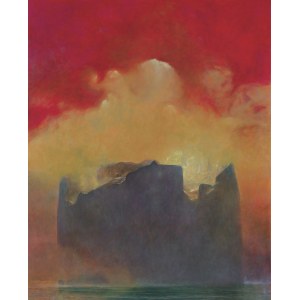
120,0 x 98,0 cm - oil, fiberboard
signed on the reverse: Z-8 | BEKSIŃSKI
On the reverse an export stamp with signature.
Provenance:
- The painting was purchased in 1990 in Paris for the Museum of European Art in Osaka, Japan.
- After the museum closed, private collection in Asia.
Image exhibited, reproduced and described:
- Beksinski. Paris-Osaka-Warsaw, Agra-Art Gallery, Warsaw 1 July - 4 September 2021, cat. no. 28, pp. nlb. ill. in color;
- Japanese Collection. Beksinski and others, Agra-Art, Warsaw 2021, p. 81, color ill.
- Dmochowski Gallery NET website (Room 11. Paintings. Years 1984-1989).
The depiction of an abandoned island against a bloody sky was one of the "landshapes" created as a result of the artist's commission agreement with art dealer Piotr Dmochowski in late December 1987. According to its content, the Master undertook to paint sixteen paintings similar in style to the fantasy landscapes of the second half of the 1970s. Compositions from that period - shrouded in an aura of magic and mystery rather than full-blown macabre - were devoid of visible "death designators." Their absence was a basic condition imposed on the artist, who commented on the aesthetics of the commissioned paintings with the note: "without guts and cobwebs." In the case of Z-8, the role of creator - typical of a "photographer of vision", full of anxiety mood - was taken over by a reference to one of the most recognizable paintings of the Symbolist era - Arnold Bőcklin's Island of the Dead (1827-1901). When asked about the sources of inspiration for his work, the artist admitted to being fascinated by this "created for dreaming" (German: ein Bild zu Träumen) work:
- How do you see references in your work to the art of the great visionaries of the past, such as Gustave Moreau, Arnold Bőcklin, Odillon Redon, Blacke? How do you feel about the Young Poland inspirations, which are obvious to viewers of your art?
- The question is already answered and I am not making an objection here. As a rule, I am compared with Link and Bosch, and then in both cases a strong objection arises in me. Of course, it is beyond my power to accept all of Bőcklin, but his Isle of the Dead made a huge, unforgettable impression on me as a child, and this impression continues to this day. (Zdzislaw Beksinski, interviewed by W. Skrodzki, "Project," vol. 26, no. 6, 1981).
The ruins of a forgotten fortress, visible in the middle of the ocean, is one of the few paintings in which Zdzislaw Beksinski - who practiced art away from all manifestos and "isms" - chose to refer to the canon of 19th-century painting.
♣ to the auctioned price, in addition to other costs, a fee will be added, resulting from the right of the creator and his heirs to receive remuneration in accordance with the Act of February 4, 1994 - on Copyright and Related Rights (droit de suite)
* To the Purchase Price will be added an additional 8% border VAT (in accordance with §12 item 2 of the Regulations)
(Sanok 24 II 1929 - Warsaw 21 II 2005) studied from 1947 to 1952 at the Faculty of Architecture of the Cracow University of Technology.
He was a self-taught artist who achieved an unquestioned position in Polish contemporary art, confirmed by the presence of his works in prestigious exhibitions and museum collections. He was initially involved in photography, which he had been interested in since his student years, after 1956 gaining recognition as a creator of photograms with an aesthetic based on textural effects. In 1958-1962, he created abstract paintings-reliefs of rich texture, mainly metal, which are a variation of matter painting. Toward the end of this period, he created openwork forms with figure shapes and full-bodied sculptures in metal. The next stage of his work was 1962-1974, when he devoted himself mainly to drawing. In the 1960s he drew with pen and ink figural compositions characterized by caricatured deformation of figures. From the late 1960s, he created charcoal and crayon drawings, a monochromatic variant of his parallel painting work. Since 1974, he has dealt almost indivisibly with painting. His distinctive style was based on technical perfection, accompanied by an extraordinary vision. He painted a post-disaster world, marked by the stigma of death and decay. His paintings are populated by figures and creatures with admittedly human or animal shapes, but with the characteristics of phantoms, automatons or decaying corpses. The artist did not give his paintings and drawings titles (except for ordering symbols), thus emphasizing his lack of interest in the literary side of the depictions. He himself said that when painting he completely surrenders to the vision, "photographing" it. In recent years, he has incorporated electronic image generation techniques into his artistic technique, which he used to create computer photomontages. Beksinski's art, which has been exhibited and discussed many times, arouses extreme emotions among experts and the public.
The largest, systematically replenished collection of his works in the country is in the Historical Museum in Sanok, abroad - in Paris, in the possession of Piotr Dmochowski, who has been collecting works and promoting the artist's work since 1983. He organized individual exhibitions of Beksinski's works at, among others, Galerie Valmay in Paris in 1985, 1986 and 1988, as well as a permanent exhibition at Dmochowski's own Galerie - Musée-galerie de Beksinski, which existed from 1989 to 1996. He also published monumental albums of the artist in 1988 and 1991.
In Poland, Beksinski's monograph by Tadeusz Nyczek was published by Arkady in 1989 (second edition in 1992). In the spring of 2005, a major exhibition of Beksinski's paintings took place at the Abbotsford Palace in Gdansk Oliva, and the director of the Sanok Museum Wieslaw Banach published a comprehensive monograph on the artist.
Since October 2016, an exhibition of 250 works (paintings, drawings, photographs) by Zdzislaw Beksinski from the private collection of Anna and Piotr Dmochowski has become a permanent fixture at the Nowa Huta Cultural Center. Meanwhile, a permanent exhibition of 30 Beksinski paintings from the Dmochowskis' collection has also been on display at the Archdiocese Museum in Warsaw since June 2021.
(Photo: Piotr Dmochowski, CC BY-SA 3.0, https://commons.wikimedia.org/w/index.php?curid=8960820 )







![Zdzisław BEKSIŃSKI (1929-2005), Bez tytułu [7], 1958](https://img1.one.bid/img/7081/2022469_1w.webp)








Последно разглеждани позиции
Влезте, за да се запознаете със списъка с артикулите
Любими
Влезте, за да се запознаете със списъка с артикулите