K. Frank Jensen (b. 1933)
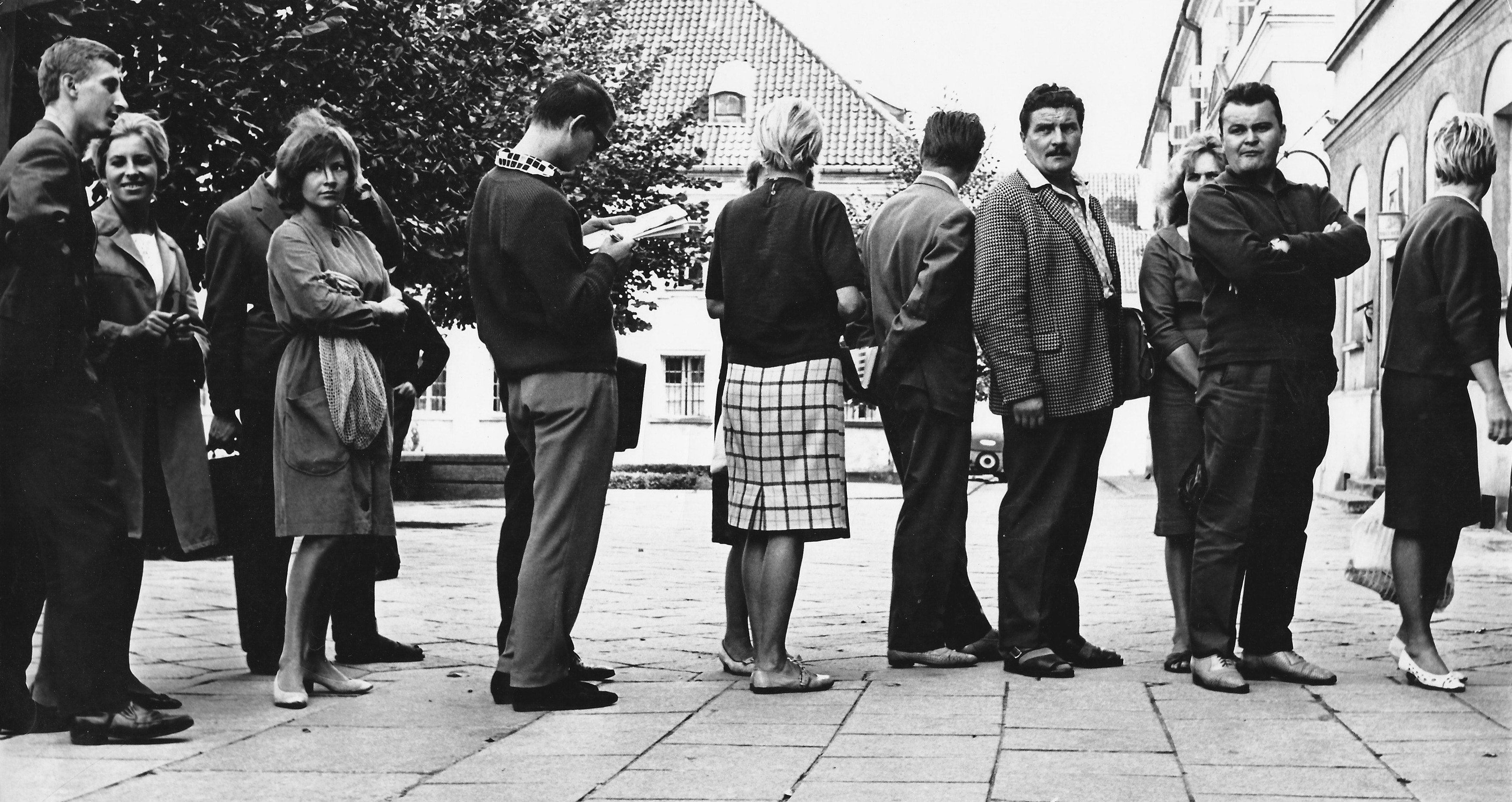
Queue, Warsaw 1963
bromide/paper, 16 x 29.6 cm, vintage print
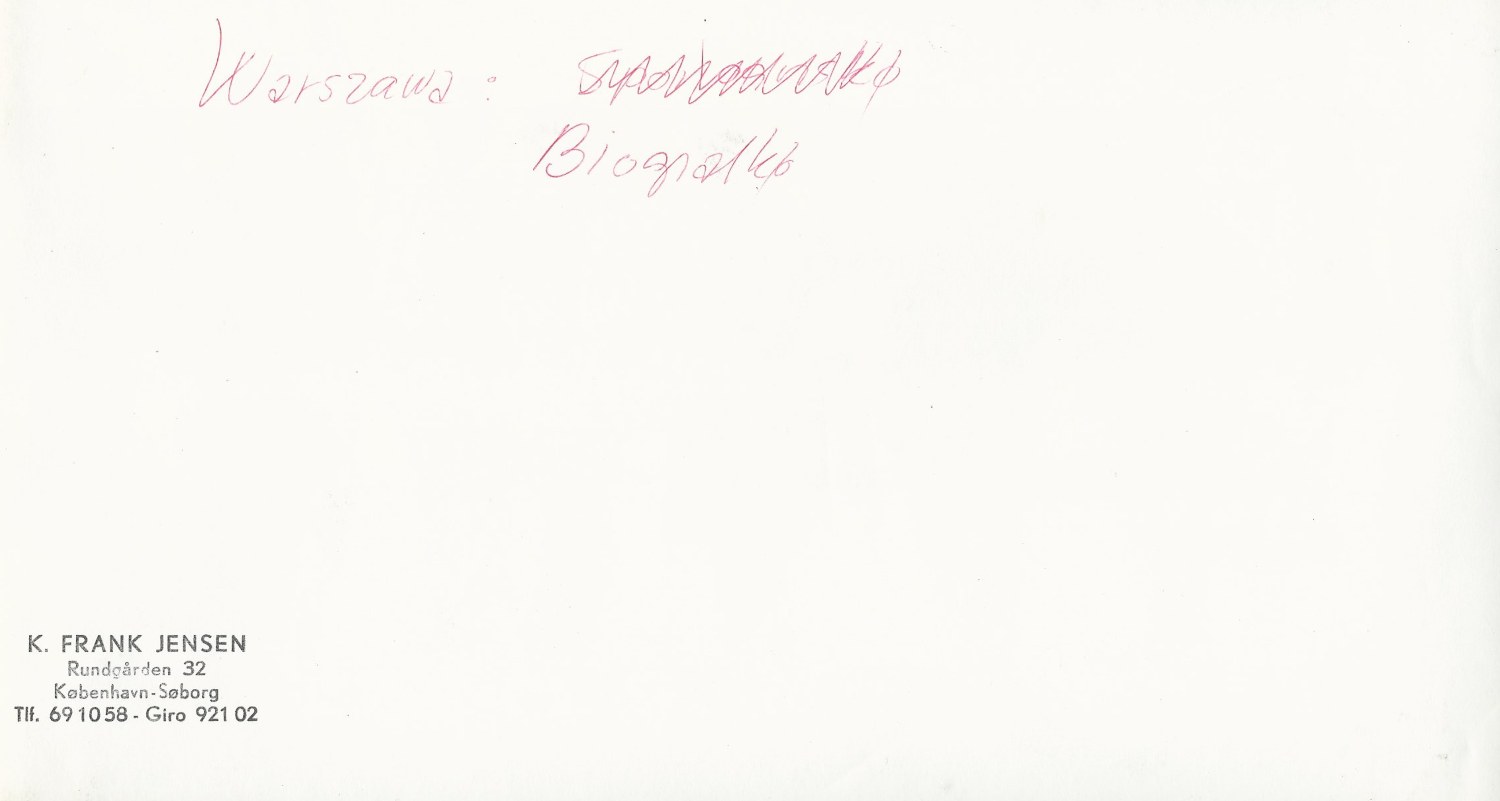
stamp and artist’s inscription on the reverse
Thirty-year-old Frank Jensen arrived in Poland at the turn of summer and fall 1963. He intended to take a series of photographs and get to know the Polish photography community, about which he had heard many good things from a Danish director friend who had studied at the Łódź Film School. Poland seemed to him to be a photographer’s paradise—not only because of its visual appeal, but above all because of the status that photographers enjoyed here. He was impressed by the fact that photography in Poland was recognized as an autonomous art form and that photographers enjoyed the status of artists, benefiting from many privileges. The situation was similar in other Eastern Bloc countries.
In an article on Polish photography published after his return home, Jensen highlighted the comprehensive support for the field provided by the Ministry of Culture. His native Denmark lagged far behind in this regard. Polish artist-photographers had at their disposal not only the pages of general-interest and specialized magazines, but also a network of galleries, a range of professional and amateur competitions and exhibitions, and the most famous among them published their own albums. To get a sense of photography’s popularity in Poland, one need only consider that in 1963 there were 45 photography associations here, both national and local. All of Poland was taking photographs—from Białogard to Zielona Góra! Through the Danish-Polish Friendship Society, Frank Jensen made contact with the doyen of our photographers, Alojzy Czarnecki of Toruń; who, in turn, arranged for him to meet his daughter, Janina Gardzielewska, who was making a name for herself in the same field, and through her, further contacts were established with Edward Hartwig, Henryk Hermanowicz, and Krystyna Neuman-Gorazdowska. There wasn’t enough time for more professional meetings, though the young Dane, equipped with a fine Leica, was undoubtedly a highlight for his fellow photographers. Let us remember that this was a time when contact with foreigners was rare. No wonder the monthly magazine "Polska" organized a contest for its readers titled " My Encounter with a Foreigner."
Jensen, along with two companions, traveled by private car from Warsaw to Zakopane, stopping for a longer period in Łowicz and the surrounding area, a region that proved to be the most interesting to him. The Danish photographer sought authenticity, evidence of a life under threat and in the process of fading away. He was interested in photographic documentation. He captured subjects, events, and places that were slipping into the past under the pressure of civilization and mass tourism. He had already completed many years of photo shoots during which he managed to capture the unique atmosphere of the French Camargue region and legendary sites in Great Britain associated with the Knights of the Round Table.
Łowicz and its surroundings exemplified an original peasant culture which, according to Jensen, could not be found anywhere else. He was captivated by the authenticity of the people, far removed from the “folk art” offerings promoted—specifically for tourists—by official propaganda. The inhabitants of this “endemic” region lived at their own pace: in their daily lives and on holidays. Jensen photographed them on market days and holidays. He was fascinated by the behavior and faces of these people, who seemed not to notice the foreigner observing them through his camera. Old women wrapped in shawls engaged in quiet conversations, returning from church, waiting for something. The young people, too, were in no hurry, moving to the rhythm of the sometimes natural, sometimes ritualistic succession of the hours of the day, the year, and life. The people in Jensen’s photographs from the Łowicz area exist between the everyday and the festive, between the profane and the sacred. Their surroundings, too, are frozen in a picturesque blend of ordinariness and festivity.
A different atmosphere reigned, of course, in the capital, which Jensen photographed in both fair weather and rain. Once again, he is most interested in people. With a reporter’s keen eye, he observes them on the street, in a store, on a bench—in motion and in moments of rest. He is captivated by the horizontal rhythm created by anonymous people standing in line for something or waiting under umbrellas at a bus stop. He captures split-second moments of movement: when shapely legs step onto a tram; when a little girl runs across the square; when a plump lady in front of a store refreshes herself with kefir from a bottle. It is worth comparing Frank Jensen’s impressions from his visit to our capital with the opinion of the prominent French critic Pierre Restany, who, in an article published at the time in the Parisian magazine "La Galerie des Arts," wrote with disgust about Warsaw’s nightmarish urban planning, devoid of any modernizing vision. Jensen likely felt the same way, photographing the mass of the Palace of Culture and Science in foreshortened perspective, as well as the urban chaos of the emerging “modern” parts of the city, captured from the palace terrace. Nor does Warsaw’s Old Town, which Restany brutally criticized as a symbol of our national sentimentality, impress the visitor from Copenhagen. In his photographs, the fake nature of the facades of the capital, rebuilt from the rubble, is clearly visible. Even then, the artificiality of this concept could not be hidden. It is the people who bring life here—full of vigor, amusement, and big-city flair.
This is the time of “small stabilization,” in which—following the relative liberalism of the “thaw” period—the authorities return to a position of force, though enforced through more veiled means. The propaganda seeping through the available mass media fosters the illusion of a normal, civilized life. The characters in Tadeusz Różewicz’s play *Witnesses, or Our Little Stabilization* describe their precarious situation: "Stupidity takes on normal proportions / infinity is shorter / than Sophia Loren’s leg / love and hate / have lowered their standards / white is no longer so white / so blindingly white / black is no longer so black / so truly black / the temperature is average / the winds are moderate / (...) one crosses one leg over the other / houses stand / cars drive / gentlemen have ladies / ladies have furs / furs have collars / (...) one can step in / one can step out / one can be outraged / not too deeply / one can drink coffee (...)". Those who have doubts should be persuaded and encouraged by reports from construction sites, workplaces, and scientific laboratories. The authorities no longer wish to impose socialist realism through decrees, but they would like to finally put an end to the dark prose of café existentialists, to provide uplifting, vibrant examples drawn from real life. In this regard, they are counting heavily on professional photographers and the growing number of amateur photographers who have at their disposal a direct medium—one that supposedly cannot lie, that awakens and satisfies the world’s hunger.
I wonder if Jensen—while marveling at the possibilities of Polish photography—was aware of its dual nature? Development for development’s sake? Experiments for the sake of experimentation? Freedom for freedom’s sake? That did not exist in the People’s Republic of Poland, nor could it have. He just happened to come into personal contact with those photographers who took a strongly aesthetic approach, without engaging in the direct depiction of reality. Had he met Eustachy Kossakowski or Tadeusz Rolke, he would have seen how they had to contort themselves to take photographs that were formally good yet simultaneously engaged, fitting the propaganda project of the monthly "Polska," for which they worked and which was published—curiously—in two distinct versions: one for readers on one side of the "Iron Curtain" and one for those on the other.
Although Jensen’s stay in Poland was brief, he lost none of the freshness of his perspective. Examining the contact sheets from the dozen or so rolls of film he “snapped,” we can see the directness with which he chose his subjects, the naturalness with which he sought out motifs, and the ease with which he selected frames, keeping only the most precise ones. In his own country, he could not hold the title of “visual artist,” yet it was he who practiced “photography of life,” “total photography,” which his contemporaries only dreamed of.
Anna Baranowa - Kraków, October 2009