Tadeusz Chrzanowski (1926–2006)
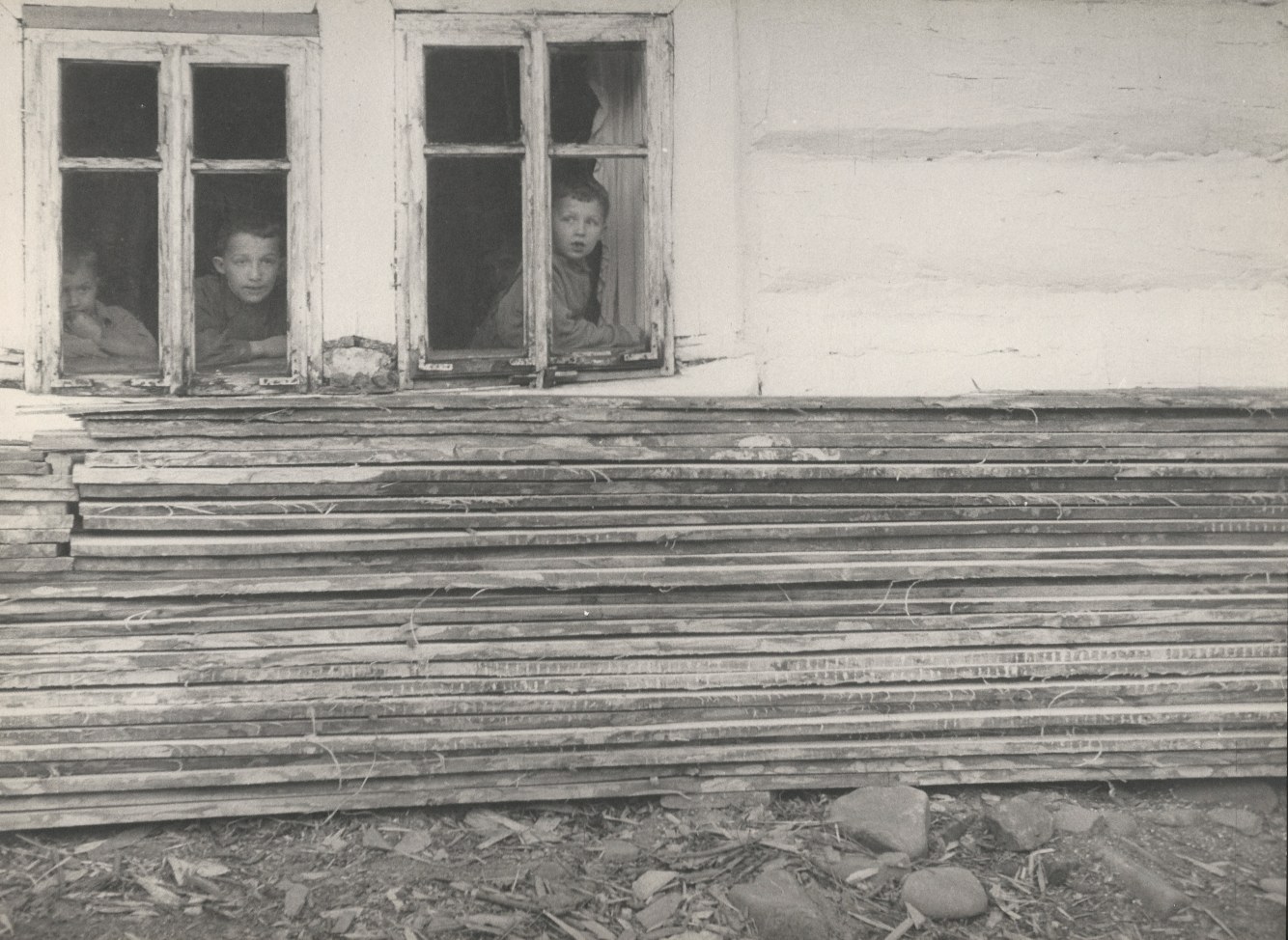
In the Window, 1950s
bromide/paper, 29.7 x 39.8 cm, vintage print
artist’s stamp on the reverse
Tadeusz Chrzanowski was born in Kraków on May 14, 1926. After spending years in his hometown of Moroczyn near Hrubieszów, he settled in Kraków after the war, where he studied at the Academy of Commerce and later began further studies in art history at the Jagiellonian University. As a student, he had the interesting experience of being part of the Logofagów Club, which brought together independently-minded youth—a unique testament to insubordination in the deeply ideologized conditions of the Polish People’s Republic. Membership in the Club was at once a school of free thought and lasting friendships. For many decades, Tadeusz Chrzanowski was also very closely associated with the circles of *Tygodnik Powszechny* and *Znak*. The main focus of his professional activity, however, was art history. In 1952, he earned a master’s degree in this field; in 1971, a doctorate; in 1980, a habilitation; and in 1990, a professorship at the Catholic University of Lublin. At KUL, he headed the Department of Artistic Culture.
To his students, he was known as a polymath—an outstanding expert on the modern era who navigated the fields of medieval studies and contemporary history with impressive confidence. Over two hundred publications closely related to art history, including a massive inventory project conducted jointly with Marian Kornecki, involving the documentation of monuments throughout Poland —earned Tadeusz Chrzanowski the status of one of Poland’s most distinguished art historians. The forty invaluable volumes of the Catalog of Art Monuments in Poland are not only a matter of travel, often under difficult conditions, but also the creation of comprehensive documentation, which requires the application of a thorough research methodology. It also involved photographic documentation—Tadeusz Chrzanowski, having taken hundreds of photographs over many years, became an outstanding photographer. Chrzanowski was introduced to the secrets of photography by the outstanding photographer—and, privately, his stepfather—Włodzimierz Puchalski. We must not forget this crucial aspect of Chrzanowski’s body of work, as in many cases his seemingly documentary photographs contain a significant artistic element, which allowed him to take his place among the members of the Association of Polish Art Photographers.
Tadeusz Chrzanowski’s body of work, however, consists not only of scholarly and photographic works, but also of poetic works, with which he made his debut as a writer, as well as numerous texts in the field of cultural journalism. He was a columnist (for many years his weekly columns appeared in the aforementioned “Tygodnik Powszechny”) and a reviewer of art exhibitions and films. His literary talent, combined with intelligence, a sense of humor, and a sharp tongue, won him not only readers but also the recognition of professional writers. He was a member of the former Polish Writers’ Union, the Polish Writers’ Association, and the Pen Club. He played a significant role in each of these organizations. Another chapter in Tadeusz Chrzanowski’s career is his social activism: as president of the Association of Art Historians, and especially as chairman of the Social Committee for the Restoration of Kraków’s Monuments. He also collaborated with the Educational Film Studio in Łódź, the Office of the Provincial Conservator of Monuments in Kraków, as well as the Institute of the Polish Academy of Sciences in Warsaw and—as an educator—with Kraków’s universities: the Pedagogical University, the Academy of Fine Arts, the Kraków University of Technology, and the Jagiellonian University. He received honorary doctorates from the Pedagogical University of Kraków and the Kraków University of Technology.