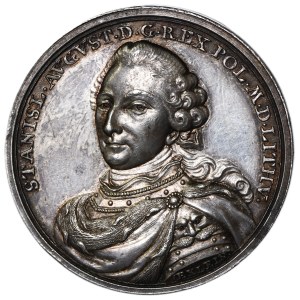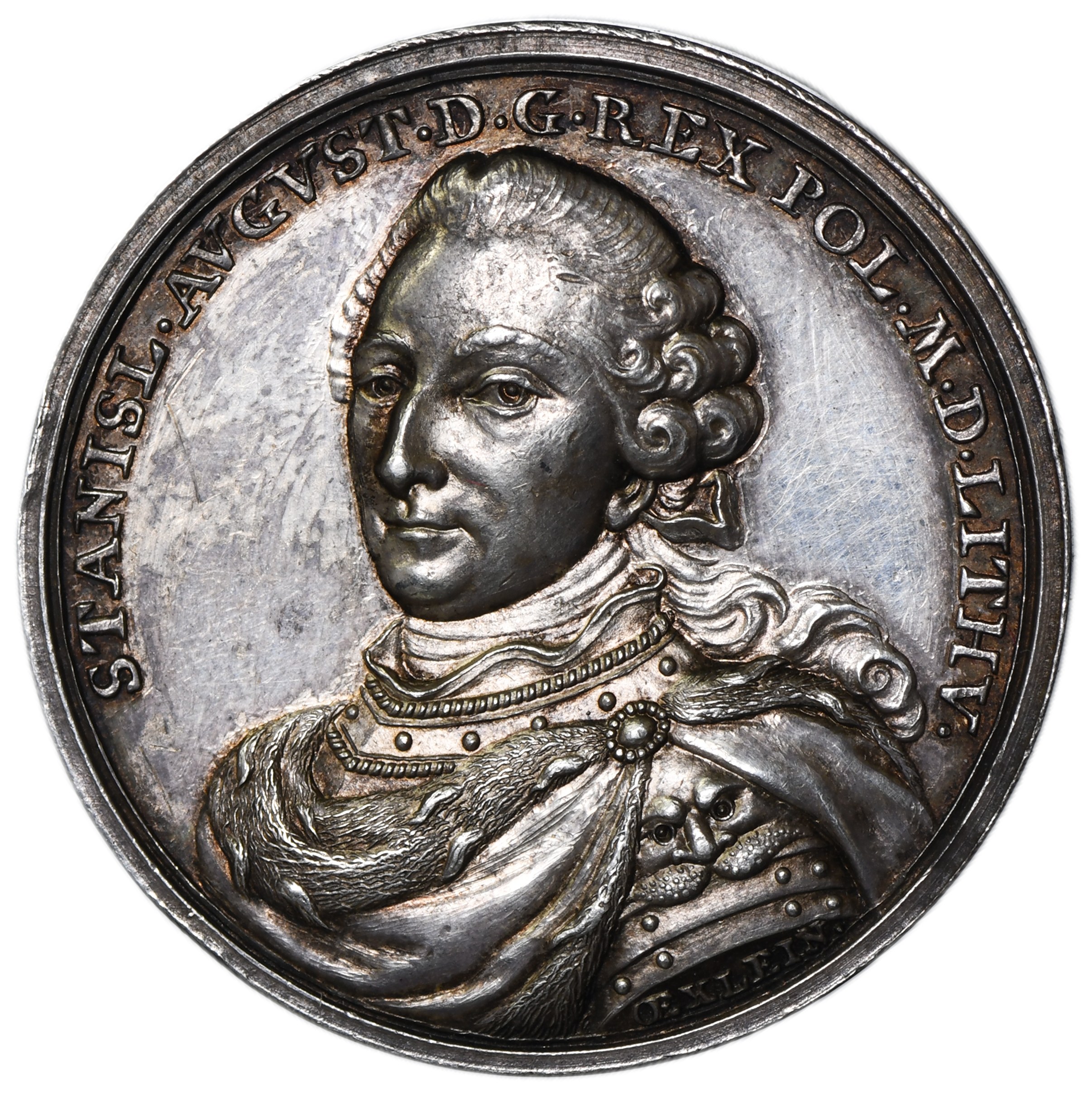
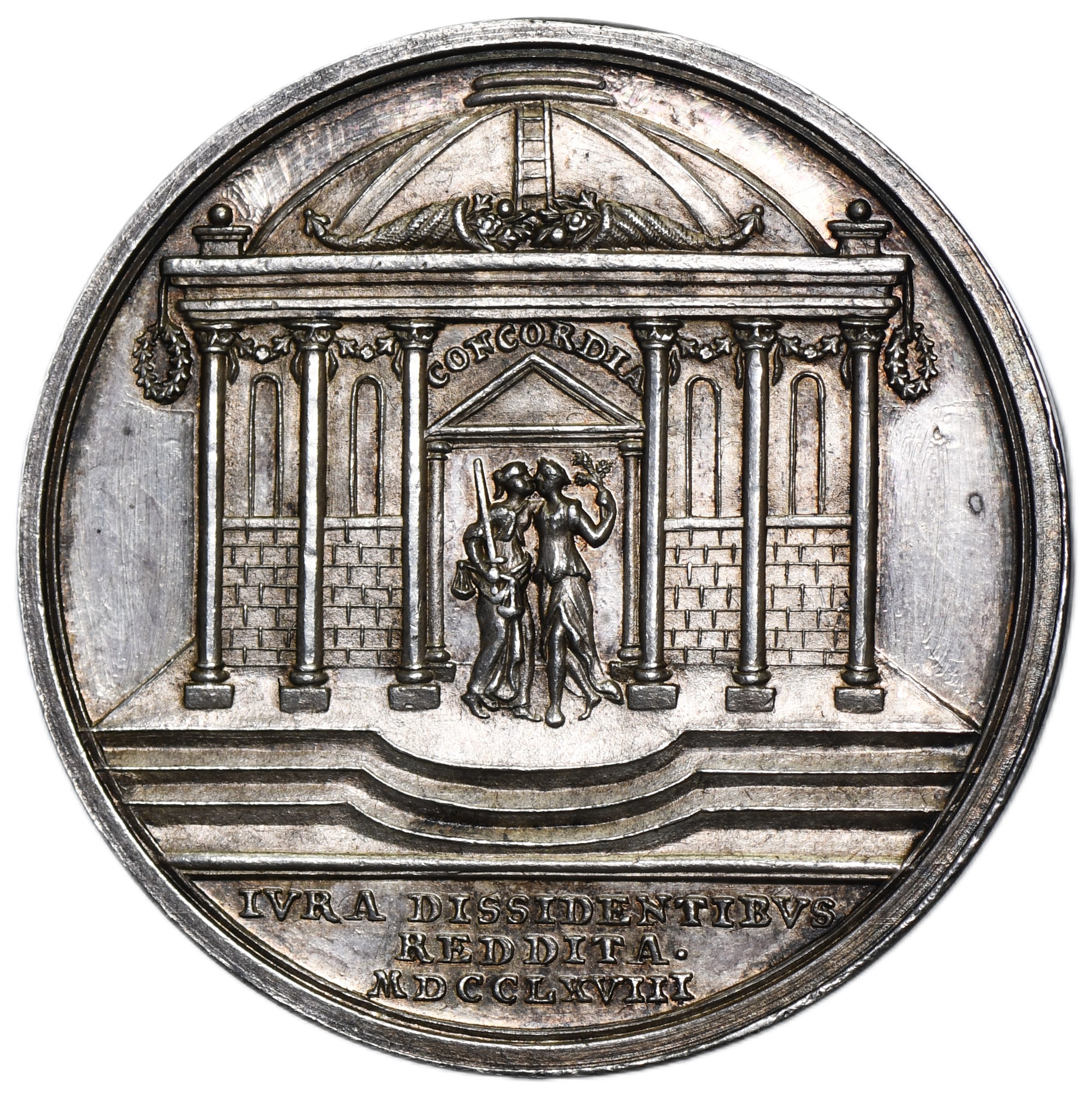
Issued on the occasion of equal rights of dissidents with Catholics by Stanisław August Poniatowski, 1768.
Medal by JL Oexlein, signed on the obverse.
Smoothed background.
An interesting addition to any collection of medals, especially from the period of Stanisław August Poniatowski.
Obverse: bust of the king in armor and cloak three-quarters to the left, signature OEXLEIN on the shoulder.
STANISL AVGVST DG REX POL MD LITHV
Reverse: in the portico of the temple, Justitia and Pax kissing, above which the inscription CONCORDIA, in the section the inscription in three lines IVRA DISSIDENTIBVS / REDDITA / MDCCLXVIII
Silver, diameter 38 mm, weight 21.93 g
Edward Raczyński writes about this position as follows: "From the time of their acceptance of the Christian faith, Poles not only staunchly but also zealously adhered to the Roman Catholic faith, and did not allow those who differed in their faith from the Roman Church to settle in their midst. Sometimes, in earlier centuries, private individuals and larger congregations came along who, having accepted teachings inconsistent with the Roman Church, undertook to express their own opinions and spread throughout the Polish lands. As we read, the sect of the Flagellants began to spread here, as Naruszewicz of Baszka proves, around the year 1261; which, however, is subject to doubt, because it is true that at that time this sect began and spread throughout the Italian lands, but the popes also successfully resisted it, and the rulers in their own lands did not tolerate it. I would therefore rather understand that this sect moved to Poland from Germany around the middle of the following century. where a terrible plague, called black, resurrected her. To suppress such and similar errors, the authority of the bishops was sufficient at that time. With the enlightenment and authority of the Roman See, they knew how to condemn and punish her even when necessary, without involving secular authority. An example of this involvement in Poland is found only in 1424, under Władysław Jagiełło. This monarch issued the sentence on the date in Wieluń, on Judica Sunday, that is, on the fifth Sunday of Lent, which imposes a heavy penalty on those who differ in faith from the Roman Church. But the date of this sentence itself reveals the motives for its making; for that same year, Žiška, the leader of the Hussites in Bohemia, died, and was succeeded by Prokop, against whom Sigismund the Emperor, even using the full might of his weapons, could achieve nothing. Therefore, King Jagiełło, fearing that these storms might reach Polish, a nation of one origin, with a very similar language and long-standing ties, attempted to prevent the misfortunes of his country with this verdict. In this verdict, he ordered special caution for those arriving from Bohemia to Poland, and recommended that Poles return to their homeland within a certain period of time under severe penalties. At the same time, he completely forbade the export of goods from Poland to Bohemia, namely lead, weapons, and food. The thought and motives of this law completely reveal all this. From that time on, for a hundred years and more, no laws punishing dissenters were passed by the secular authorities, convinced that judging what agrees with or contradicts the established religion in the country belonged to the bishops, its guardians. Only occasionally, more violent riots and religious disputes, initiated in various places, especially in Prussian cities, were prevented by sent commissions, court rulings, and local royal laws. For the spirit of proselytism, so often against the Church, The accusation against the Romans, far more powerfully animated those who intended to introduce, expand, and consolidate the changes occurring abroad in Poland. The leniency of Polish laws and the customs of the local inhabitants, which did not allow for the violent adaptation of laws to new dissenters, which a hundred years ago had been established against the Husssites, other specific events that would take a long time to enumerate, and finally, the insensitivity of many bishops, as long as it concerned only the teachings of the Church—all these factors combined to quickly and powerfully spread opinions opposed to the Roman Church. They were joined by very large and wealthy houses, such as the Górkas, Zborowskis, Ostrorógs, Zebrzydowskis, Stadnickis, and Gorajskis in Poland, the Radziwiłłs, Tyszkiewiczs, Chodkiewiczs, and Pacs in Lithuania. These, considering what the sovereign princes in Germany had done and what benefits they had derived from the change of religion, had similar laws. They appropriated sovereignty over their estates; therefore, they began to bring in clergy of their own faith, take away churches, encourage and lead their subjects to a similar faith, appropriate funds, and forbid the payment of eternally due tithes. This, along with the deprivation of jurisdiction, awakened the bishops, whom Cardinal Commando, even the nuncio in Poland at the time, openly supported in his letters to Rome, because, having grown cold in other matters, they insisted with the greatest fervor on their tithes. So, I say, the bishops began to complain, call for the defense of their rights, incite other Catholics, and King Sigismund Augustus himself, to shield them from such violent attacks. However, no bishop, no most zealous senator, or citizen participating in the debates, saw a difference of religion as any obstacle to the highest dignities and taking a seat in both the Senate and the Chamber of Deputies, although Those who differed from them in faith violently threatened to withhold the aid needed for the war, and demanded more and more prerogatives and freedom for themselves. Therefore, both the Senate and the Chamber of Deputies considered them not insignificant among themselves, and nothing harmful to them, nothing offensive to their civil rights, was decided. For the Constitution of Sigismund Augustus, issued in Kraków in 1550, could not have been considered strictly binding law, since the Catholics did not refer to it in so many subsequent adventures. Meanwhile, the Constitution promulgated at the Parczów Sejm in 1564 was the work of both Catholics and dissidents, of the twofold earlier confession, who, although hated each other in the fervor of those centuries, united with each other against Catholics, and with Catholics even against Aryans, neo-Baptists, Socinians, and the rabble of that foreign fugitives such as Bernardine Ochin, Faustus Socinus, and many others, whom both Catholics and former Protestants desired to expel from Poland and thus passed this law. This state of affairs remained when, during the interregnum following the death of Sigismund Augustus, these two parties clashed powerfully. While, to avoid major extremities, one party decided to establish a Catholic king, the other made an addition to the royal oath to ensure peace between the religious dissidents.
The original meaning of the word dissidentes undoubtedly included Catholics, and meant that the king was to try to ensure that those who were arguing about faith lived in peace with each other, but soon after, through widespread use, the word began to mean those who differed in religion from Catholics.
The return of many noble houses to the Roman Church weakened the dissident side. After all, they managed to maintain themselves in both the Senate and the Chamber of Deputies, and in distinguished offices, not only under Sigismund Augustus's closer successors, but even under Sigismund III, Władysław, and John Casimir. Although the former diligently tried to place anyone who wasn't Catholic in the Senate, he often abandoned this endeavor out of consideration for the great houses. At the Sejm of 1662, under King John Casimir, Bogusław Prince Radziwiłł was seen in the Chamber of Deputies, although he was still serving in Brandenburg at the time. I understand that more examples of this would be found in later times. There were apparently some plans to bar the path to honor for dissidents at the Treaty Sejm, due to the still-lingering hatred of the Saxons, especially the royal minister Flemming, but they settled for commonplace expressions that did them little harm. In 1718, at the Grodno Sejm, a deputy from the Wieluń region was barred from speaking in the Chamber of Deputies on religious grounds and dismissed from the proceedings. At the Convocation Sejm of 1733, a law was passed expelling all dissidents from the Senate and Chamber of Deputies in the future, and forbidding them from any dignities. Even elected dissidents were not admitted to the Chamber of Deputies at that same Sejm. I understand that this law, so offensive to dissidents, was passed partly to weaken the Saxon party, depriving it of the support of many sympathetic people who had close ties with the Saxons, and partly because the sad tragedy in Toruń, which occurred nine years earlier, was still fresh in the memory at that time. This opinion seems to be confirmed by the addition to this constitution, which, under the harshest penalties, forbade going to foreign powers, which was considered a great offense for Toruń at that time. These constitutions of the Convocation Sejm of 1733 (the original edition) were transformed and completely transferred to those found in the sixth volume of the constitutions; but the constitution against dissidents not only remained, but was also confirmed at the pacification sejm of 1735, and at the convocation sejm, and in the act of the general confederation of 1764, and by the pacta konserta of king stanisław august.
The disappointed dissidents, in the hopes they had placed on the increased light and prosperity of their age, began to think of ways to regain their former national prerogatives and to remove the obstacles that blocked their path to national honors, and since they saw no way of obtaining this from their compatriots, they appealed to the powerful protection of the Russian Empress.
After the interregnum ended and the king was universally recognized, Russian troops were withdrawn. The old policy of the Russian state compelled everyone to seize opportunities that would give this monarchy influence in Polish affairs. Moreover, the Empress believed that becoming the guardian of religion in Poland was a decent recompense for some of the wrongs done to her. She therefore eagerly seized this opportunity, and first, to test the inclinations of the minds, she ordered a motion to be made at the Sejm of 1766 by appointed officials to grant greater freedom to dissidents and restore some of their prerogatives. This motion was met with cries of utter disgust, not only from those entering the session but also from the arbitrators, and opposing opinions were met with applause, truly scandalous in such a solemn setting. Thus, a constitution was enacted, confirming all the rights against dissidents.
When this failed, the dissidents, assured of the empress's effective assistance, plotted two confederations: a Crown confederation in Toruń and a Lithuanian confederation in Słuck. A certain coolness between the St. Petersburg and Warsaw courts revived the hopes of the more powerful lords, who proved to be the most opposed to King Stanisław. Thus, under the guise of patriotism, a confederation was formed, the so-called general confederation of the Crown and Lithuania, under the command of Prince Karol Radziwiłł, who had been deprived of the Vilnius voivodeship during the interregnum. A parliamentary session was held immediately, where, while greater sympathy was shown towards the dissidents, the Russian envoy, supported by the arms of his monarch, and by nature exceedingly violent, kidnapped two bishops of Kraków and Kiev, Hetman Rzewuski, an old man of great dignity and amiable to all, and his son, the starost of Dolina, then envoy, from Warsaw and ordered them to be taken to Russia, where they spent several years in exile. "I have it from the lips of the most serious that the kidnapping of the bishop of Kiev, a lord of meager wealth, mediocre credit, and unfit for intrigue, resulted from an error—that is, an envoy issuing an order, or an officer receiving an order, when the real intention of the envoy was to send Bishop Wołłowicz of Lutsk to Russia. But this error, when it was known, was not corrected out of pride, premature shame, or fear of greater unrest. Indeed, to free Załuski would have presented a spectacle before the public eye that could have further outraged the minds. Taking Wołłowicz away would have been a repetition of the violence that the entire nation had complained about quite vigorously. Therefore, Załuski had to go into exile, unaware of the reason for his departure. The terrified parliamentary assembly saw no way to resist the open violence. Some remained gloomily silent, others complained about such an insult to national independence, but the power of Russia and the efforts of its minister brought matters to the desired end from the dissidents. These deliberations were transferred from the public assembly to a small number of delegates, whose task was to facilitate these matters with the Russian minister and the ministers of the Protestant powers, who had once been involved in concluding the Peace of Oliwa. The Russian minister made sure that the number of those opposed to Russia's plans did not outnumber the delegates elected. Thus, from this delegation, the dissidents received even more than they expected. They were granted access to all honors and dignities, to the possession of all kinds of royal estates, to full legislative power, and were granted great freedoms in the conduct of their rites and the construction of churches. Courts less suspect to them were established, and laws regulating their residence among other citizens, their trade, and their association with people of the same profession were abolished. In short, they were granted complete equality with Catholics. And although the Catholic religion was accorded a certain precedence and primacy, this was more a declaration of honor and a false title than a true elevation over other religions, except that it was guaranteed that the king would always be of the so-called Catholic, ruling religion.
And this is precisely what the medal cited here calls consent, on the one hand, and on the other, rights restored to dissidents.
I must admit, in praise of these dissidents, that they showed themselves far removed from the pride and violence of their ancestors two hundred years ago, who, like Catholics, shrank from remaining. The dissidents, endowed with such great prerogatives of our times, used them with great caution and moderation, which was not least contributed to by the serious complaints against the actions of this Sejm that arose soon after throughout Poland and Lithuania, and later by the confederations. The dissidents themselves determined the use of the granted prerogatives, renounced some very hateful ones, allowed others to be limited or modified, and indeed, by a separate act of the treaty with Russia concluded in 1775, March 15th, the Russian Empress allowed the nobility, Greeks, non-Uniates, and dissidents to be excluded from the Senate and from the ministries both in the Crown and in the Grand Duchy of Lithuania, while the number of dissident deputies was reduced to three, one from each province. By the same article, the judicium mixtum was abolished, referring cases to the assessory, but in dissident cases, there would be an equal number of Catholic and dissident assessors. They were not seen violently breaking into the Senate, they appeared rarely and in very small numbers in the Chamber of Deputies, and this as citizens participating together in the national debates, and not, as an example of the age of Sigismund Augustus, as dissidents forming a separate assembly, always ready to wrestle with the Catholics."