


Height x width: 29.5 x20.5 cm
tempera on panel
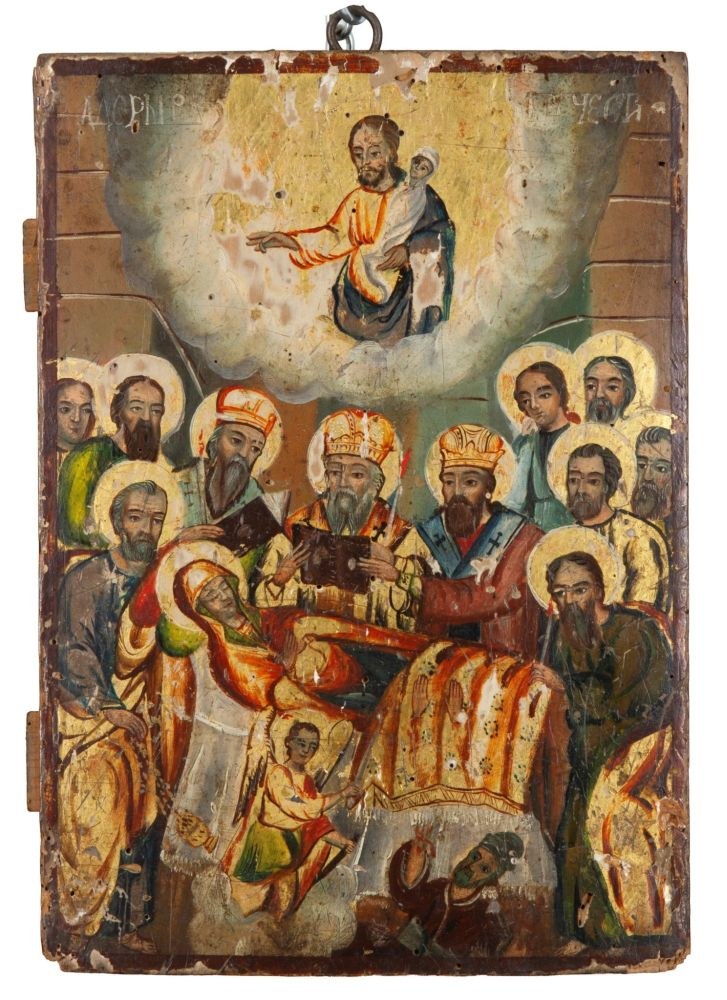
Icon on panel depicting the Dormition of the Mother of God (Uspenie Presvyatoy Bogoroditsy), one of the Twelve Great Feasts (Dodekaorton) of the Orthodox liturgical calendar, celebrated on 15 August according to the Julian calendar.
The composition depicts the Virgin lying upon her funeral bier, wrapped in the traditional dark red maphorion, while the Apostles and the Fathers of the Church gather around her body in an attitude of prayer and veneration. At the centre of the group stand three bishops, identifiable as the great Fathers of the Eastern Church, in accordance with the traditional iconographic model.
Behind the funeral bier, Christ appears within a large radiant mandorla, holding in His arms the soul of the Virgin, represented as a small swaddled child clothed in white garments, symbolizing her birth into eternal life.
In the lower section is depicted the well-known episode of the impious priest Jephonias, who, attempting to overturn the Virgin's bier, is miraculously stopped by an angel who severs his hands—an episode derived from the apocryphal accounts of the Dormition.
The gilded background, the gold-leaf halos, and the strongly hierarchical composition confer a profound liturgical solemnity upon the scene. Slavonic inscriptions along the upper border identify the subject, while the overall composition faithfully follows the iconographic models of nineteenth-century Russian icon painting.
The iconography of the Dormition constitutes one of the fundamental subjects of Byzantine and Russian sacred art, commemorating the passage of the Mother of God from earthly life to heavenly glory. Throughout the eighteenth century and the first half of the nineteenth century, this subject was widely produced in the workshops of central Russia, particularly in the artistic centres of Moscow, Mstëra, Palekh, and Kholuy, for both private devotion and domestic iconostases.
Item condition grading: ***good.
The lot is in a good state of preservation with the normal wear and defects commensurate with its age and use over time. The painted surface is in poor condition, exhibiting widespread losses of the ground layer and paint film, extensive surface abrasions, numerous areas of paint loss, and significant wear, particularly along the upper edge and the outer borders. Also visible are widespread craquelure, minor lifting of the ground layer, scratches, deterioration of the gold leaf, and numerous small holes attributable to the former attachment of a metal riza or other ornamental elements.
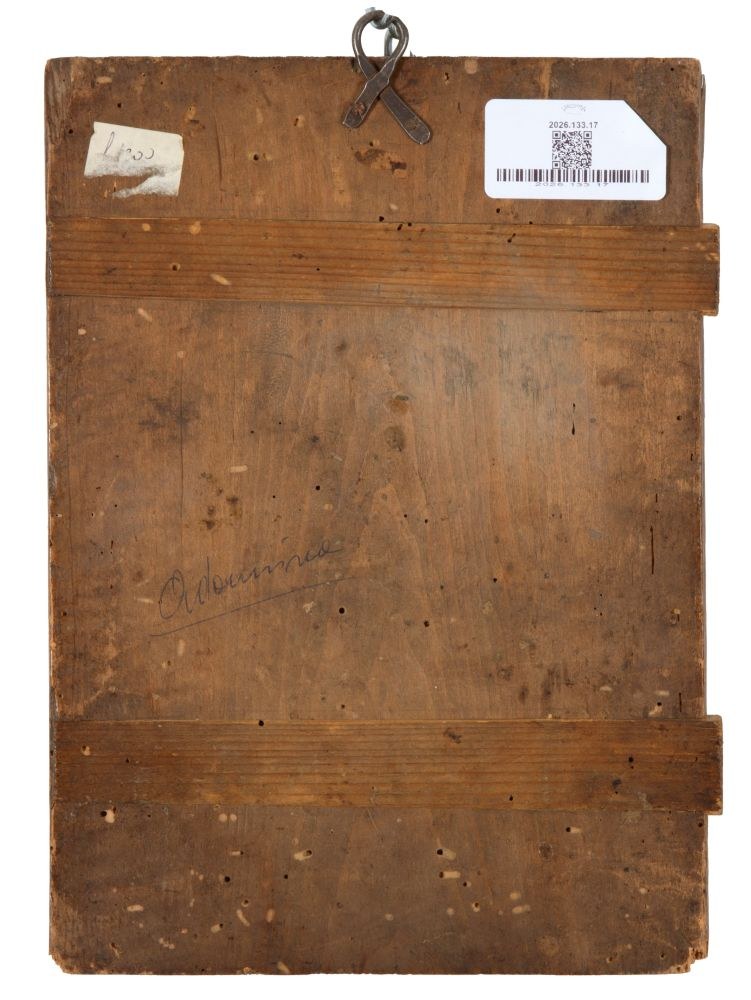
The wooden support is structurally stable and retains its two original rear cross battens (šponki), characteristic of the traditional construction of nineteenth-century Russian icons. The reverse displays the normal signs of age and use, with no evidence of invasive structural restorations. Despite the extensive losses affecting the painted surface, the iconographic composition remains clearly legible, and the work retains significant historical, devotional, and collectors' interest.










Последно разглеждани позиции
Влезте, за да се запознаете със списъка с артикулите
Любими
Влезте, за да се запознаете със списъка с артикулите