



1. Zygmunt Bielawski, A Missal for Children, Religious Library, Lviv, 1936, 12.5 cm, leather-bound, dedication from Basia Niedźwiecka, 1942, a memento from her First Communion in exile.
2. Eugeniusz Romer, *Pocket Political Atlas*, Atlas Lwów, Warsaw, 1937; 20 cm, cloth binding, dedication by the author, Zofia’s uncle
3. Paper knife with a mermaid, Poland, Warsaw, Orno, silver, fineness 3, weight 10.6 g, length 14 cm, hallmarks: 3, head in a scarf, W, Or/no
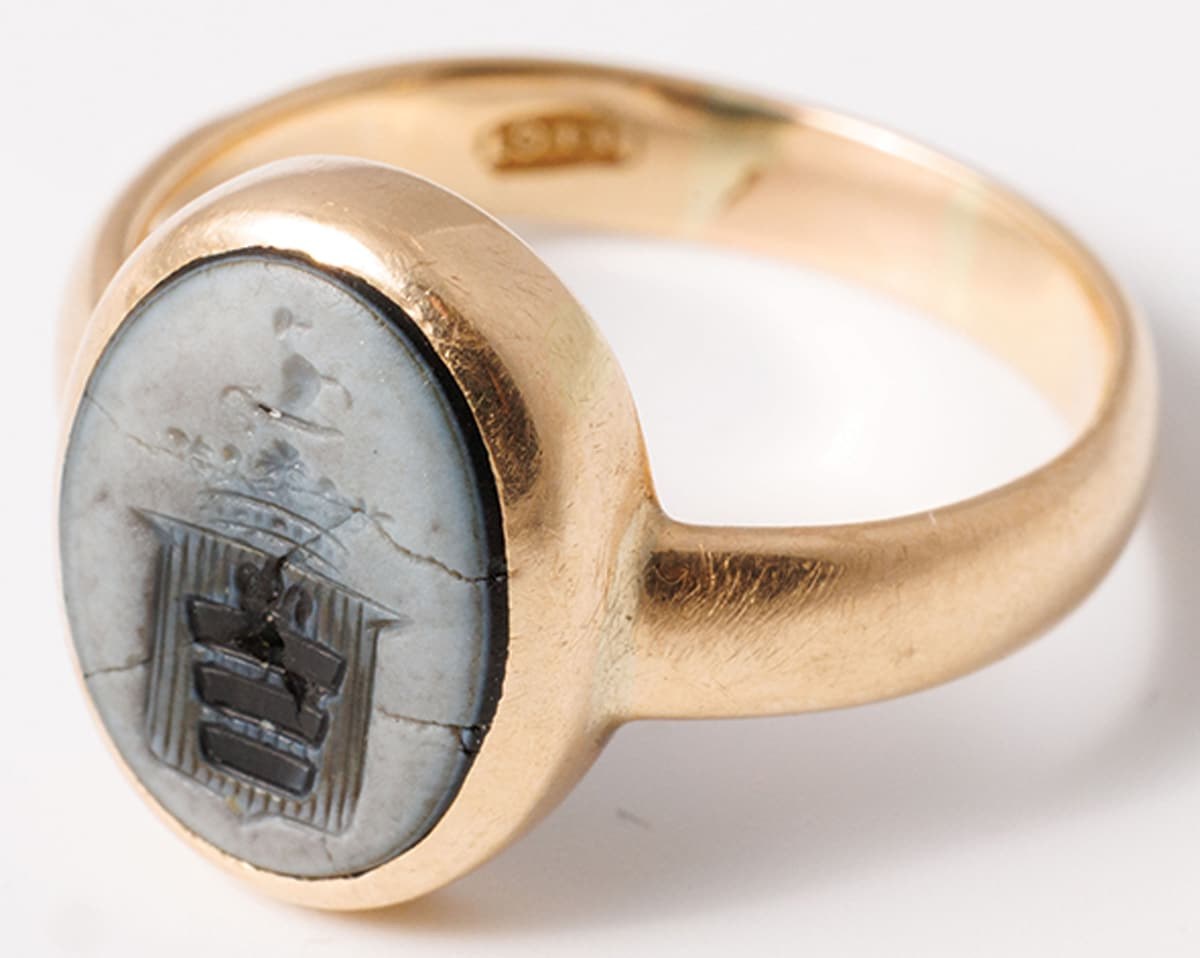
4. Signet ring with the Roch III coat of arms, 18th-century stone, later setting
gold, layered onyx, total weight 4.23 g, size 17 mm
5. Icon, Pantocrator, tempera, wood panel, silver frame, 925 silver; 48 x 38 mm, hallmark: 925
6. Brooch, silver, black onyx, weight 4 g, length 63 mm, hallmark: W, head in a scarf, 3, ZM
7. Brooch in the shape of a Volkswagen Beetle door, England, London, 1990, silver, 925, weight 3.3 g, 28 mm, hallmark: JCB, lion, lion’s head, Q
8. Four family photographs: a, 12 x 17 cm, inscribed “My Uncle Łuszczewski’s Palace and Park”; b, horse-drawn carriage, 5.5 x 8.2 cm, inscribed: Debniki, August 27, 1913; c. a copy of a group portrait from the assembly point for Poles in Anders’s Army, 96 x 132 mm, inscribed: Father Cieński, General Szyszko-Bohusz, Bishop Gawlina; d. copy of an ID photo
Zofia Felicja Anna Przerwa-Tetmajer (née Łuszczewska, coat of arms: Pierzchała, 1933–2009) was a Polish activist and a member of a prominent landowning family. She was the daughter of Bronisław Łuszczewski (1910–1984) and Anna Franciszka, Countess Romer (1906–1936). She was deported with her family in 1940 from Lviv deep into Russia. Her family died during the transport. Zosia was taken in by a Polish family near the Mongolian border. In 1942, she reached a Polish assembly point for Polish orphans near Anders’s Army. After the evacuation, she and other children were sent to New Zealand to live with a foster family. In 1963, her uncle Andrzej Wodzicki found her through the Red Cross. She came to Poland, where she was reunited with her father after many years. She remained in the country. She married Andrzej Włodzimierz Przerwa-Tetmajer (b. 1930) on June 8, 1963, in Wrocław. Her husband, Andrzej, was a descendant of the same branch of the famous artistic and independence-movement family that produced the renowned poet and novelist Kazimierz Przerwa-Tetmajer and the painter Włodzimierz Tetmajer. After her husband’s death in 1970, she emigrated to the United Kingdom. She taught Slavic studies at Cambridge. She often returned to Poland. She died in December 2009 in Warsaw. The urns containing her ashes were interred in the family tomb at the cemetery on Grabiszyńska Street in Wrocław.
Starting price: 5,500
Estimated value: 7,000–8,000. Inquire about this item











Последно разглеждани позиции
Влезте, за да се запознаете със списъка с артикулите
Любими
Влезте, за да се запознаете със списъка с артикулите