


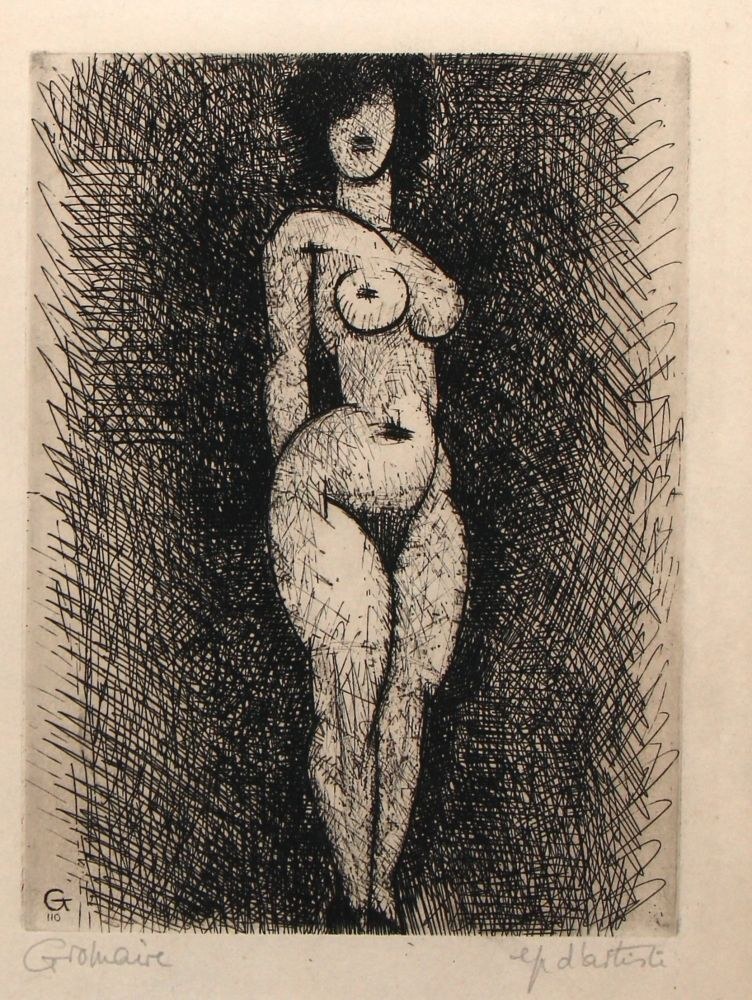
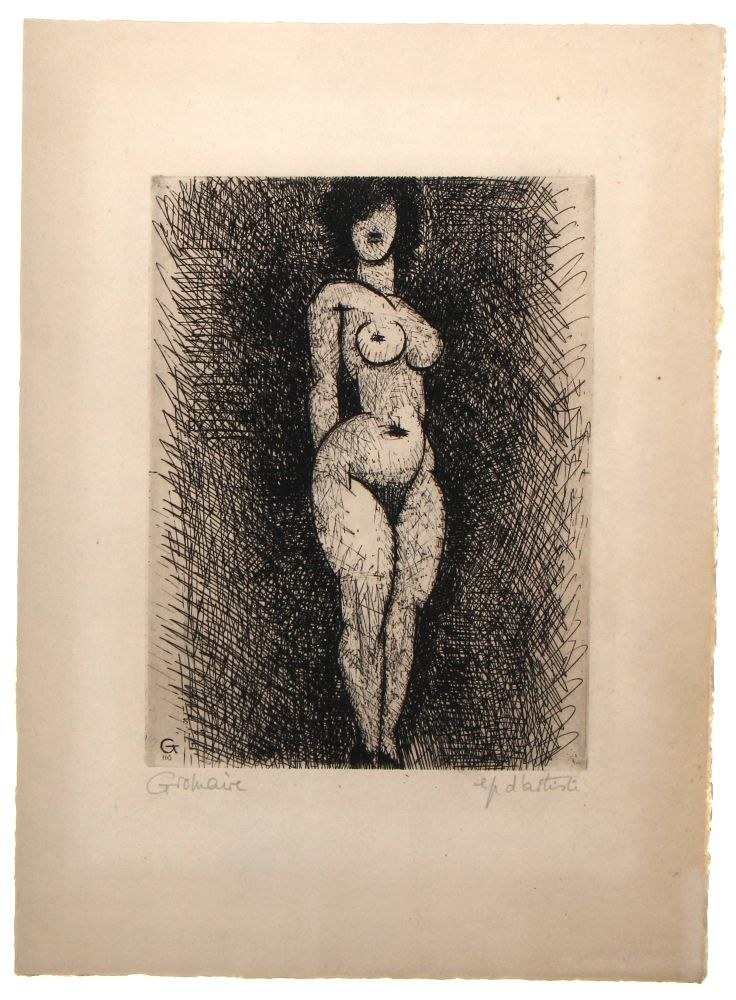
Marcel GROMAIRE (1892–1971) “Standing Nude” (1935),
Etching, signed in the lower left corner, artist’s proof.
Dimensions: 24 x 18 cm, 38.5 x 28 cm (sheet)
Marcel Gromaire (1892–1971) was a painter associated with Socialist Realism and Expressionism. Born in Noyelles-sur-Sambre, Gromaire studied law in Paris, where he first came into contact with artists from Montparnasse. Early on, Gromaire was influenced by painters such as Henri Matisse, Paul Cézanne, and later Fernand Léger. Gromaire served during World War I, from 1912 to 1916. His wartime experiences had a significant impact on his artistic development.
Upon his return to Paris in 1919, he initially worked as a film critic. A year later, Gromaire met the collector and patron Dr. Girardin, who supported his artistic career for the next several decades. His style during this period was influenced by German Impressionism, Cubism, and Flemish art. These works, largely figurative and realistic, were characterized by somber tones and expressive brushstrokes. Although war was his primary subject, he also painted portraits and female nudes.
In 1933, the artist had a retrospective at the Kunsthalle de Baie. In 1937, he was invited to decorate the Sèvres porcelain factory pavilion at the World’s Fair in Paris.
In 1950, Gromaire moved to the United States, where he received the Carnegie Award. In 1954, he was made a Commander of the Legion of Honor. Gromaire also taught at the École Nationale supérieure des Beaux-Arts and received the Grand Prix National des Arts.
Today, his works are held in prestigious collections around the world, including the Art Institute of Chicago, The Museum of Modern Art in New York, the Réunion des Musées Nationaux in France, and the Harvard University Art Museum.











Последно разглеждани позиции
Влезте, за да се запознаете със списъка с артикулите
Любими
Влезте, за да се запознаете със списъка с артикулите