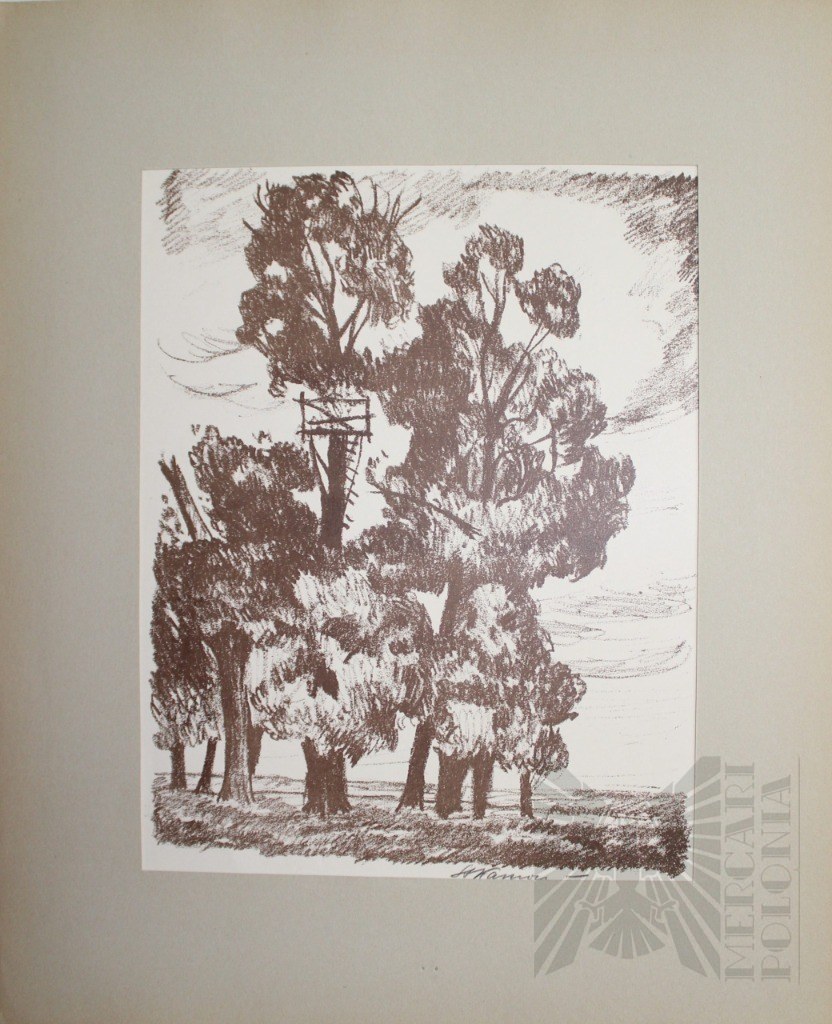
Stanislaw Kamocki (1875 - 1944), Observation post II,1934
original autolithography, signed in pencil, p.d. "St.Kamocki", 31 x 22 cm in light original passe - partout, dated.
The work comes from: "Portfolio of Autolithographs of Legionary Artists Issued in the Twentieth Anniversary of the Armed Deed of the Legions 1919-1934".
The portfolio was published in 1934 in Cracow by the Section of Legionary Artists and accompanied the Historical Exhibition of the Polish Legions at the National Museum in Cracow. The exhibition was later also shown in other cities, including Lviv. Also present at the exhibition were Ignacy Pinkas' Legion-themed works, most of which were unfortunately lost during World War II. Some are known from photographs, while those that survived, such as the portrait of artilleryman Tadeusz Muller, are in the National Museum in Cracow. The portfolio contains 15 lithographs by 10 artists, including Ignacy Pinkas. They include works by Stanisław Dąbrowski, Kazimierz Dzieliński, Stanisław Janowski, Franciszek Jaźwiecki, Stanisław Kamocki, Tadeusz Korpal, Tadeusz Seweryn, Wincenty Wodzinowski and Leon Wyczółkowski. The works show portraits of soldiers, combat and life in the trenches, war cemeteries and symbolic scenes. Most are signed in pencil by the authors. All works were created especially for the exhibition in question.
Autolithography - a lithograph, created by the author - a graphic artist directly on the lithographic stone. In the 19th century, there were many lithographic workshops in which drawings created by artists were transferred by hand by artisan-lithographers (in mirror reflection) onto lithographic stones. Such lithographs lost an important feature of an artist's work - the trace of the creator's hand. Therefore, at the end of the 19th century, artist-engravers (in Poland, among others, Witold Wojtkiewicz, Leon Wyczółkowski and Kazimierz Sichulski) began to create autolithographs, applying the image with lithographic ink or greasy crayon directly on the stone. At the same time, they had to remember that - as in the case of, for example, woodcuts - the image on the stone, including any inscriptions, would appear on the print in a mirror image.