


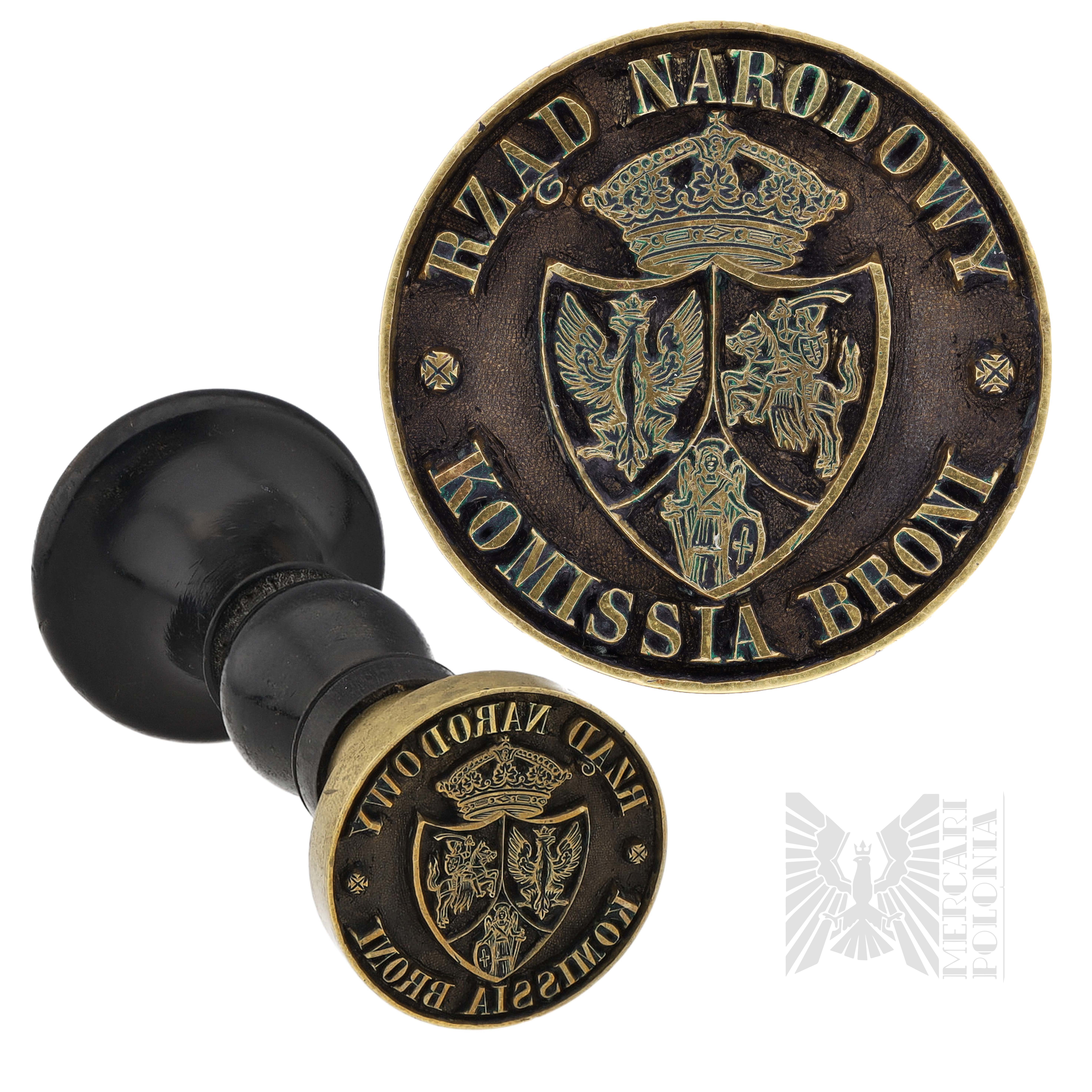
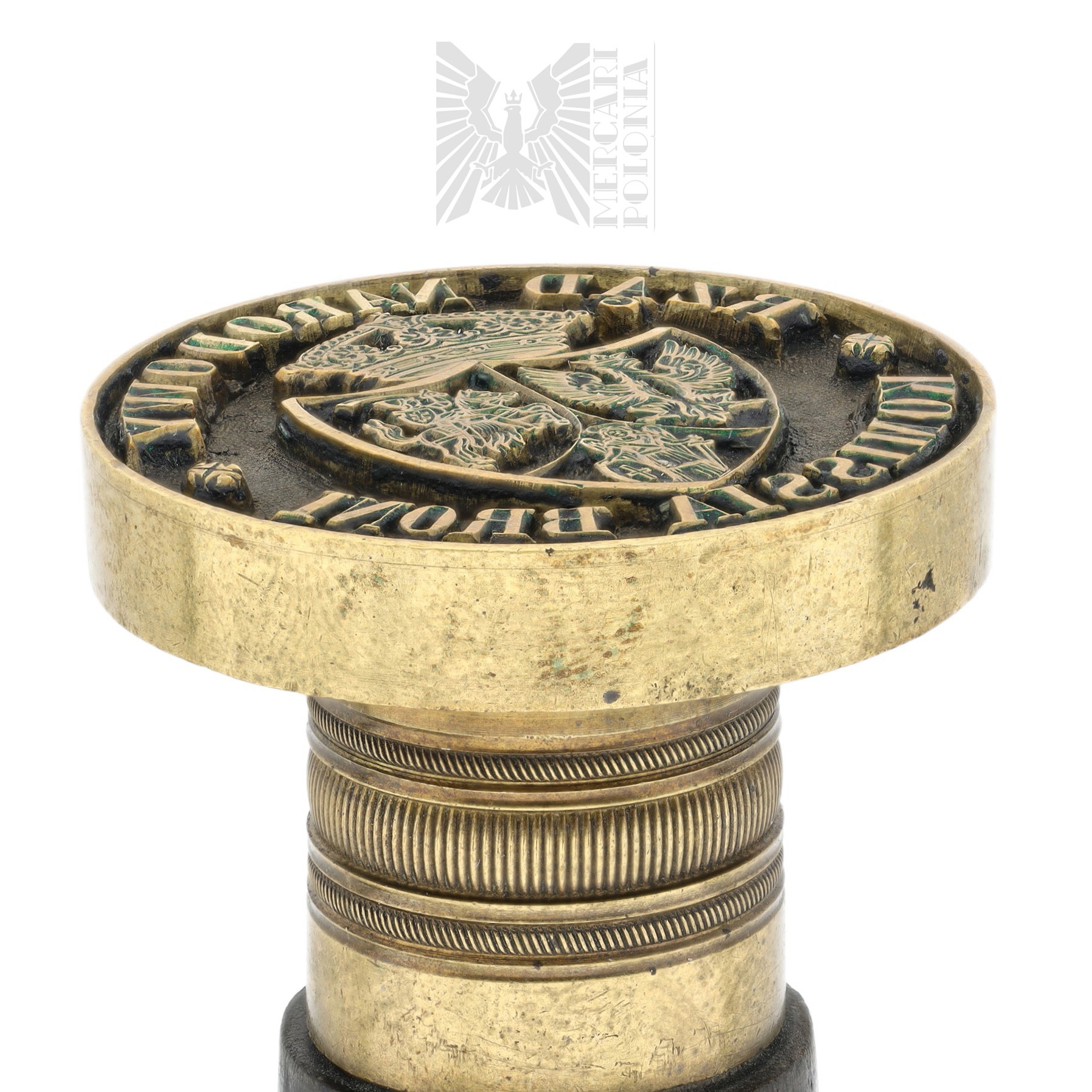
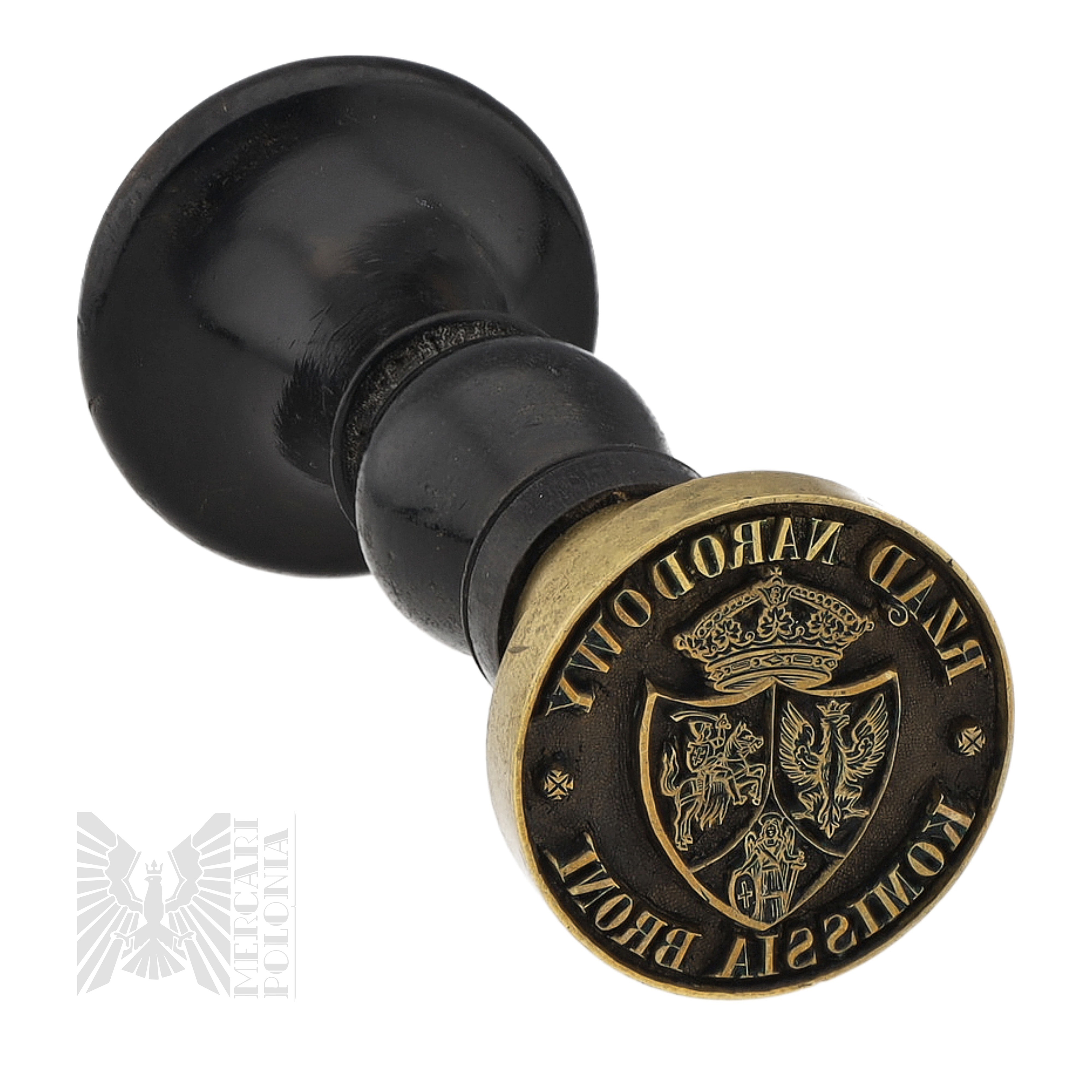
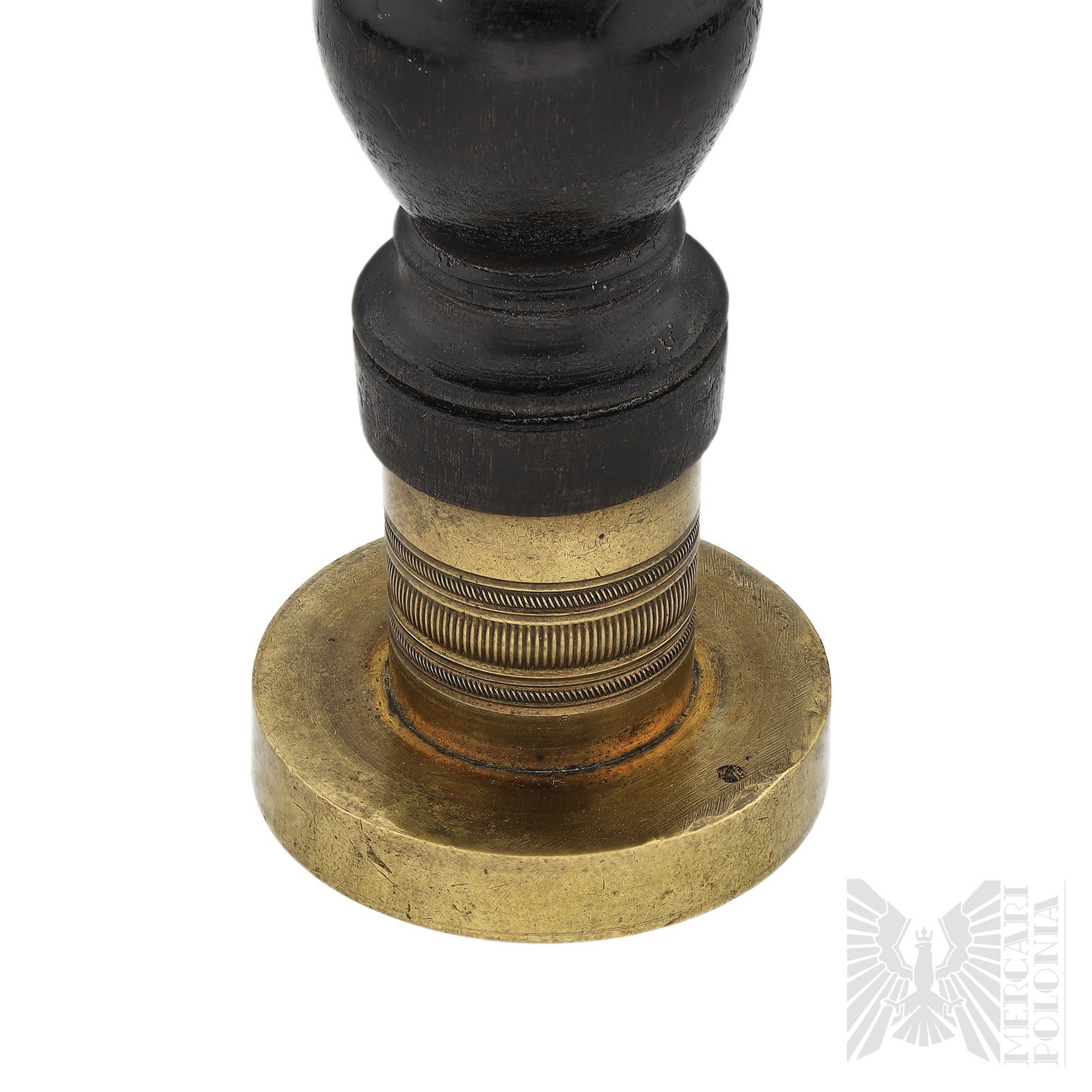
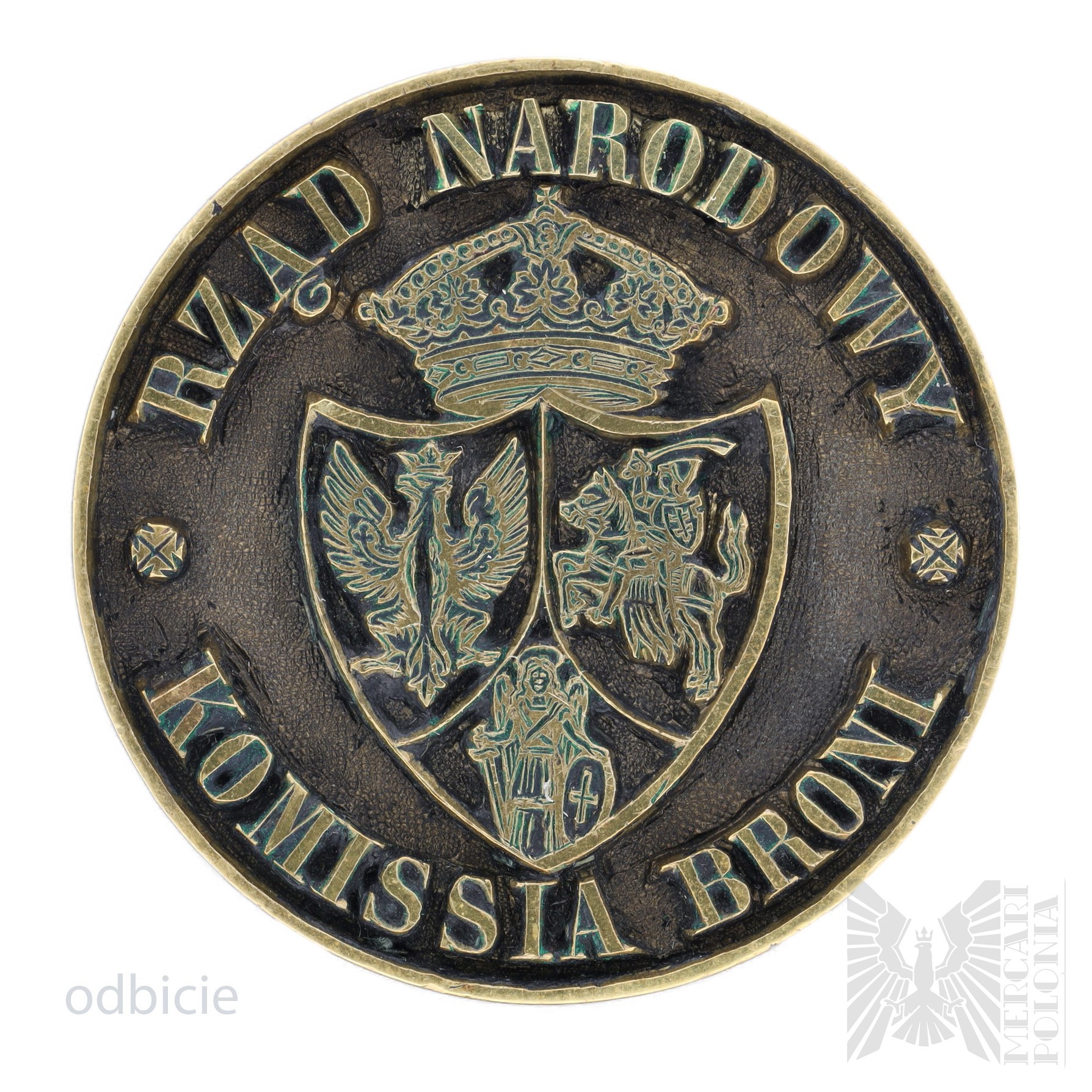
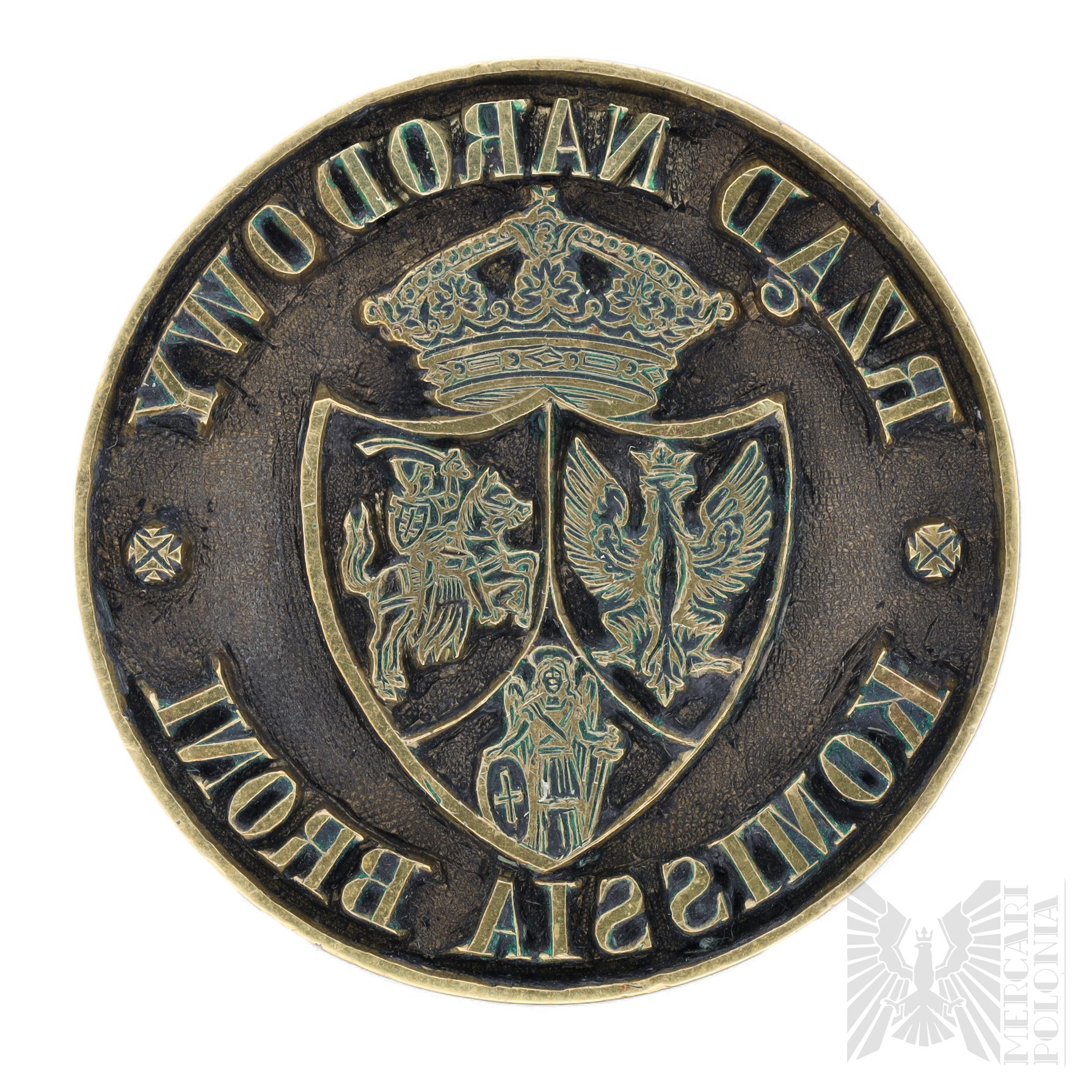
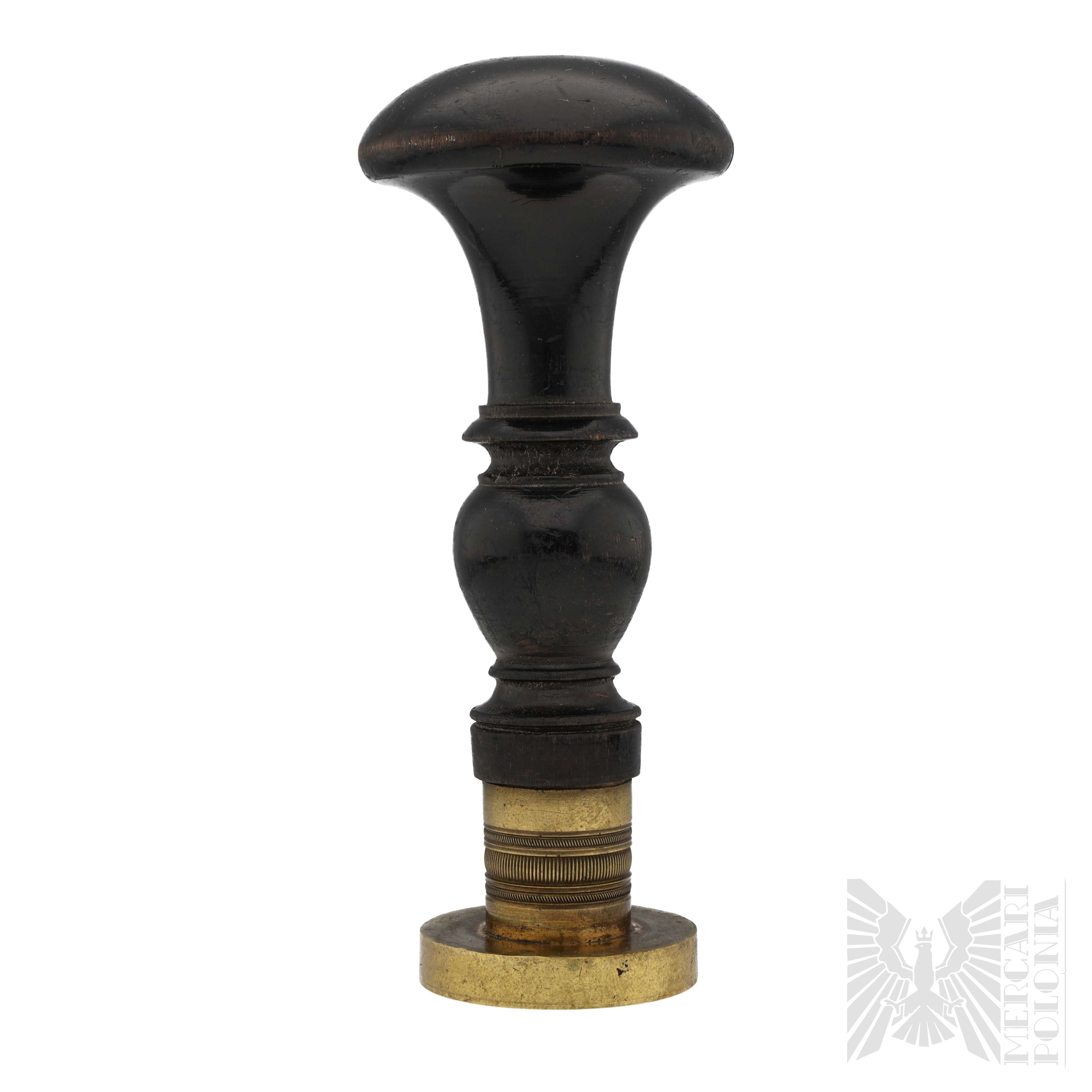
A unique stamp piston from the January Uprising period made around 1863 for a representative of the Insurgent National Government, the Arms Commission. Probably the Arms Commission in Liège which was in charge of the mission to obtain arms for the January Insurgents.
Brass stamp piston, 36.6mm in diameter, ebony or black stained wooden handle. Total height 119.7mm. Round piston in the center a three-field coat of arms surmounted by a closed crown, symbolizing Poland, Lithuania and Ruthenia, depicting an eagle without a crown holding a cross and a sword, a horseman with a shield and a sword (Pogoń Litewska) and an archangel with a sword (Ruthenia). Around the coat of arms the inscription "National Government, Komissia Broni" is inscribed.
"The National Government, preparing thus for a general uprising, was concerned about sufficient preparation of firearms. In every letter, whether to Prince Czartoryski in Paris or to the arms commission in Liège, it constantly insisted on the purchase and shipment of arms. The arms commission reported to the Government in early August that it was having difficulty in buying and shipping arms, since shipments are so often taken by the Prussian authorities before they reach the border that merchants are now unwilling to sell and ship arms at their own risk.
This is because until now, purchased weapons, in accordance with the National Government's decree of April 26 b., were deposited only at the place of purchase, and the final due was paid only after it was ascertained that they had been delivered abroad and handed over to the proper agent. Now the merchants demanded payment of the full amount due immediately at the place of purchase. The National Government, in response to these objections of the arms commission at Liège, wrote in a rescript dated August 11 that it had never forbidden the purchase of arms and transportation at its own risk; that the National Government feels too strongly about the need to supply the nation with arms to have put up any obstacle.
That, however temporarily short of cash, the Government would try to supply the committee with adequate funds, and that all proceeds from the $40-million forced loan the Government was allocating for the purchase of arms. When again the arms commission made some objections and presented some difficulties, the National Government again wrote in a rescript dated September 1: "It insistently repeats that contracting for arms at the risk of the National Government not only does not forbid, but on the contrary, that if the acquisition of arms on other terms should delay their transports, one should rather abandon the pursuit of apparent advantages than omit even the slightest opportunity to supply the country with arms, Indeed, the difficulties in supplying arms were extraordinary. Prussia developed great vigilance and held entire transports, often at the border itself. A significant number of weapons, already transported across the border, were taken by the Muscovites. I can confidently calculate that only, and at most, one rifle out of 15 purchased reached the hands of soldiers.""".
https://journals.pan.pl/publication/107118/edition/92804/teka-komisji-historycznej-2013-vol-x-polskie-zakupy-broni-w-liege-podczas-powstania-styczniowego-idesbald-goddeeris-ranson-hanne?language=pl
Bibliography: Józef Kajetan :Pamiętniki o powstaniu styczniowem. Volume 2", Warsaw 1925
General condition as in photos.










Последно разглеждани позиции
Влезте, за да се запознаете със списъка с артикулите
Любими
Влезте, за да се запознаете със списъка с артикулите