


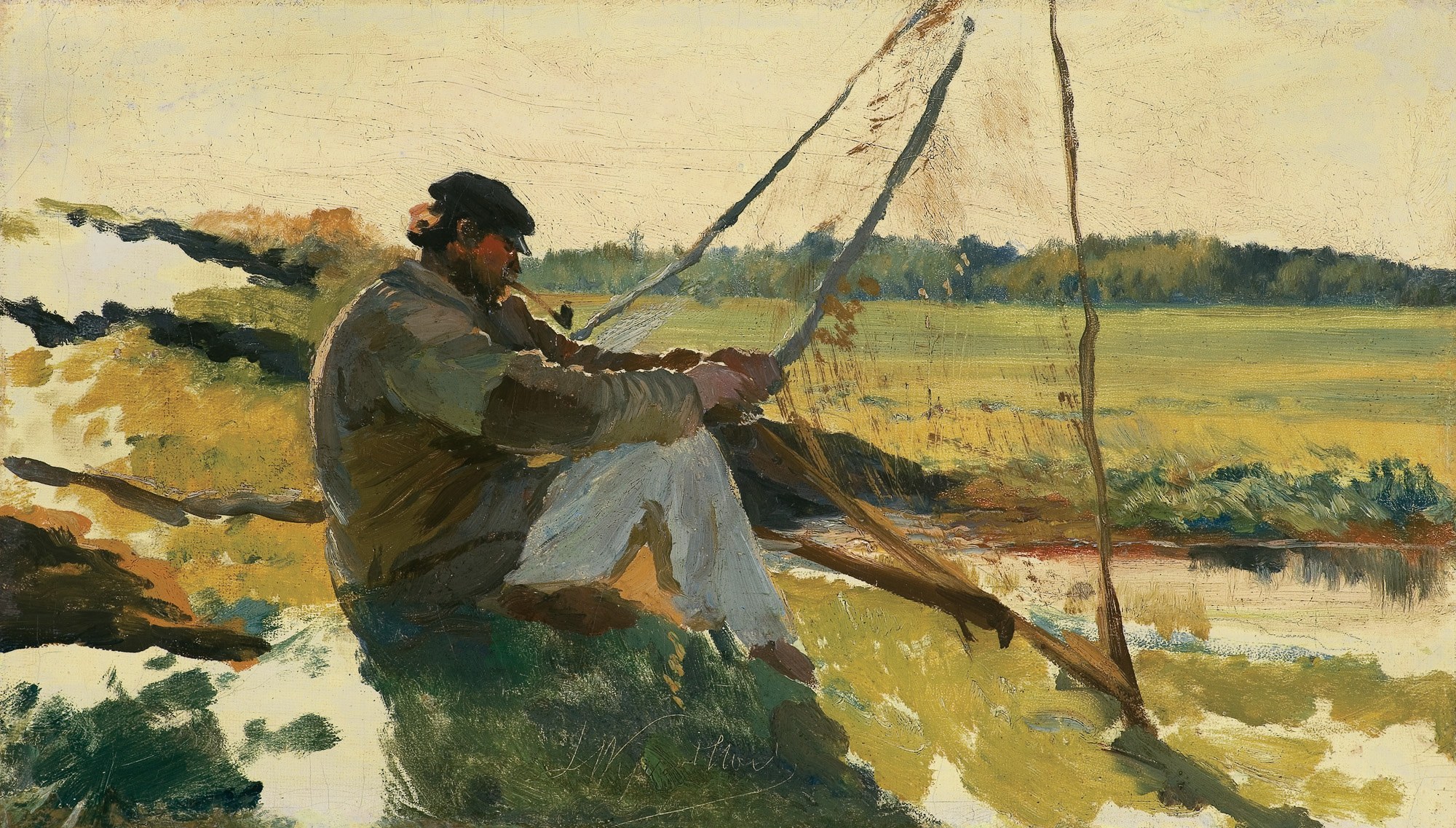
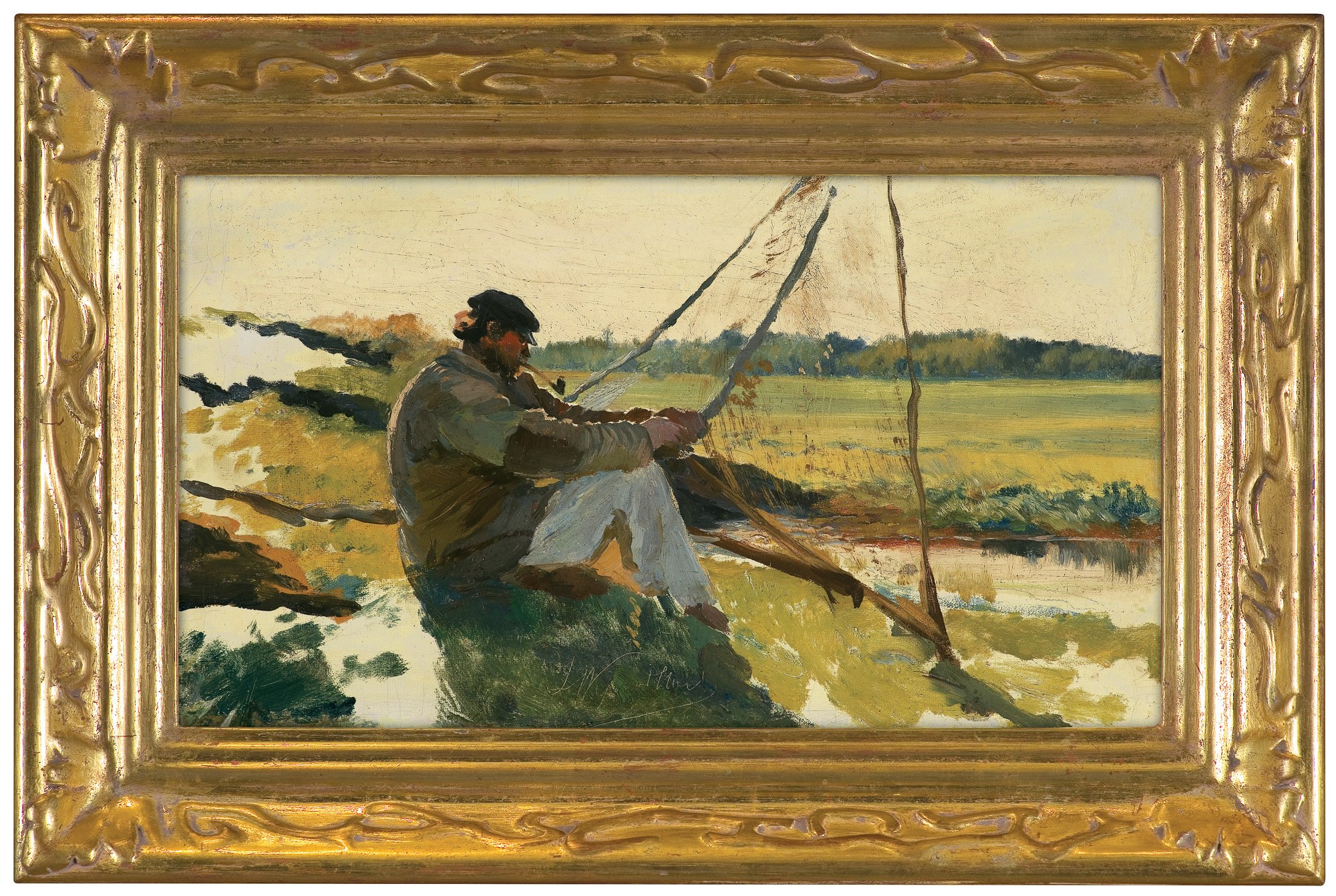
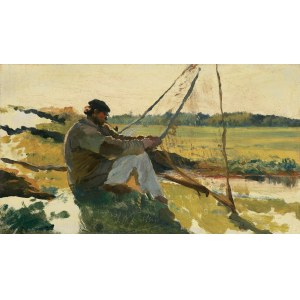
19.5 x 33.8 cm - oil on canvas, mounted
signed at the bottom center: L. Wyczółkowski
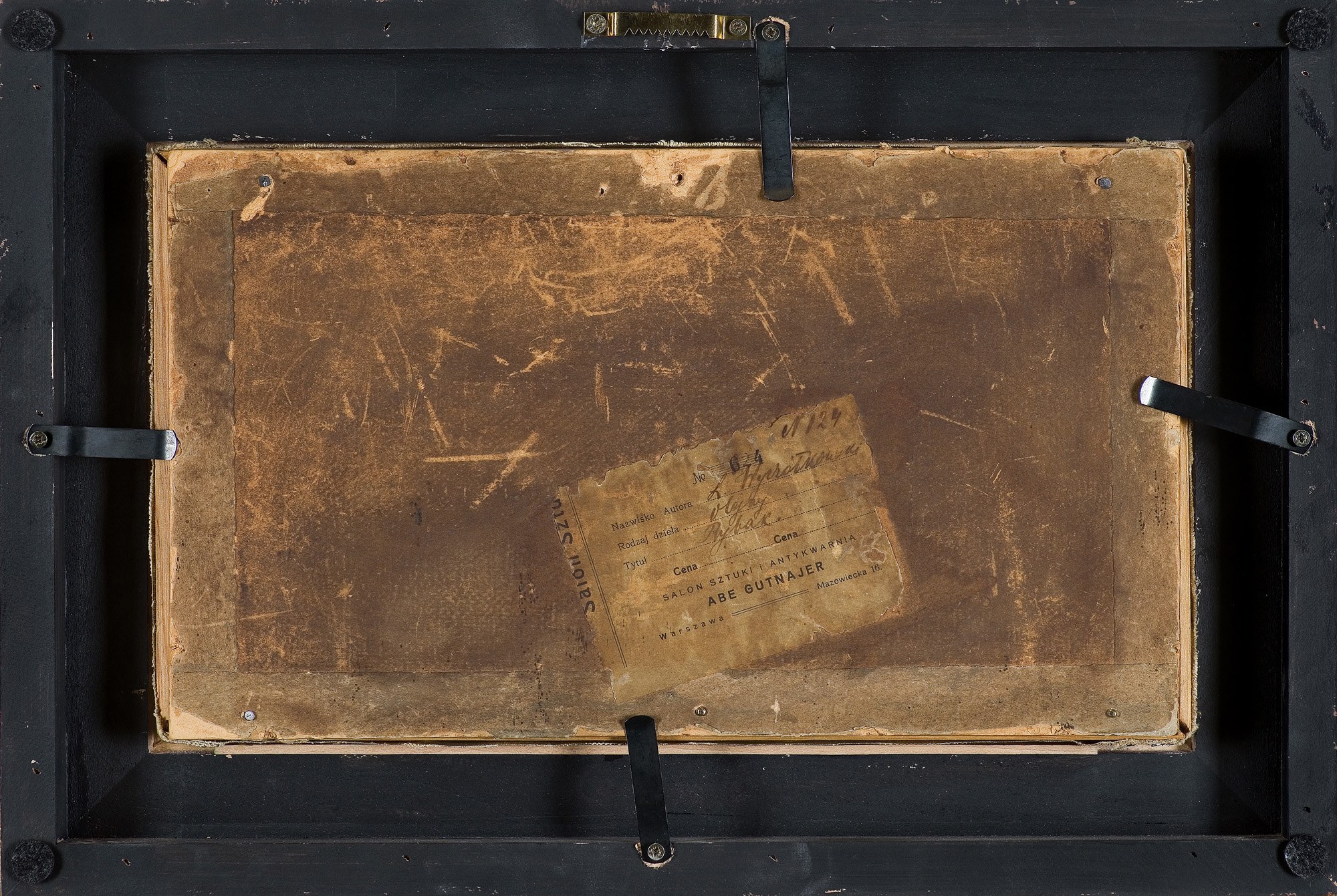
On the back, a label (print, stamp, ink): N 124 | No. 624 | Artist’s Name: L. Wyczółkowski | Medium: oil | Title: The Fisherman | Price: ... | Price: ... | ART GALLERY AND ANTIQUE SHOP | ABE GUTNAJER | Warsaw, 16 Mazowiecka St.
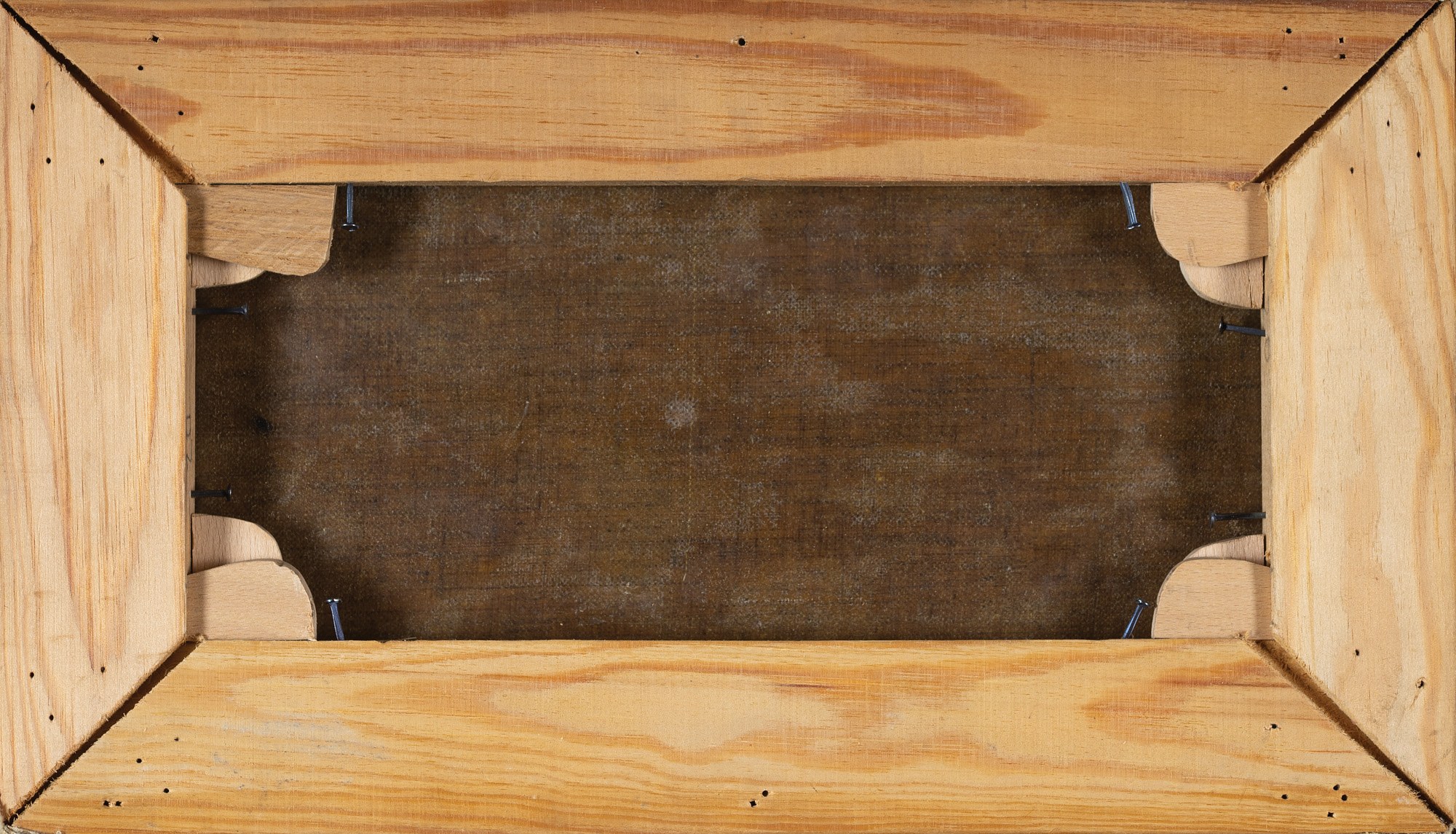
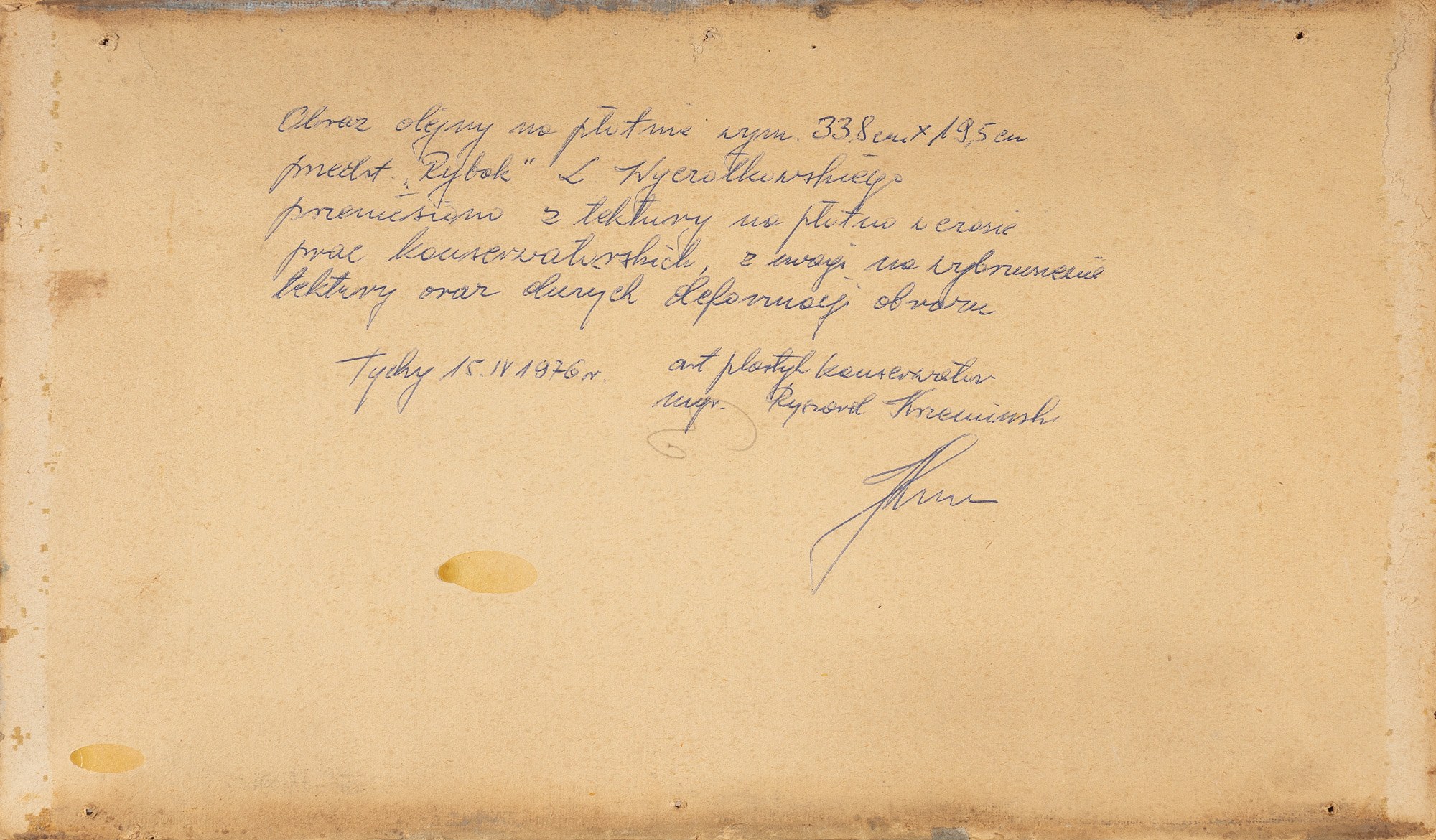
On the inside of the back panel (ballpoint pen): Oil painting on canvas, dimensions 33.8 x 19.5 cm, | depicting... “The Fisherman” by L. Wyczółkowski, | transferred from cardboard to canvas during | conservation work due to bulging | of the cardboard and significant deformation of the painting. | Tychy, April 15, 1976, | artist and conservator | Ryszard Krzemiński, M.A. |
[signature].
The painting has been reproduced and mentioned in:
– Abe Gutnajer’s Art Gallery and Antique Shop (catalog), Warsaw 1926, unnumbered p. 5, item 52 (Fisherman);
– Ryszard J. Kluszczyński, From Malczewski to Wyspiański, published by WBC, 2018, p. 36;
– Ryszard J. Kluszczyński, The Great Book of Polish Painting, WBC, 2019, p. 184;
– Ryszard J. Kluszczyński, The Art of Young Poland, WBC, Kraków, 2020, p. 139, ill. 204;
– Ryszard J. Kluszczyński, Leon Wyczółkowski, published by WBC, Kraków, 2022, p. 8;
– Ryszard J. Kluszczyński, A History of Polish Painting: From Gothic Panel Painting to Stefan Gierowski, WBC, Kraków, 2022, p. 260.
Paintings depicting fishermen are one of Wyczółkowski’s most famous series. Of all the works attributed to this series, only a few have survived to this day, making the painting offered here a truly unique collector’s item.
A different character is evident in this previously unknown portrait of a fisherman sitting on the riverbank with a sack in his hand. It draws attention with its cool color palette, dominated by shades of yellow and light green, as well as the masterful depiction of the riverside thickets. Light falling from the left illuminates the man’s back and the patched sleeves of his shirt, while his dark, weather-beaten face is bathed in partial shadow; his cap and pipe—familiar to us, for example, from *The Sower* (1896)—and his loose, whitish trousers complete the peasant’s attire. This freely painted study was created en plein air, which explains its distinctly Impressionist character.
Ryszard J. Kluszczyński, Leon Wyczółkowski..., p. 8.
Wyczółkowski’s trip to Podolia and the Kiev region in 1883 marked a turning point in his artistic career, associated with his rejection of academic norms in favor of direct observation of nature. His ten-year stay in Ukraine and his subsequent exposure to Claude Monet’s Impressionism reinforced the artist’s pursuit of luminist techniques and his exploration of light-saturated color. The Impressionist period in Wyczółkowski’s work was very brief, lasting only a few years. However, the works created during this time place him at the forefront of the transformations taking place in Polish painting at the time. Impressionism as interpreted by Wyczółkowski was not merely a faithful imitation of the French masters, as Marian Turwid aptly put it: Wyczółkowski emerged from realism, and by studying light and color, he ceased to be a realist. The experiences of the Impressionists and his own studies in the open air only enriched the realist’s technique, just as his later studies of Japanese printmaking taught him an economy of expression that at times reached an impressive level of synthetic composition (M. Turwid, cited in: Museums of Kuyavia and Pomerania. Bydgoszcz. Leon Wyczółkowski, published by Margrafsen, Bydgoszcz 2012, p. 32).
Leon Wyczółkowski (Huta Miastkowska near Siedlce 1852 – Warsaw 1936) —painter, printmaker, and educator—was one of the most outstanding Polish artists working at the turn of the 19th and 20th centuries. He began his artistic studies in the Drawing Class in Warsaw under the guidance of Wojciech Gerson and Aleksander Kamiński (1869–1873), then continued them at the Munich Academy of Fine Arts under Aleksander Wagner (1875–1877), in Kraków under Jan Matejko (1877/78), and during two trips to Paris (1878 and 1889). After completing his studies, he settled in Lviv and later moved to Warsaw. He spent the years 1883–1893 traveling throughout Ukraine and Podolia. In 1895, he moved to Kraków after being appointed a lecturer at the local School of Fine Arts. In the following years, he traveled extensively—to Italy, France, Spain, the Netherlands, and England. He was among the founding members of the “Sztuka” Society of Polish Artists. He exhibited extensively both in Poland and abroad. He spent the years 1929–1936 in Poznań and Gościeradz, commuting to Warsaw, where (beginning in 1934) he headed the Department of Graphic Arts at the Academy of Fine Arts. He painted landscapes, portraits, genre scenes, still lifes, and flowers. He readily employed the techniques of pastel and watercolor; he was an outstanding printmaker and also worked in sculpture.










Последно разглеждани позиции
Влезте, за да се запознаете със списъка с артикулите
Любими
Влезте, за да се запознаете със списъка с артикулите