


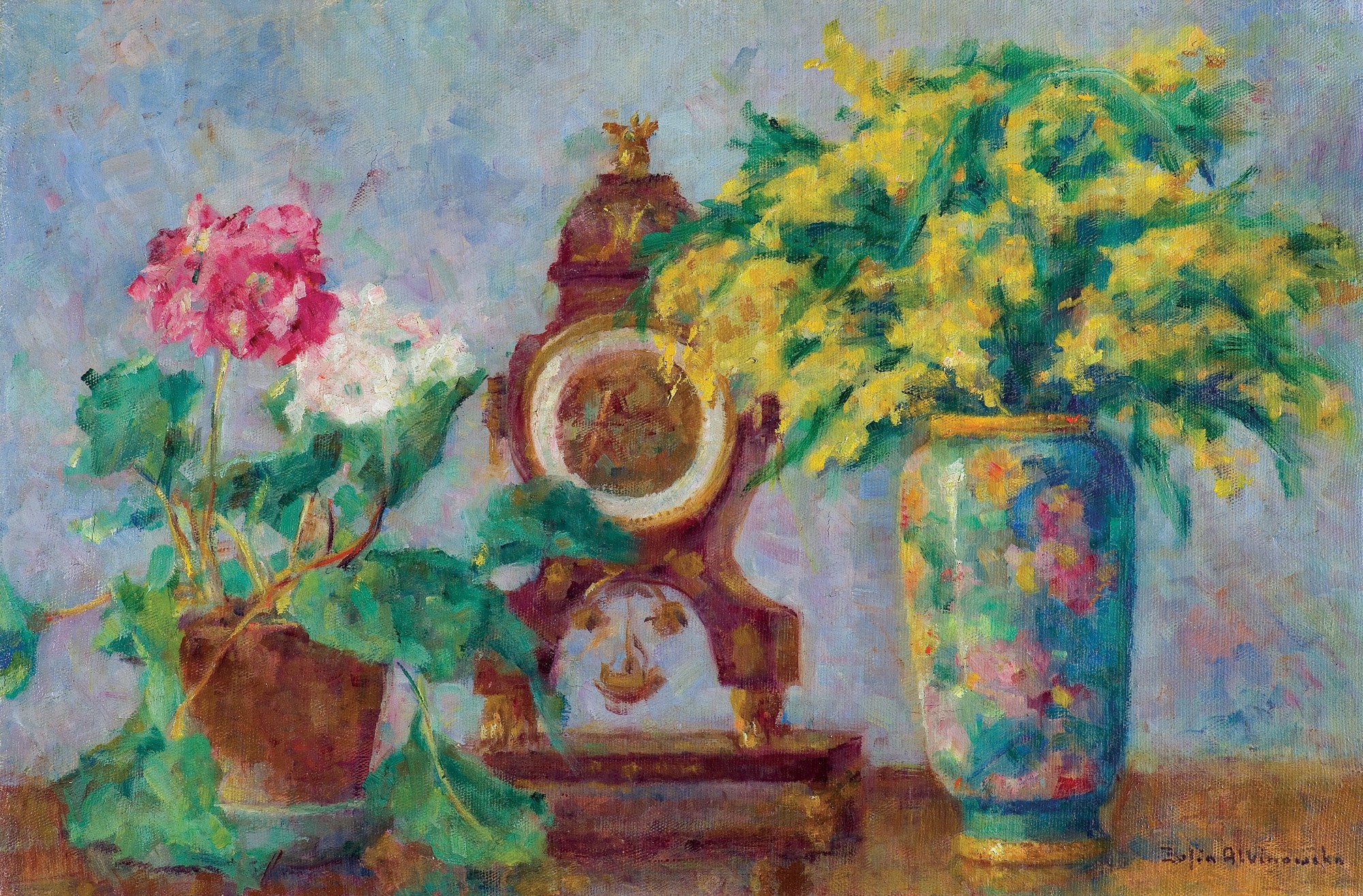
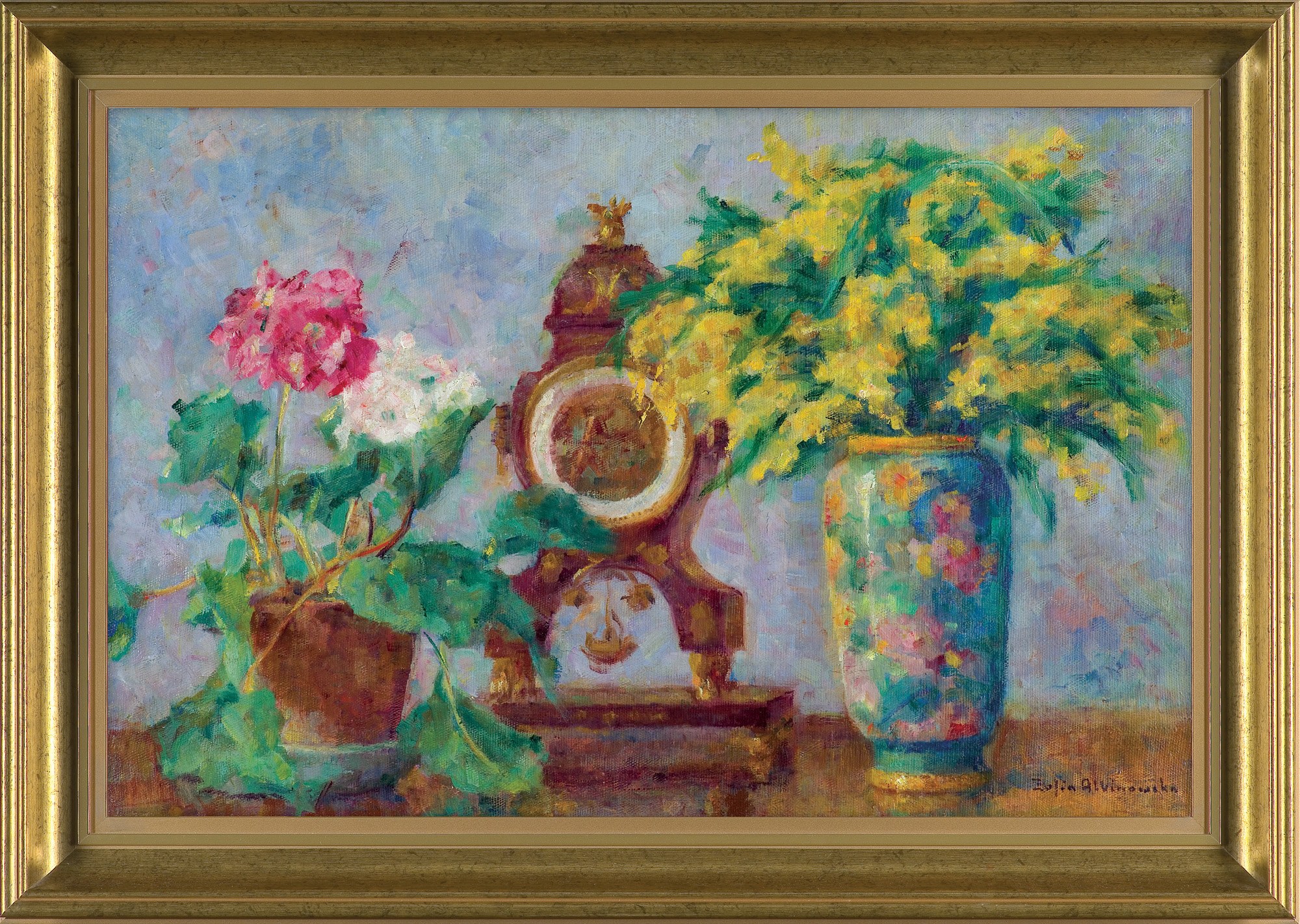
39.5 x 60 cm - oil on canvas
signed lower right: Zofia Albinowska
♣ Droit de suite: ♣ A fee resulting from the right of the artist and her heirs to receive remuneration in accordance with the Act of February 4, 1994, on Copyright and Related Rights (droit de suite) will be added to the purchase price.
Zofia Albinowska began her studies in painting and drawing in Vienna—in 1901 at H. Strehblow’s private school, and from 1902 at the school of F. Hohenberg and F. Kruis. From 1906 to 1909, she was in Paris, initially studying at the Académie Colarossi and, from 1906, at the École Nationale des Beaux-Arts, where she also studied printmaking. It was during this time that she met Olga Boznańska, whose advice and guidance she eagerly sought. From Paris, she traveled to England, Belgium, the Netherlands, and Italy. From 1909 to 1912, she studied again in Vienna, and in 1912 she settled in Lviv and began studying mathematics at the Polytechnic and the University. During World War I, she traveled to Vienna and Lowrana. In 1922, she married W. Minkiewicz, a professor at the Lviv Polytechnic. In 1926, she visited Sicily. She was a very active person—from 1917 to 1939 she served as president of the Association of Polish Women Artists, and from 1922 to 1939 she was vice president of the Lviv Society of Friends of Fine Arts (TPSP). She exhibited extensively—beginning with her debut in 1903 in Vienna, repeatedly at the TPSP in Lviv and Kraków, at the TZSP in Warsaw (honorable mention in 1930, bronze medal in 1932, 1935: silver medal), as well as in Łódź, Poznań, and Bydgoszcz. She participated in international exhibitions of women artists: in 1910 in Prague, in 1937 in Paris, and in 1939 in New York. She also had several solo exhibitions—in Lviv, Kraków, and Warsaw. After 1945, she remained in Lviv, continuing to work extensively. In 1956, she held an exhibition of paintings and prints, and in 1972, the Lviv Art Gallery organized a major posthumous exhibition of her works. In her earlier creative period, Albinowska enjoyed painting portraits (e.g., Portrait of L. Staff, 1913; Self-Portrait), characteristic figures (Breton Women, Fisherman, 1908), landscapes, and still lifes, which later—after 1920—became the main subject of her paintings. She painted flowers, stylish furniture, antique porcelain, rugs, and mirrors filling serene, softly lit interiors. The artist’s paintings are distinguished by their high level of painterly skill, thoughtful composition, and subtle color palette.













Последно разглеждани позиции
Влезте, за да се запознаете със списъка с артикулите
Любими
Влезте, за да се запознаете със списъка с артикулите