


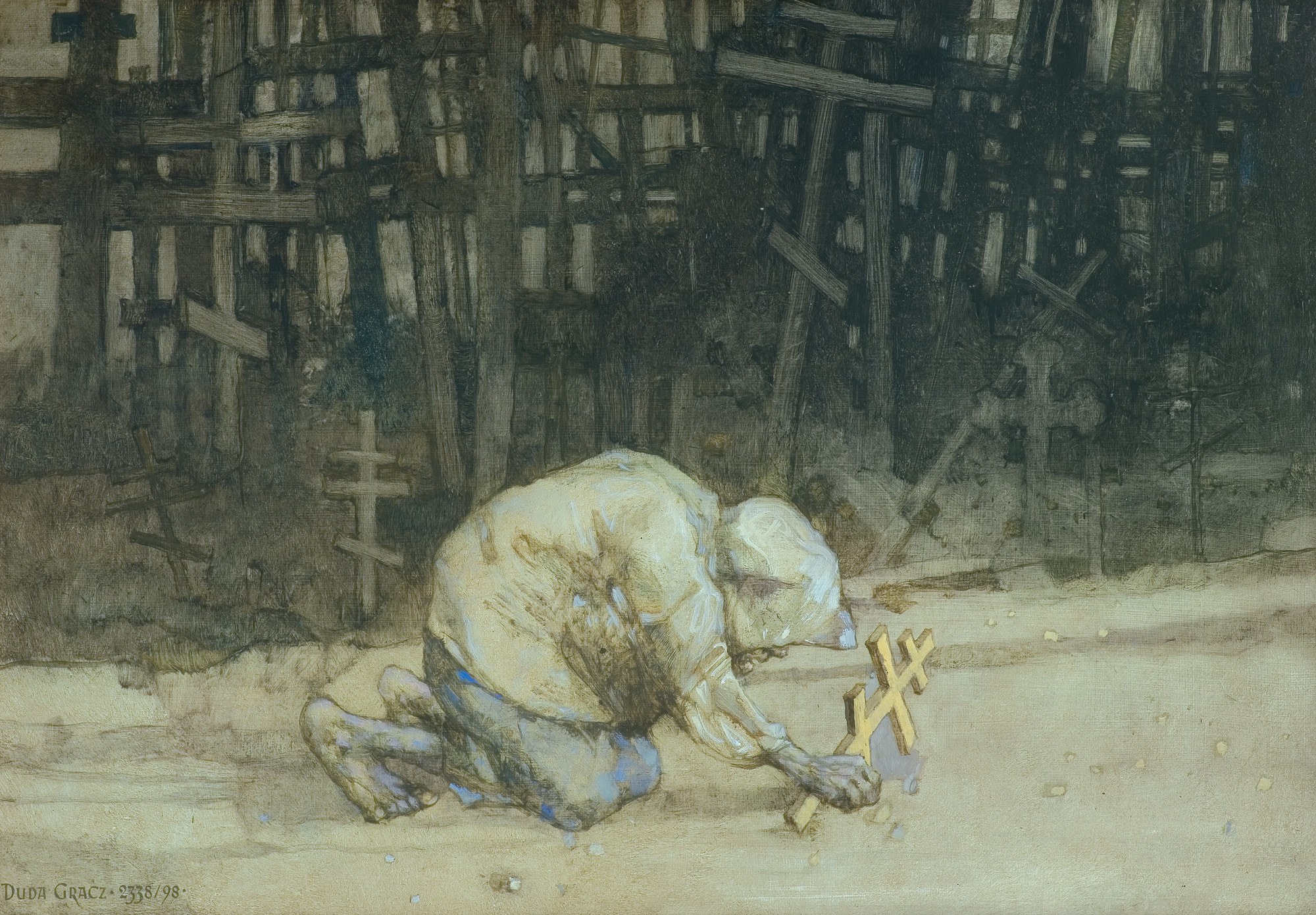
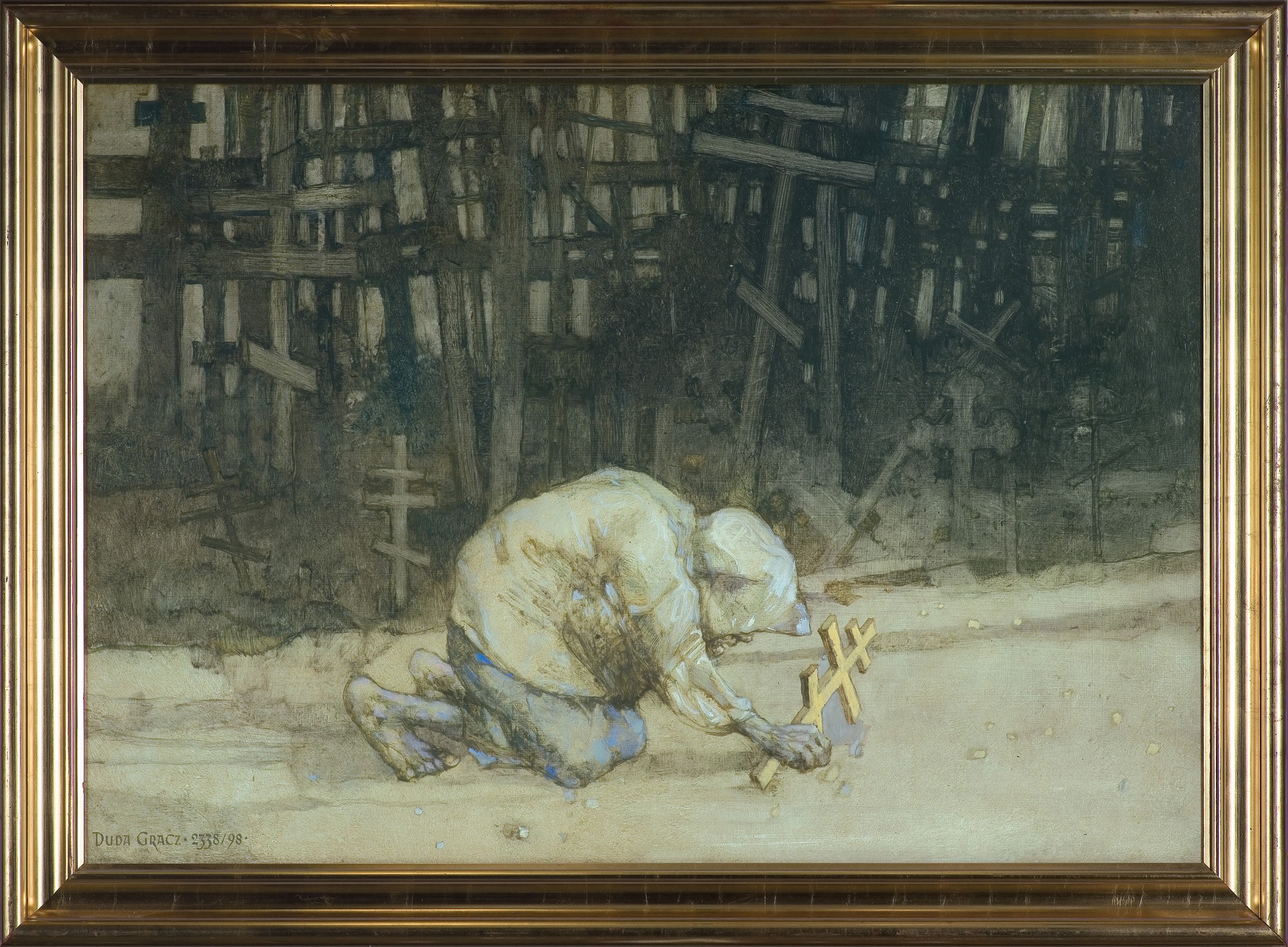
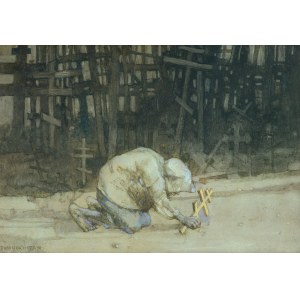
69 x 100 cm - oil on fiberboard
signed lower left: DUDA GRACZ . 2338/98 .
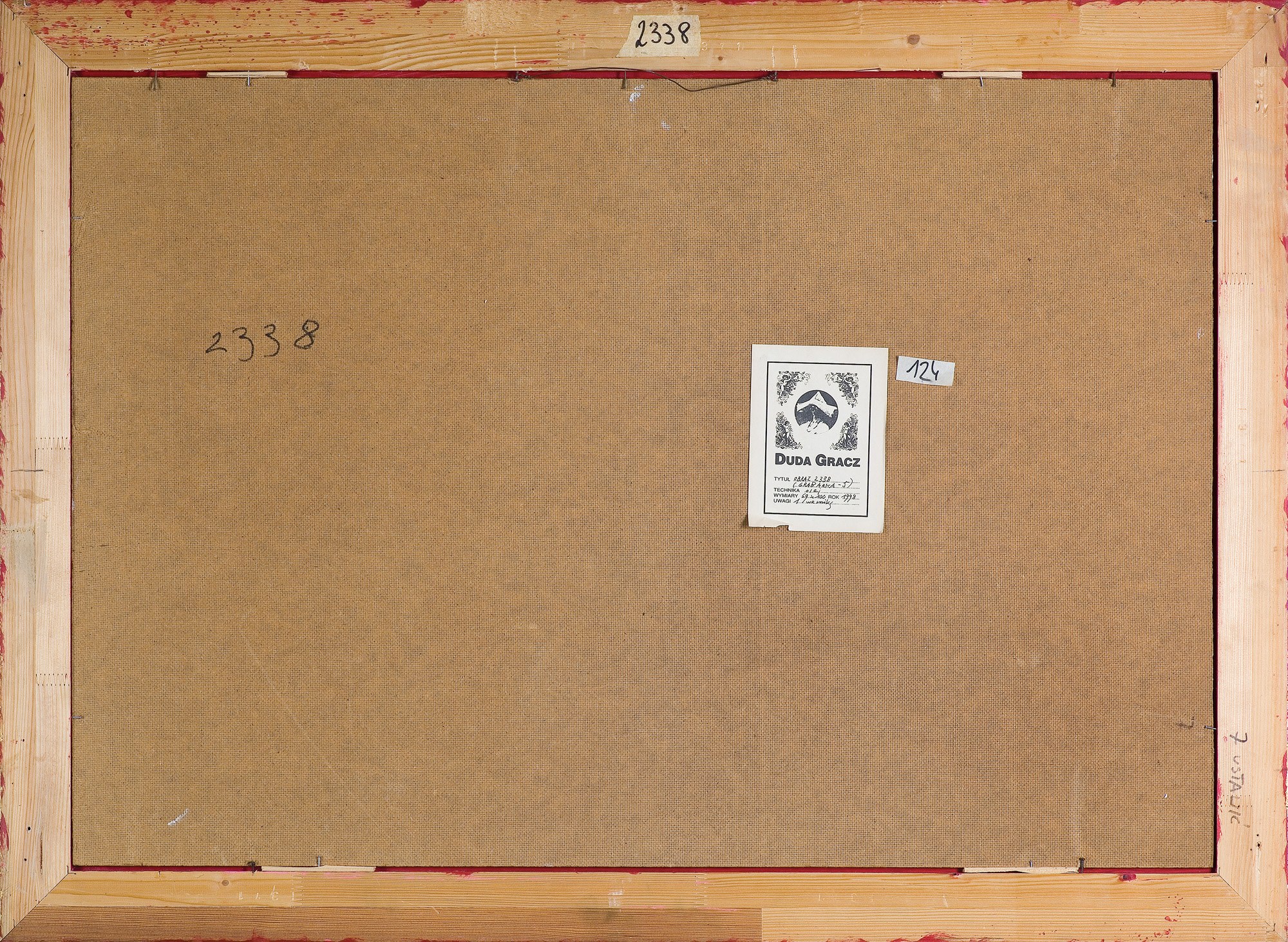
On the reverse, in the center of the board, there is an artist’s label with the painting’s details; next to it is a label with the number 124; written in marker on the left side: 2338; the number is repeated on the top rail of the frame.
♣ Droit de suite: ♣ An additional fee will be added to the Purchase Price, resulting from the right of the artist and his heirs to receive compensation in accordance with the Act of February 4, 1994, on Copyright and Related Rights (droit de suite).
Jerzy Duda Gracz (Częstochowa 1941 – Łagów 2004) – painter, draftsman, set designer, educator. He received his diploma from the Academy of Fine Arts in Kraków, Faculty of Graphic Arts in Katowice, in 1968. From 1976 to 1982, he was a lecturer at that institution, and later a professor at the University of Silesia in Katowice. He also taught at the European Academy of Arts in Warsaw (1992–2001).
His painting is characterized by technical virtuosity and attention to detail. He practiced art within a broadly defined realist tradition, featuring a dominant tendency toward the deformation of figures and the grotesque. He created a world of expository nature, employing the language of journalism and allegory. He is the author of several major works, including the ceiling painting “The Transfiguration” in the church in Toporów (1995) and the “Golgotha of Jasna Góra” series at the Pauline Monastery in Częstochowa (2000/2001).
The artist has held over 180 solo exhibitions in Poland and abroad (including in Berlin, London, Paris, Moscow, Rome, Vienna, Florence, Düsseldorf, Chicago, New Delhi, Munich, New York, and others). He has participated in approximately 300 nationwide exhibitions and international presentations of Polish art. He represented Poland, among other events, at the 41st Venice Biennale in 1984, at the 20th and 21st World Art Fairs in Cologne in 1986 and 1987, and at EXPO ’92 in Seville.
Jerzy Duda Gracz’s paintings are held in the collections of the National Museum in Warsaw, Kraków, Poznań, Wrocław, and Gdańsk; the Jagiellonian University Museum at Collegium Maius in Kraków; the Museum of the Earth of the Polish Academy of Sciences in Warsaw, in the art collection at Jasna Góra in Częstochowa, and in other regional and municipal museums, as well as in private collections, including those of W. Ochman and W. Fibak; abroad—in the Uffizi Gallery in Florence, the Pushkin Museum in Moscow, the Ghent City Museum, the “BAWAG” Foundation in Vienna, and the Vatican Collection, as well as in galleries and collections in Austria, Belgium, the Czech Republic, Denmark, France, the Netherlands, Israel, Japan, Canada, Mexico, Norway, Russia, Sweden, Switzerland, the United States, Venezuela, the United Kingdom, Italy, and Hungary.







![Jerzy DUDA-GRACZ (1941-2004), Bez tytułu [Staropolska para]](https://img1.one.bid/img/10574/3329976_1w.webp?1790930924)
![Jerzy DUDA-GRACZ (1941-2004), Bez tytułu [Błazen i klaun, autoportret utajony]](https://img1.one.bid/img/10574/3329975_1w.webp?1790930919)








Последно разглеждани позиции
Влезте, за да се запознаете със списъка с артикулите
Любими
Влезте, за да се запознаете със списъка с артикулите