


oil, canvas; 71 x 100 cm;
Signed l. d.: AKozakiewicz (initial bound with first letters).
Antoni Kozakiewicz - realist painter; from 1857-1856 studied at the Cracow School of Drawing and Painting (from 1900 - Academy of Fine Arts), then
continued his education in Vienna. Thanks to a scholarship he received, he moved to Munich, where he spent the next 30 years of his life, and his paintings
gained popularity. Then, after a five-year stay in Warsaw, he settled in Szczawnica. He was involved in realist painting. In his paintings
he mainly depicted historical and genre scenes. In the context of the offered canvas, however, the most important fact from the artist's biography is that he was a
participant in the January Uprising and was taken prisoner by the tsars.
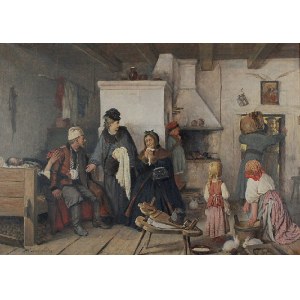
The offered canvas depicts an extremely dramatic scene with a strong patriotic message. Here, Czarist soldiers are taking a young Pole
to serve twenty-five years in the Russian army. Here we have a picture of witnesses to the tragic event, representing several generations: on a bed
rests an old man, probably the father of a mature man with a wounded arm - most likely a January insurgent, next to him his wife in black - a
national mourning, by her side an old woman raising prayers, young children watching the event are the next generation that will witness the
the rebirth of Independence. In the depths of the interior the main event of the scene is taking place: Russian soldiers are already standing in the open doorway, waiting for the one,
who will not quickly return back.
A tsarist law, in effect since 1705, specified the rules of conscription. The rules of conscription depended on the needs, initially it was one person
from 10 or 20 homesteads. In place, of the soldier killed, another person from the same area had to be posted. Military service was changed from a lifetime to a
25 years was changed in 1793. After the fall of the Kosciuszko Uprising and the third partition of Poland in 1795, Poles living in the
Russian partition were subject to the same regulations as Russians. The temporary suspension of conscription to the Czar's army was only due to the creation of the
Duchy of Warsaw. Poles did not give up the fight for independence - the November Uprising broke out on November 29, 1930. After its defeat,
began regular conscription into the tsarist army, known as branka, to prevent independence uprisings. Initially, the rule was the random selection of
of conscripts. Eventually, however, in the case of the brigade before the January Uprising, a list was created according to which soldiers were drafted, so as to
weaken the national uprising.










Последно разглеждани позиции
Влезте, за да се запознаете със списъка с артикулите
Любими
Влезте, за да се запознаете със списъка с артикулите