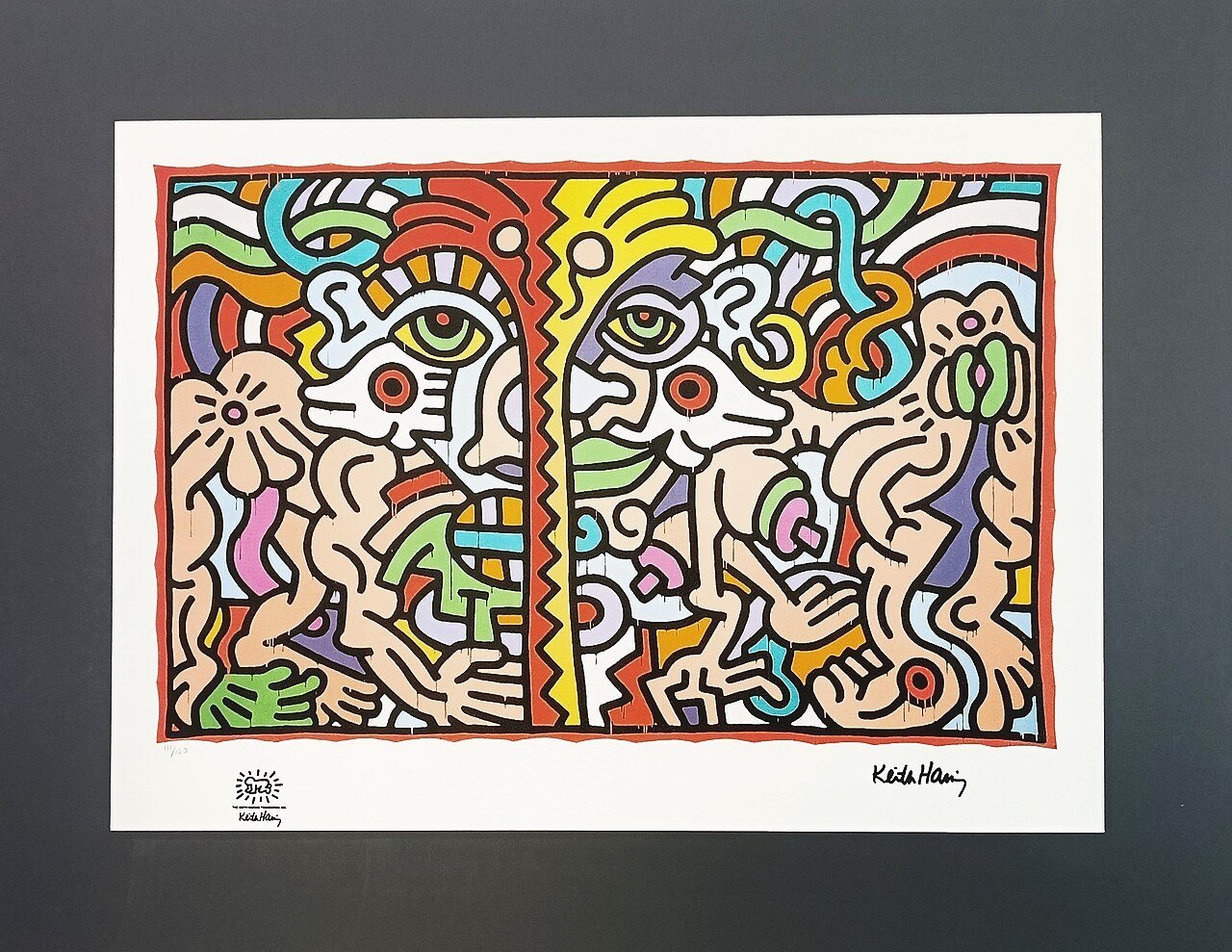
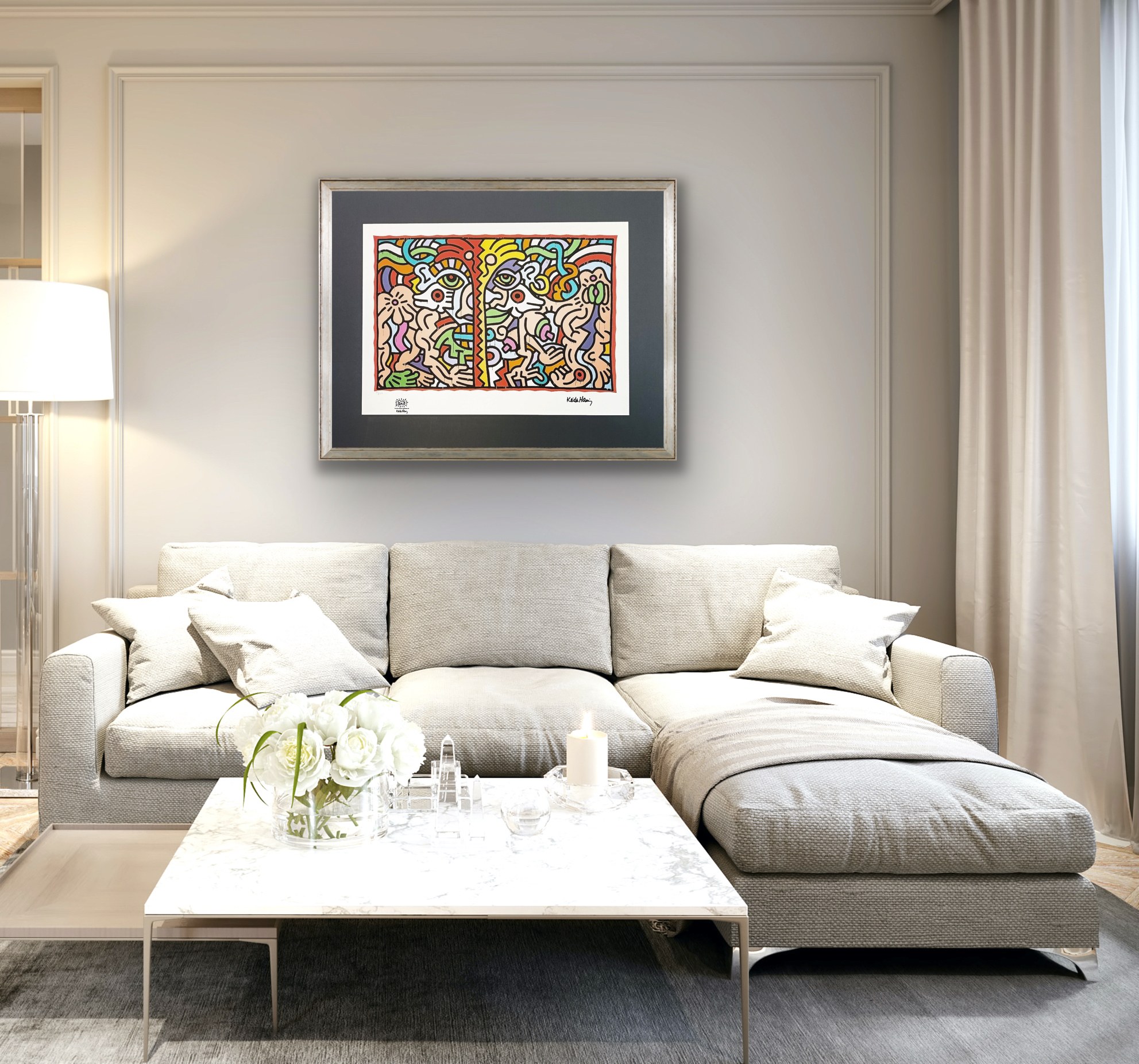
Lithograph, paper 42 x 62 cm in light passe - partout of 57 x 77 cm; limited edition, numbered in pencil 111/150, under the composition facsimile of Keith Haring's signature p.d.; dry seal of thepublisher Keith Haring Foundation l.d. and seal together with the Keith Haring Foundation logo. On the reverse "verification of authenticity" hologram. Original certificate.
Keith Haring was an American artist and activist who became famous for his dynamic, simple yet expressive drawings and prints, often depicting figures in motion, symbols and childlike figures. His style became a cultural icon of the 1980s, and his work, despite its seemingly simple form, often addressed deeper social, political and personal themes.
Haring often worked in line drawing, and his favorite medium was thick markers and chalk. In the 1980s, he began creating murals in public spaces, which became one of his main means of expression. One of his most recognizable projects was chalk drawings on blank billboards in the New York subway system. His art, although often associated with cheerful, colorful compositions, has always had a deep social and political dimension, making it timeless and universal.
"Babel of Animals"is a work that depicts animals in Haring's characteristic simplistic style. The composition refers to the biblical story of the Tower of Babel, symbolizing chaos, diversity and communicative misunderstandings among creatures. In this case, Haring applied his dynamic, zigzagging lines and repetitive motifs, apparent clutter, movement and interaction.
Haring died in 1990 due to complications from AIDS, but his influence on art and pop culture remains enormous. His work is exhibited in major museums around the world, and his Keith Haring Foundation continues to support the fight against AIDS and advocacy for human rights and education.
Keith Haring's works are regularly exhibited in galleries and museums around the world. Despite the fact that Haring died in 1990, his art enjoys unflagging interest and is often displayed as part of major retrospectives, thematic exhibitions, as well as permanent museum collections., such as at the Museum of Modern Art (MoMA) in New York - Haring had strong ties to the New York art scene, so MoMA has his works in its collection and frequently exhibits them, or the Centre Pompidou in Paris - as part of its contemporary art collection, this museum also has Haring's work and has organized significant retrospectives of his work.