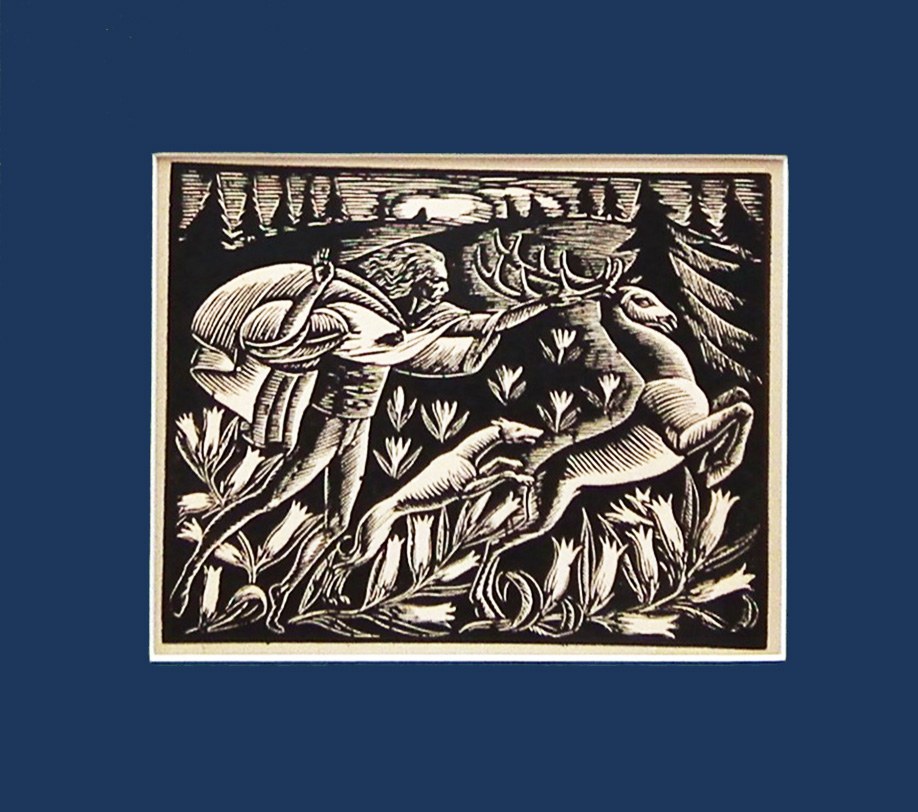
woodcut, paper, 12.5 x 15.5 cm (inside the mat), 23.5 x 26.5 cm (frame, mat);
Władysław Skoczylas was one of the most important artists of the interwar period in Poland.
He received a broad artistic education—initially studying in Vienna, then pursuing painting at the Academy of Fine Arts in Kraków. He gained additional knowledge in Paris, where he explored the secrets of sculpture, as well as in Leipzig, where he was introduced to woodcut printing.
Skoczylas is recognized by experts as the founder of the Polish school of woodcut art, and it is for this type of work that he is best known.
He published a significant portion of his woodcuts in the early 1920s in the form of albums titled *Teka zbójnicka* and *Teka podhalańska*. Their themes centered on mountain folklore, the figure of Janosik, and other bandits.
After the end of World War I, he settled in Warsaw, where he lived until his death in 1934. His studio was located at 37 Wybrzeże Kościuszkowskie—today, the Faculty of Sculpture of the Academy of Fine Arts is housed there. Skoczylas himself was, in fact, associated with the Academy of Fine Arts—in 1922, he became the head of the Department of Graphic Arts there (at that time, the institution was still known as the School of Fine Arts).
This artist’s works garnered critical acclaim both at home and abroad. In the 1920s, his works were exhibited in London, Budapest, Rome, Hamburg, and Zagreb, among other cities. Interestingly, in 1928, Skoczylas was even awarded a medal at an exhibition organized on the occasion of the Olympic Games in Amsterdam. The artist died in 1934 after a long illness and was buried at Powązkowski Cemetery in Warsaw.