


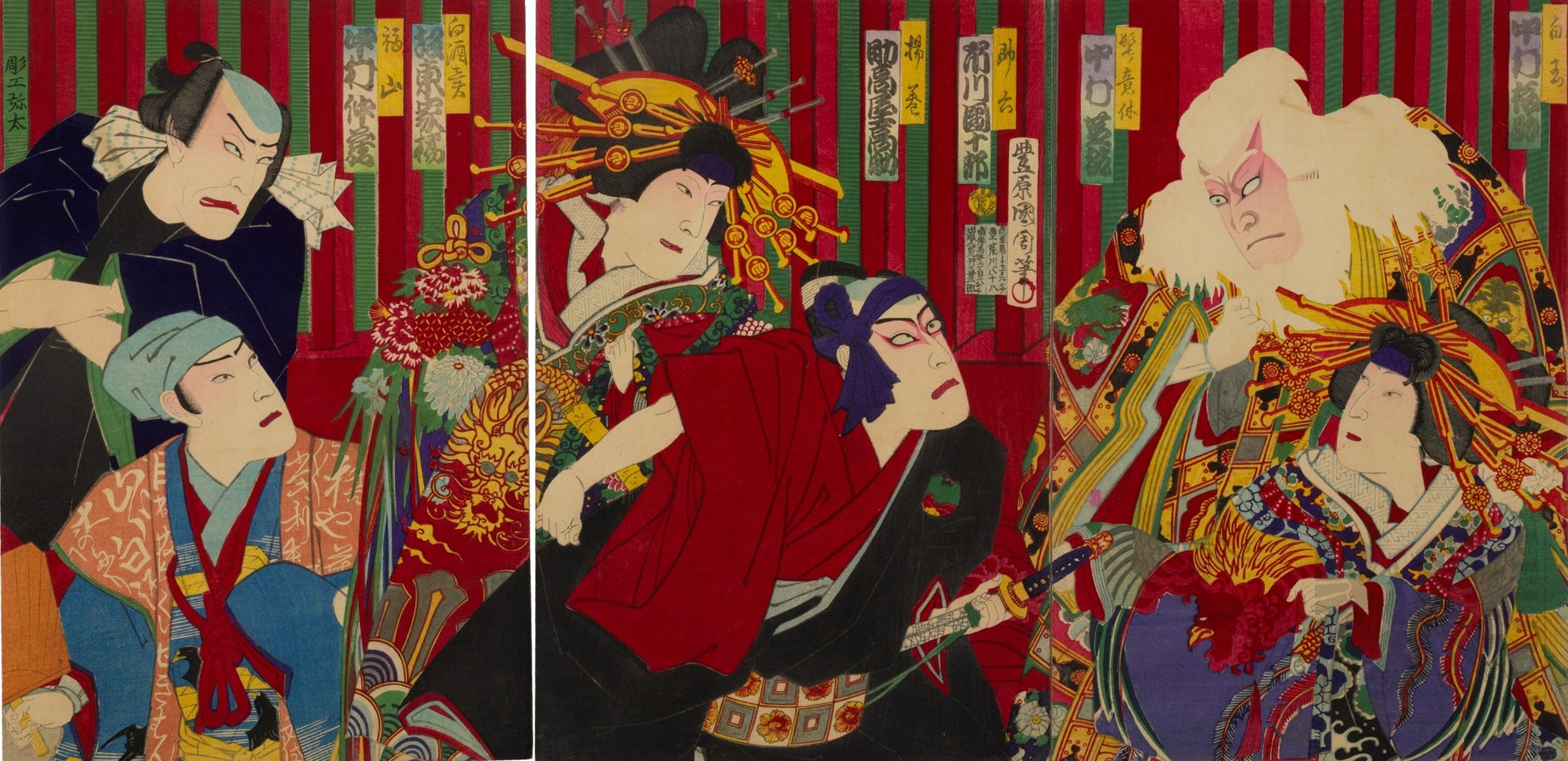
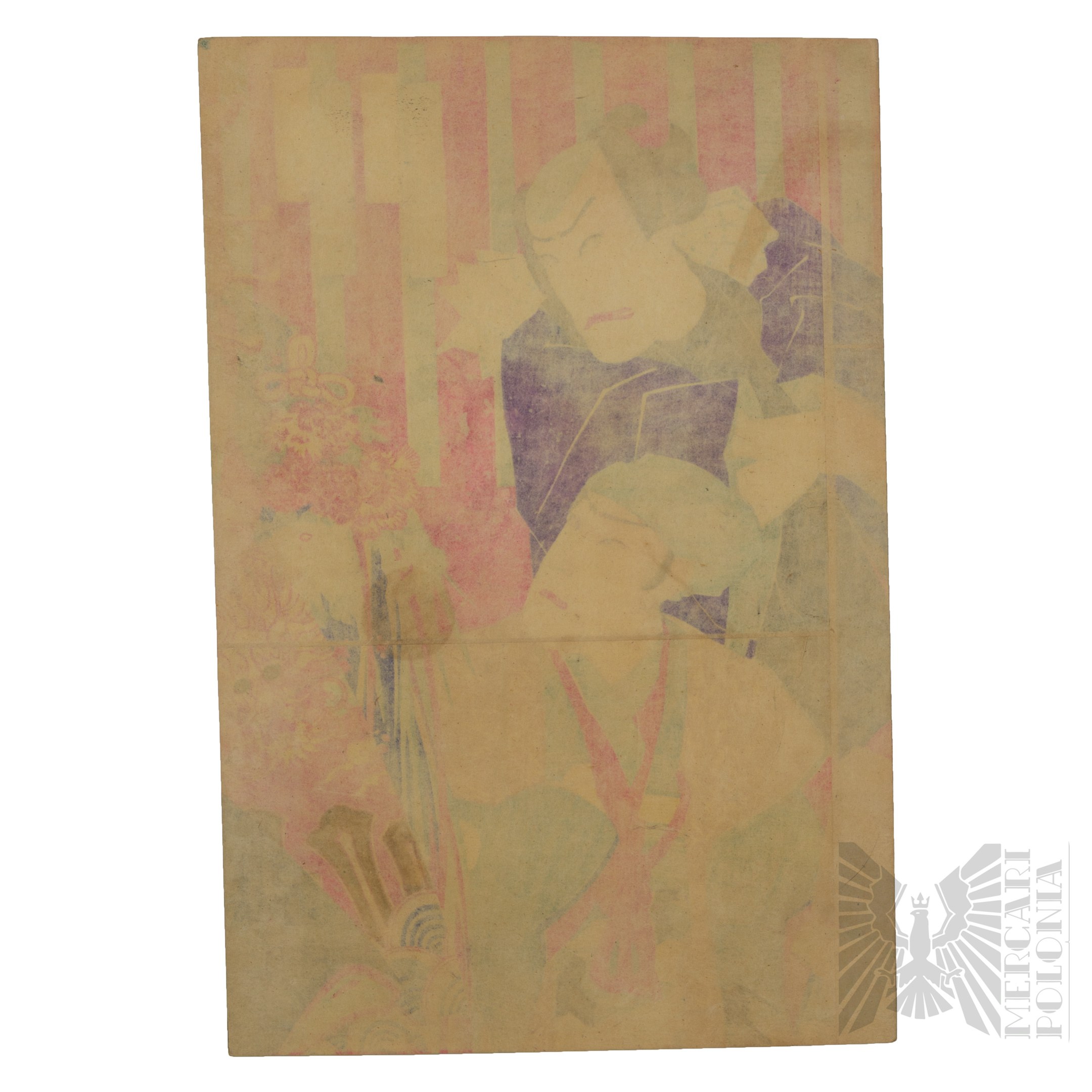
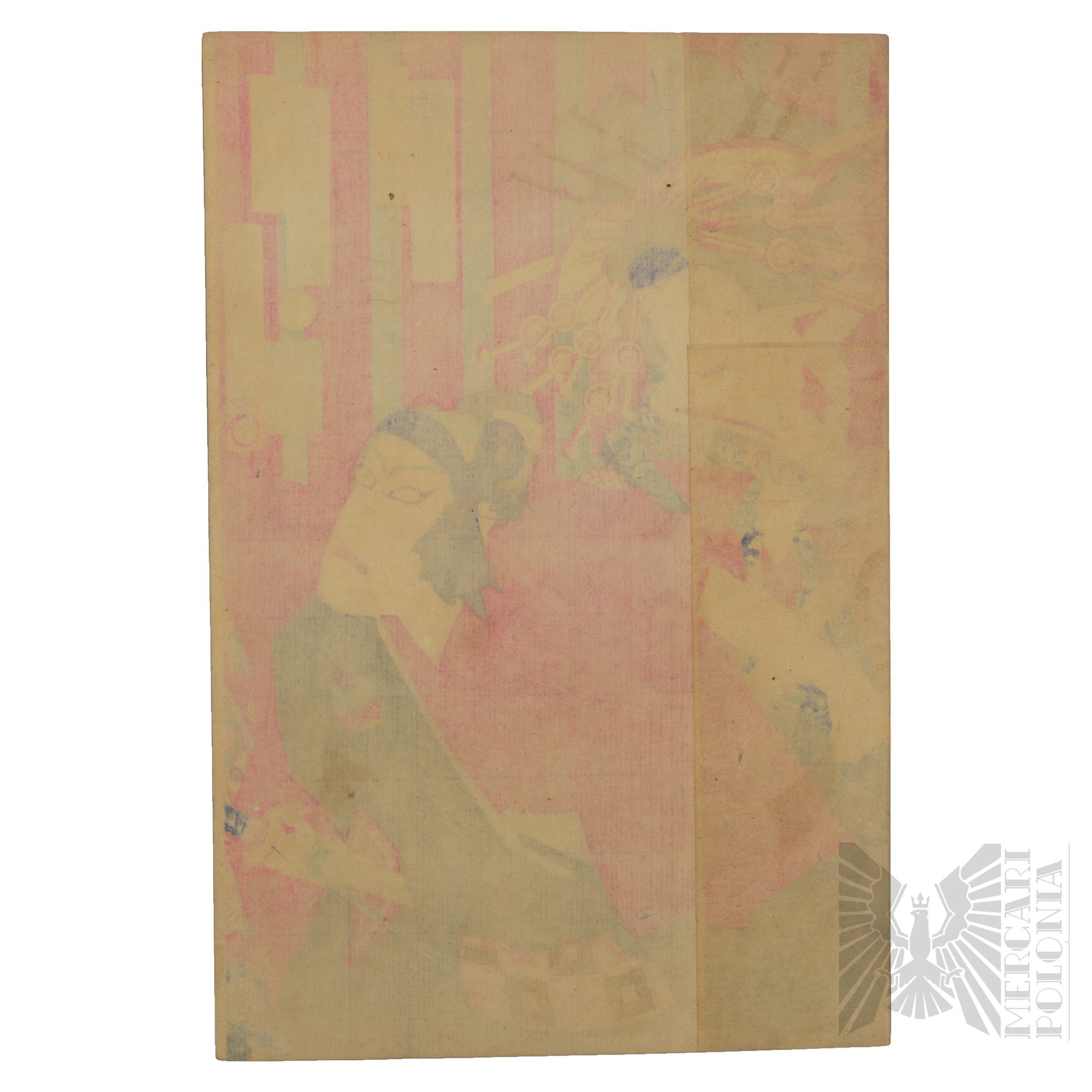
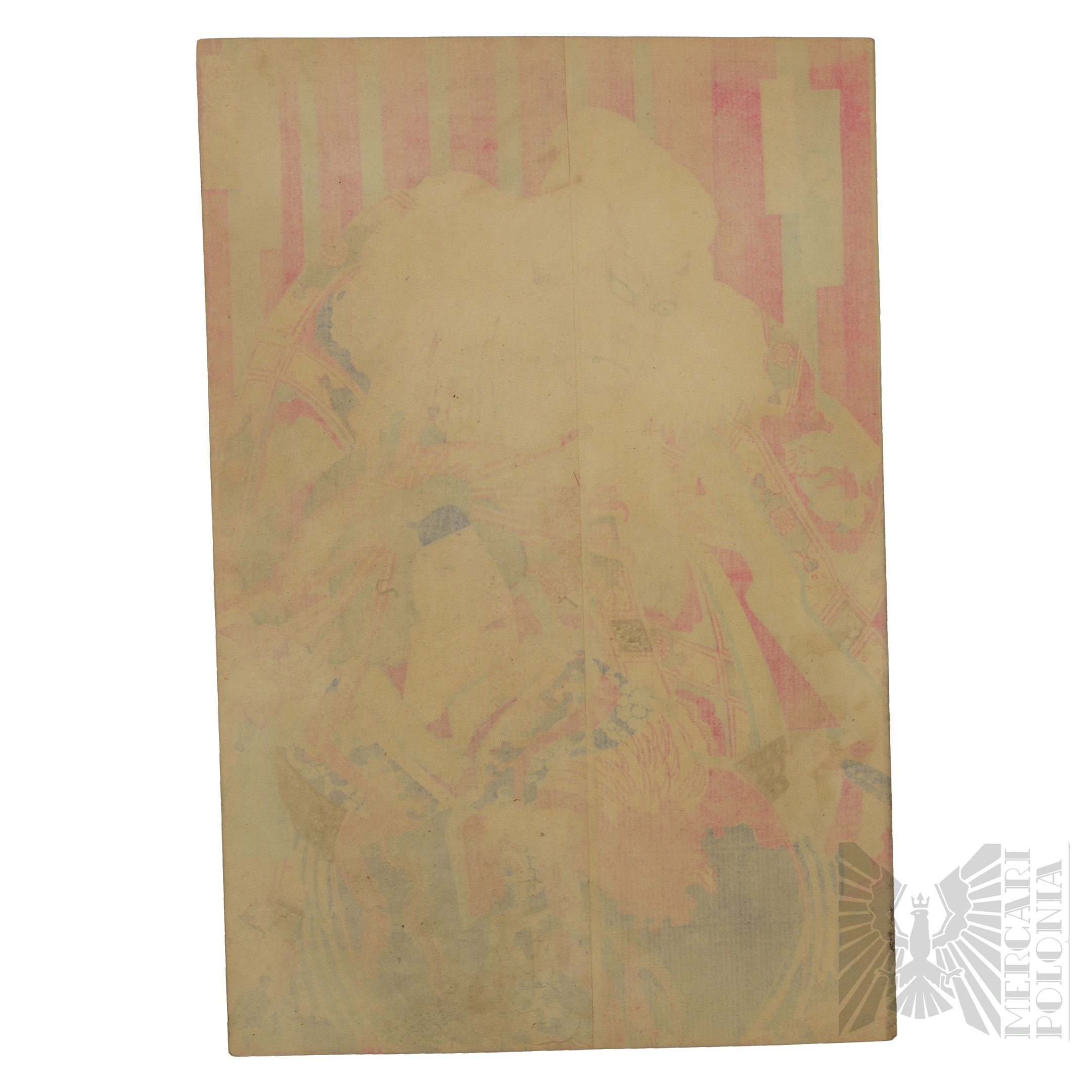
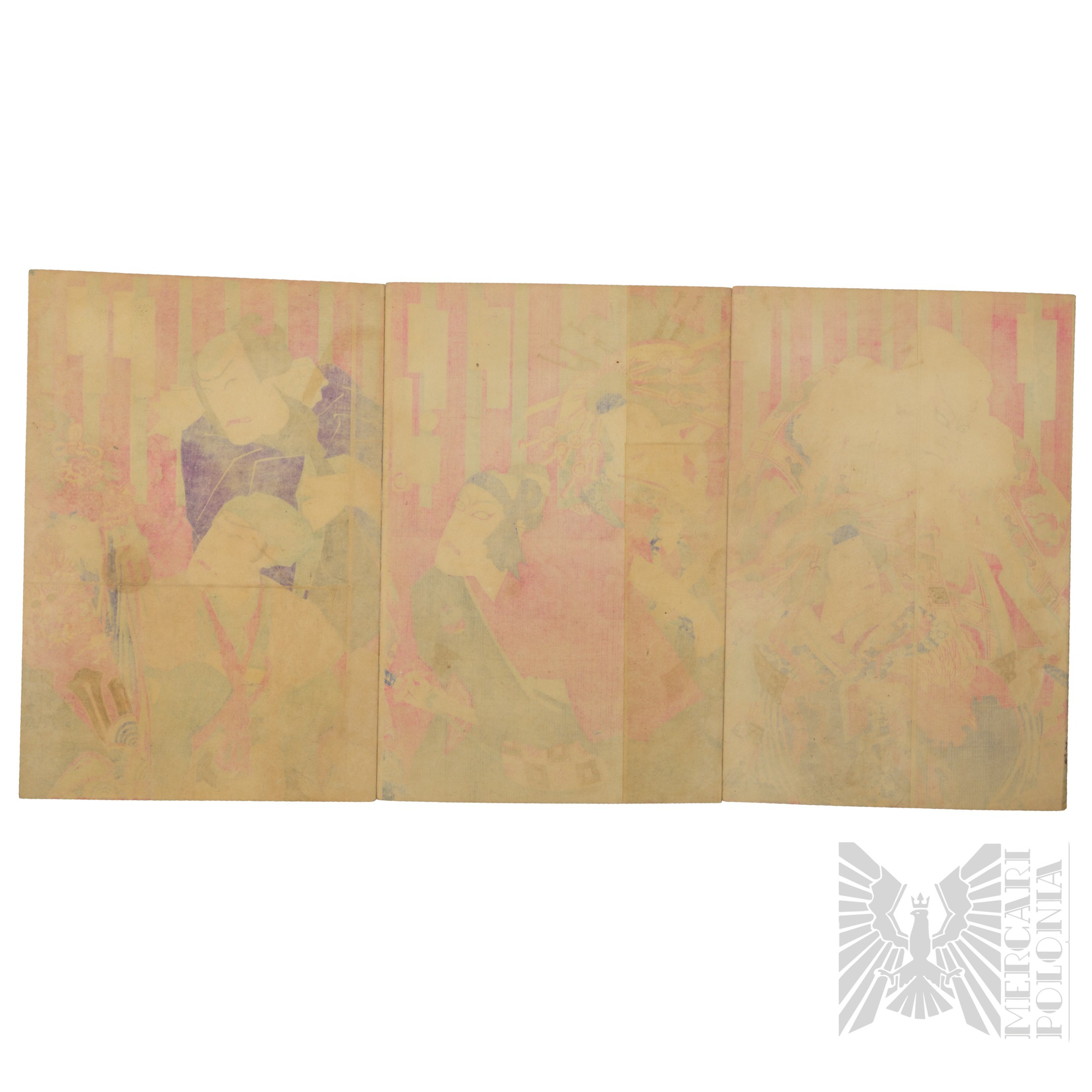
Technique: multicolored nishiki-e woodblock print, printed with ink on Japanese paper; a triptych consisting of three vertical panels. The color composition was created using separate woodblock printing plates.
Dimensions: 24.5 cm x 36 m within each sheet.
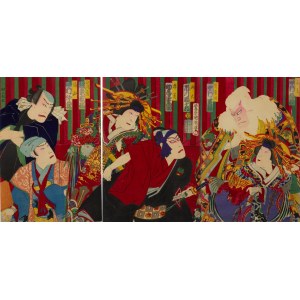
The triptych depicts six Kabuki actors performing in the play *Sukeroku yukari no Edozakura* (助六由縁江戸桜), which belongs to the Kabuki Jūhachiban canon—the eighteen most important plays traditionally associated with the Ichikawa Danjūrō acting family. The composition corresponds to a production staged in Tokyo around 1884, most likely associated with performances at the Shintomi-za theater.
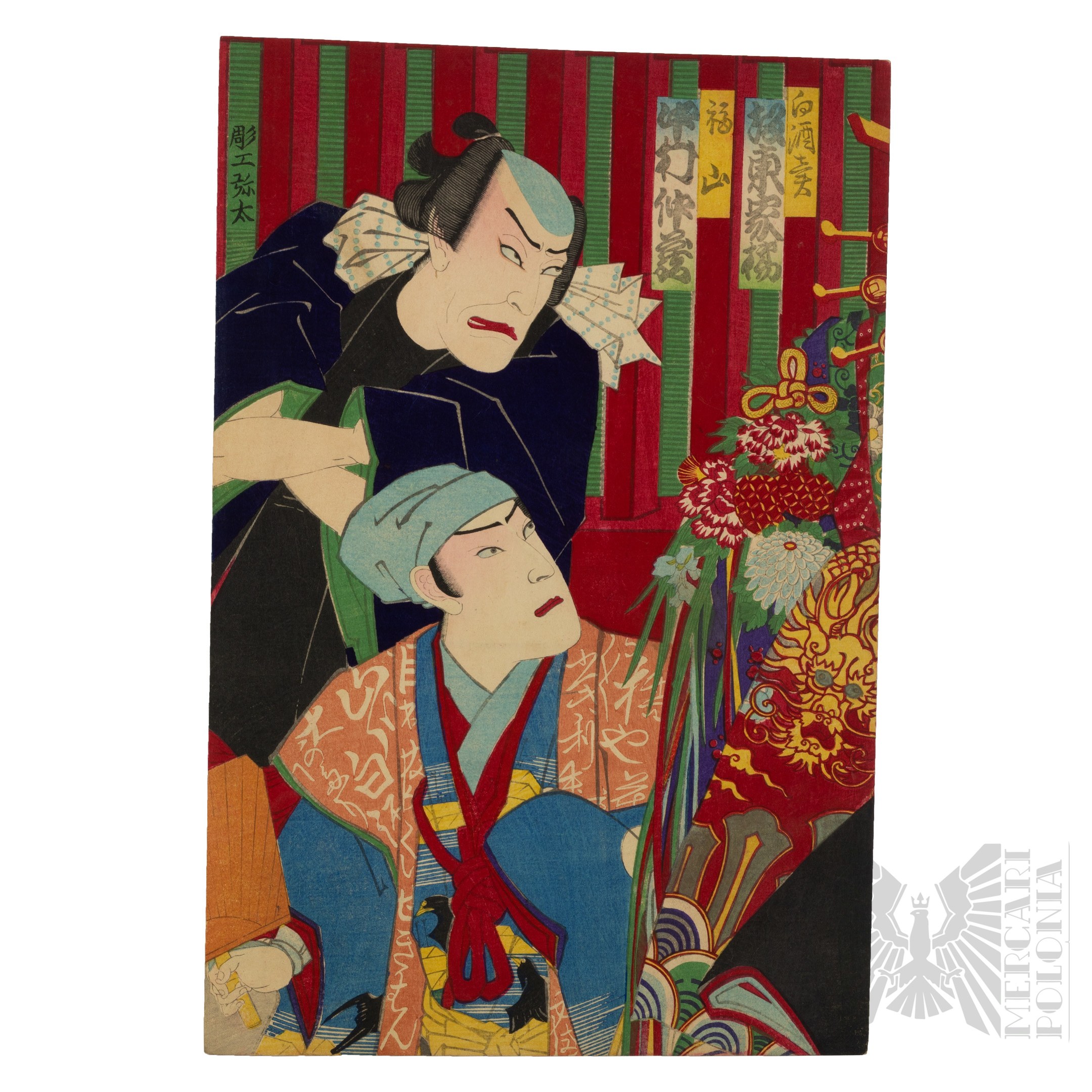
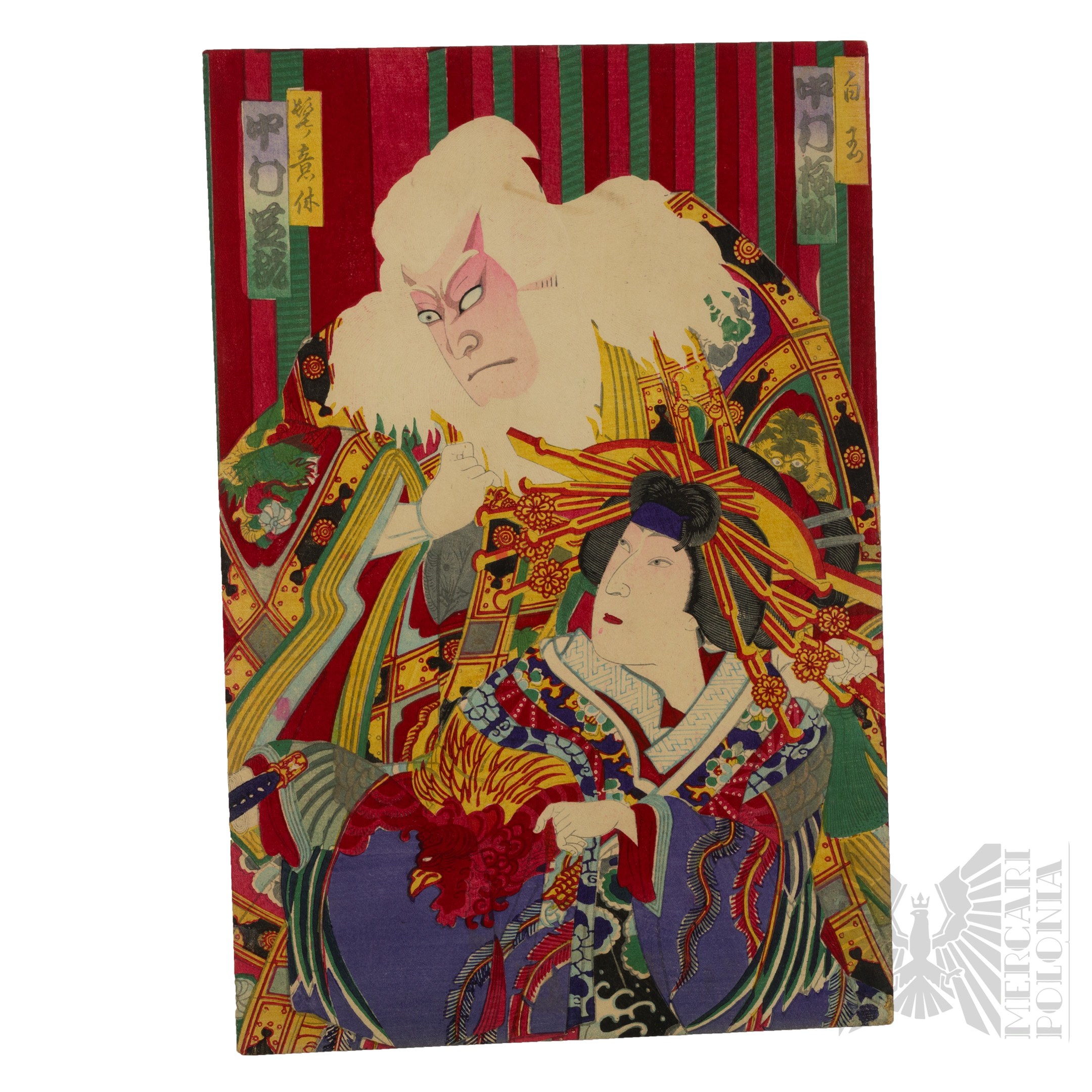
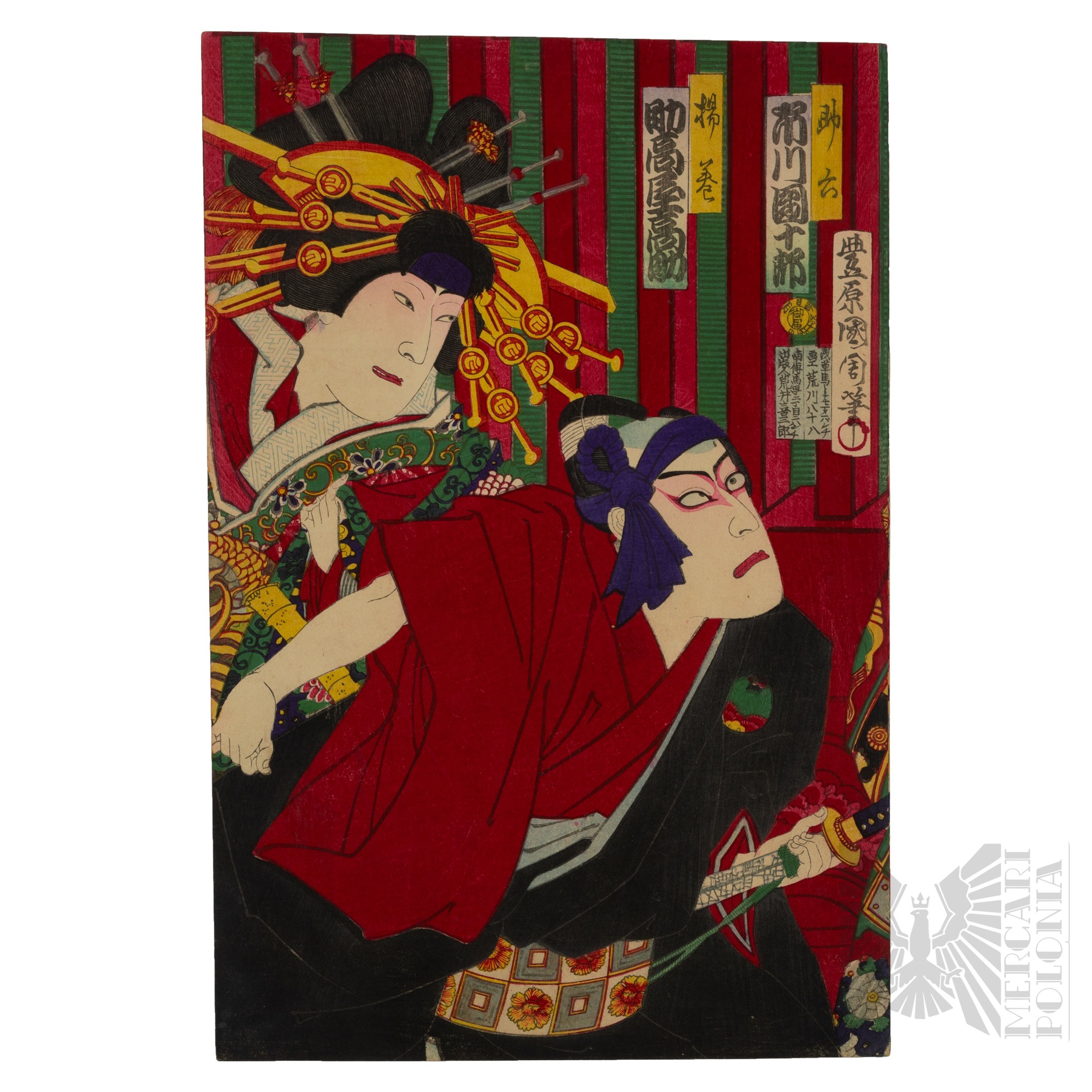
The individual panels feature monumental, tightly cropped half-length portraits of the actors. The characters fill nearly the entire surface of the sheets, partially obscuring one another. Instead of a unified spatial scene, the artist created a kind of group portrait of the cast. The background consists of alternating red and green vertical stripes, evoking the decoration of a theater curtain or screen. Vertical cartouches containing the actors’ stage names and the names of the roles they play are placed next to the figures.
The composition features Ichikawa Danjūrō IX as Hanakawado Sukeroku, Suketaka Takasuke IV as the courtesan Miuraya Agemaki, Nakamura Shikana IV as Hige no Ikyū, Nakamura Fukusuke IV as the courtesan Miuraya Shiratama, Ichikawa Sadanjī I as Shirozake-uri—the white sake vendor—and Bandō Kakitsu I as Fukuyama.
The most distinctive character is Hige no Ikyū, portrayed as a powerful old man with a massive, almost entirely white head of hair and a stern, demonic face. In contrast to him are Shiratama and Agemaki, female roles performed, in accordance with kabuki tradition, by onnagata actors. Their costumes are distinguished by their multi-layered construction, richly patterned fabrics, and elaborate hairstyles adorned with numerous kanzashi. Sukeroku is recognizable by his black costume, purple headband, and resolute, proud posture—elements that belong to the established iconographic canon of this role.
The play is set in the Yoshiwara entertainment district. Sukeroku, who is in reality the samurai Soga Gorō Tokimune, takes on the persona of an elegant urban ruffian. In search of the lost family sword Tomokirimaru, he provokes the men he encounters into duels to force them to draw their weapons. His beloved is the famous courtesan Agemaki. The hero’s main adversary is the wealthy and influential Hige no Ikyū, who is vying for Agemaki’s favor and is suspected of possessing the sought-after sword. Shiratama is Agemaki’s younger companion, while the white sake vendor turns out to be Sukeroku’s older brother, Soga Jūrō.
Kunichika employed the arrangement of large, highly individualized faces characteristic of his mature work. The figures’ expressiveness is conveyed through sharply defined eye contours, distinctive eyebrows, contrasting profiles, and intense colors. The reds, purples, greens, and blues—likely achieved in part through the use of modern synthetic dyes—reflect the aesthetic of Japanese actor prints from the Meiji period. The richness of the costume designs is set against a flat, rhythmic background composition, giving the actors’ silhouettes a monumental and decorative character.
Toyohara Kunichika, whose real name was Ōshima Yasohachi, was born in 1835 in Edo and died in 1900 in Tokyo. He trained in the studio of Utagawa Kunisada, one of the most important artists of the Utagawa school. He specialized primarily in yakusha-e—portraits of kabuki actors—and in stage scenes. Thanks to his deep understanding of the theater, he was able to capture not only the costumes and makeup but also the individual facial expressions of each performer. He gained particular popularity for his large-format diptychs and triptychs featuring close-up half-length portraits of actors. Alongside Tsukioka Yoshitoshi and Kobayashi Kiyochika, he is considered one of the most important representatives of Meiji-period woodblock printing.
Ichikawa Danjūrō IX (1838–1903), who played the role of Sukeroku, was one of the most outstanding actors of the Meiji period. He contributed to the revival and enhanced prestige of kabuki during Japan’s era of rapid modernization. He gained particular fame as a performer of heroic aragoto roles belonging to the Ichikawa family tradition. Together with Onoe Kikugorō V and Ichikawa Sadanji I, he formed an informal group of the most important stars of the Tokyo stage known as Dan–Kiku–Sa.
Ichikawa Sadanji I (1842–1904), born in Osaka, was one of the leading actors of Tokyo kabuki and an outstanding performer of male roles. He collaborated with the most important theaters and playwrights of the Meiji era.
Nakamura Shikan IV (1831–1899), depicted as Hige no Ikyū, was a versatile actor highly regarded in both male and female roles. His striking features and ability to bring distinctive characters to life meant that he frequently appeared in Kunichika’s woodblock prints. Nakamura Fukusuke IV (1865–1940), later known as Nakamura Utaemon V, became famous as one of the most important onnagata actors at the turn of the 19th and 20th centuries.
Suketakaya Takasuke IV (1838–1886) performed in wagotoshi, wajitsu, and onnagata roles, combining dramatic artistry with elegance of stage movement. Bandō Kakitsu I (1847–1893), also known as Ichimura Uzaemon XIV, specialized in gentler wagoto-style male roles and was the last manager of the historic Ichimura-za theater.
This composition belongs to a series of woodblock prints dedicated to successive productions of *Sukeroku*.
Condition: as shown in the photos.











Последно разглеждани позиции
Влезте, за да се запознаете със списъка с артикулите
Любими
Влезте, за да се запознаете със списъка с артикулите