


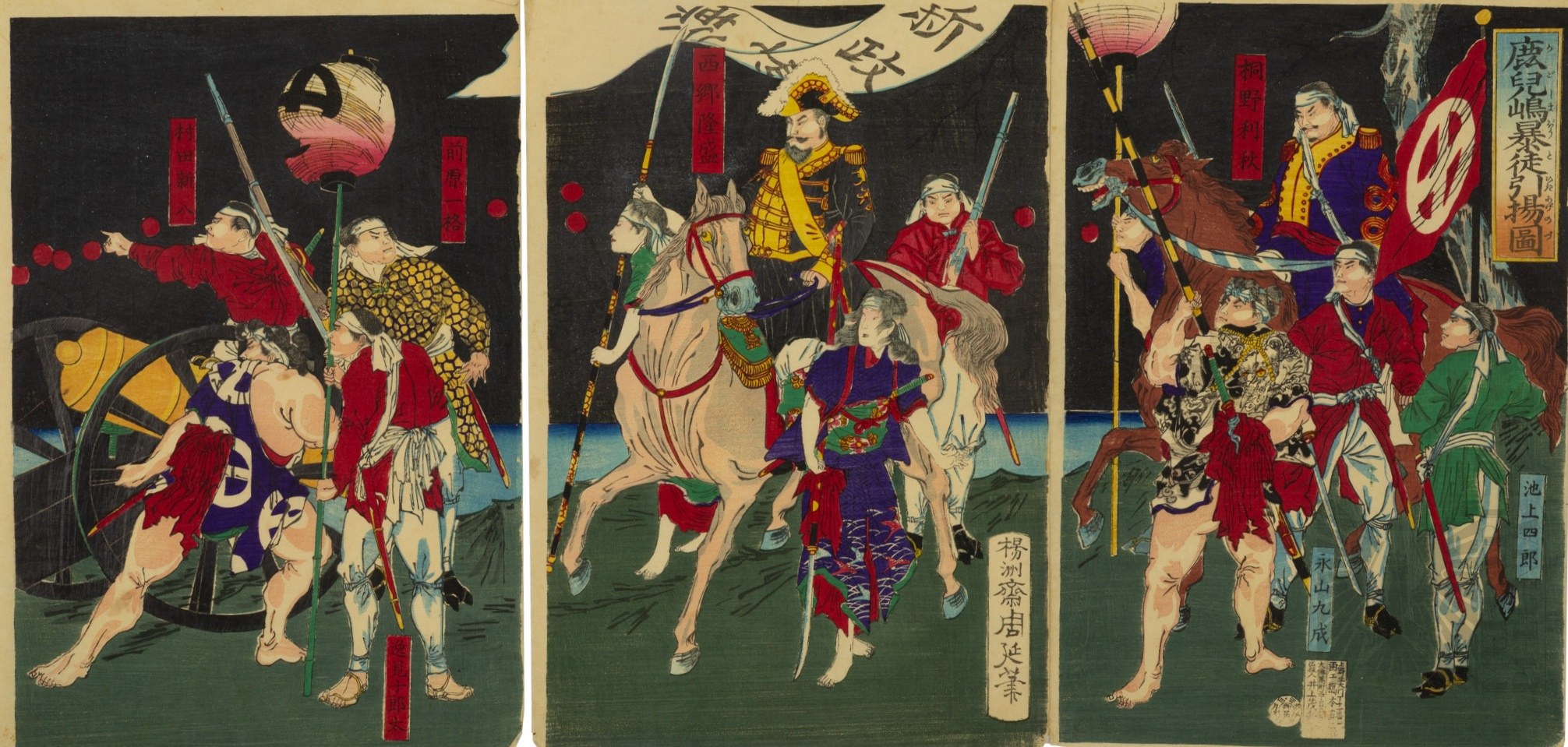
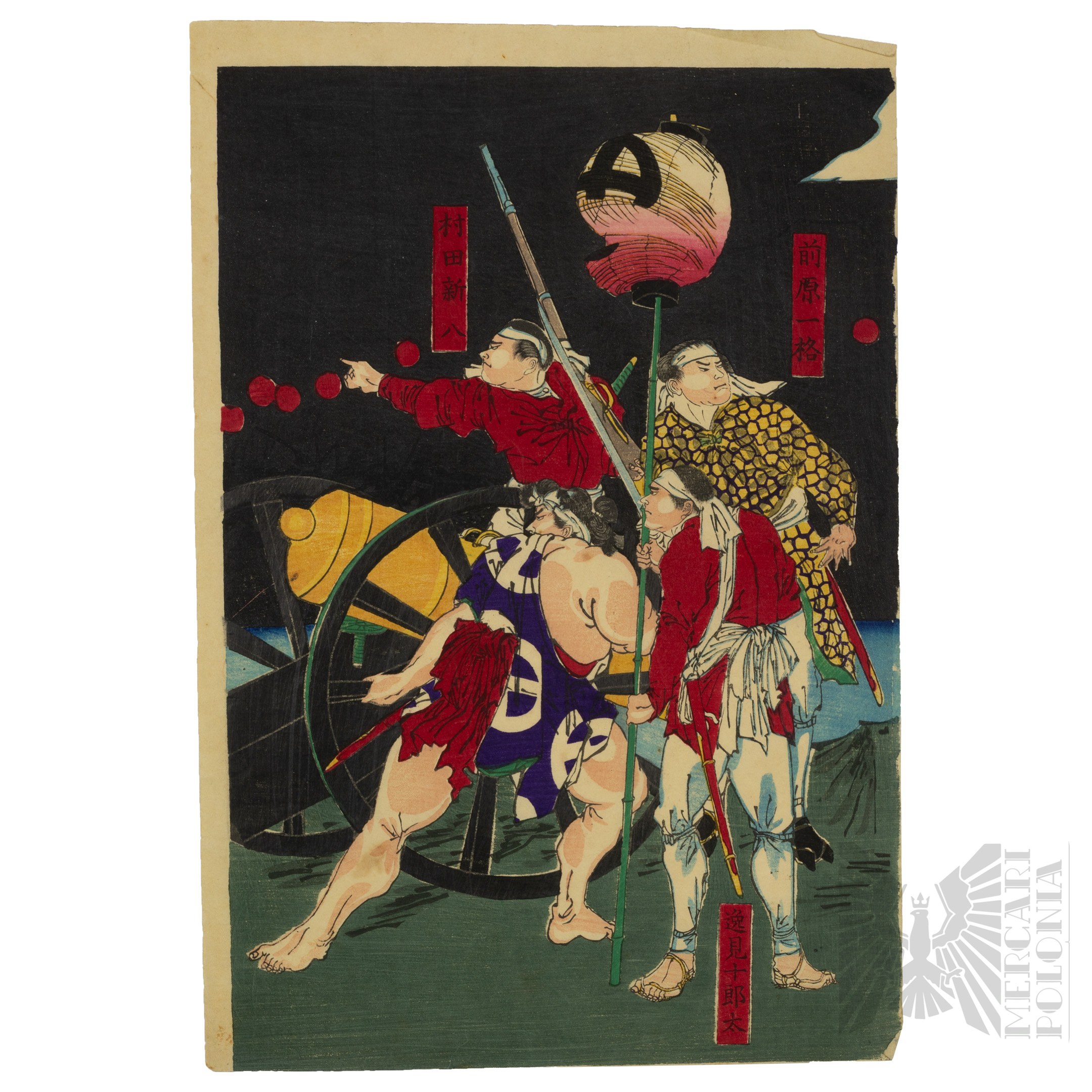
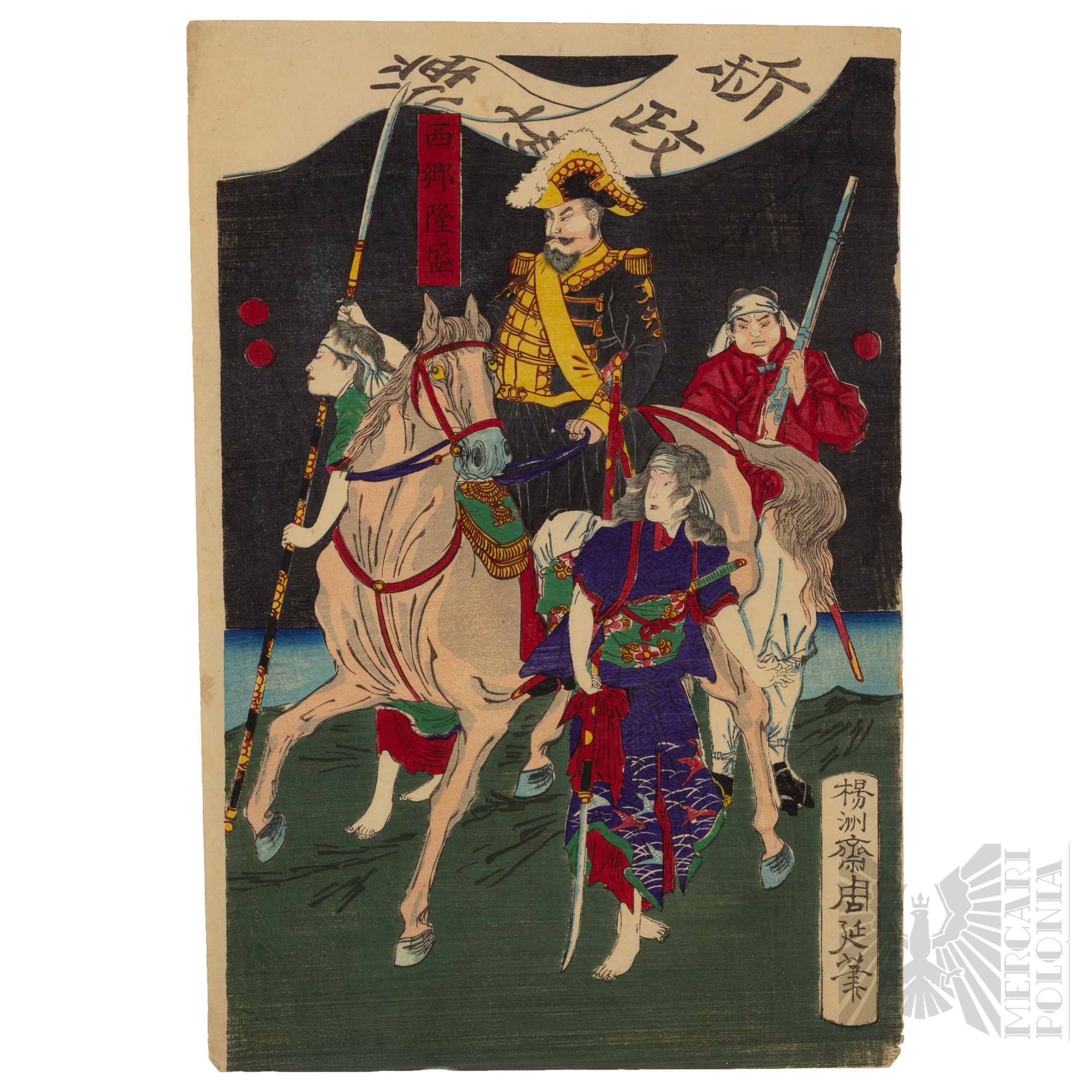
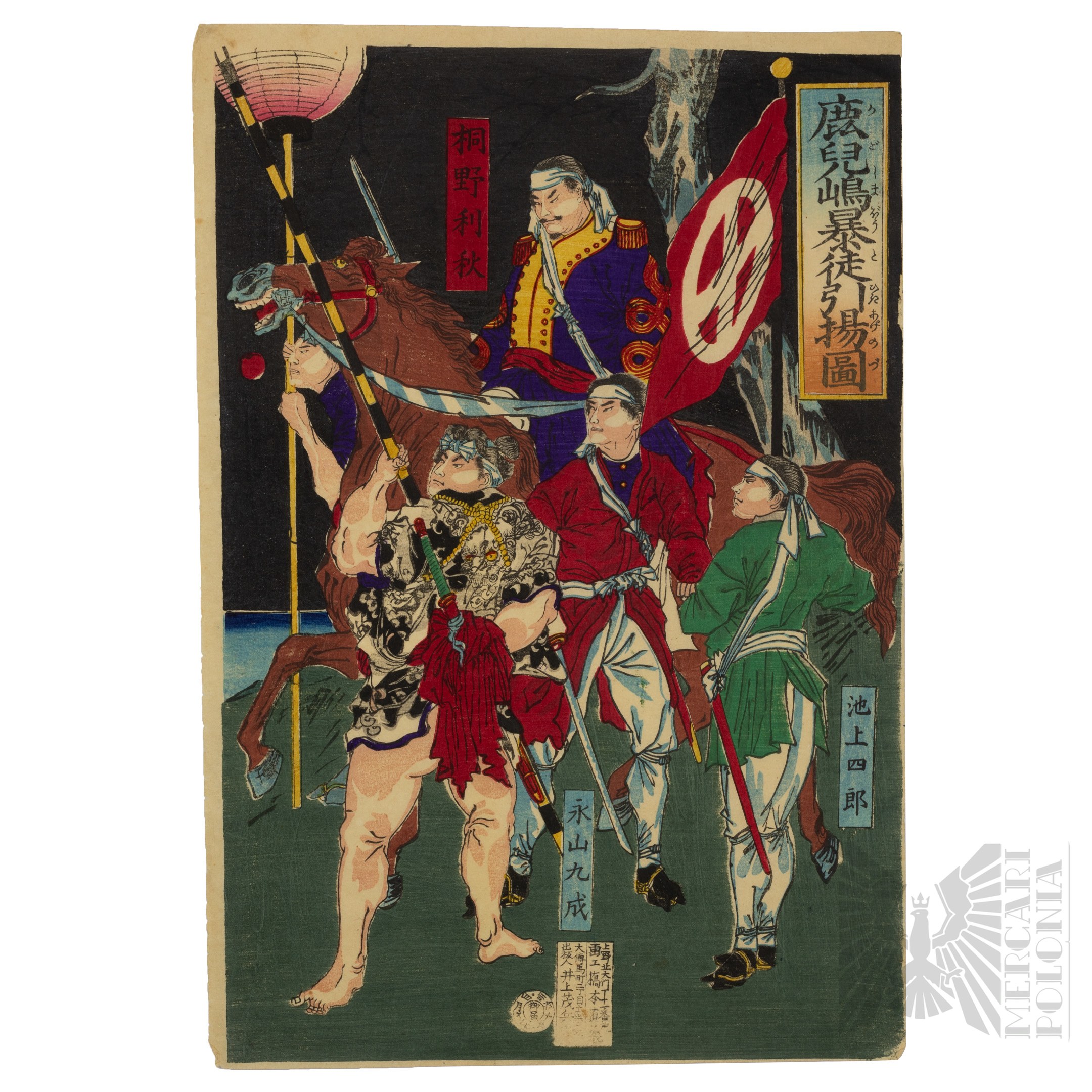
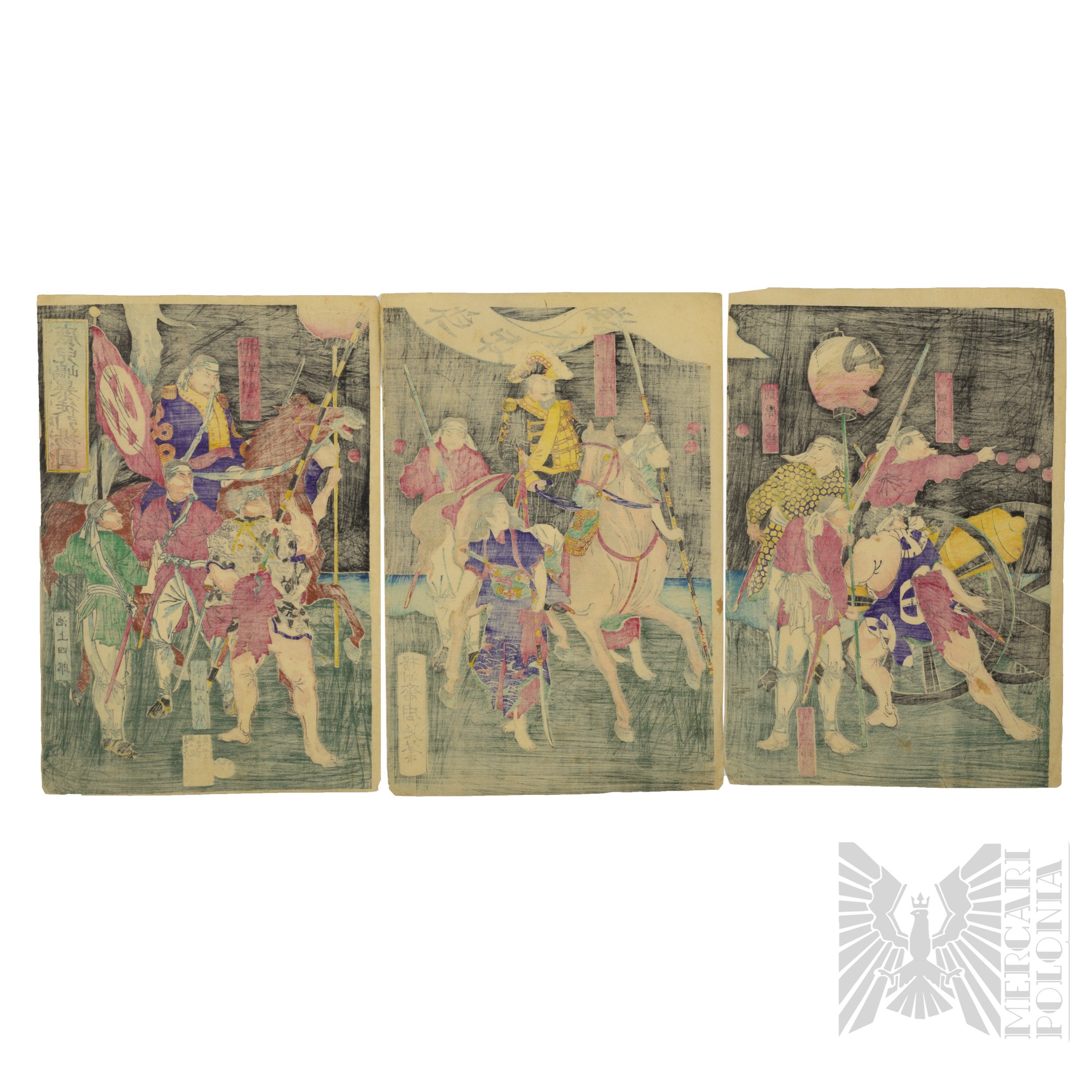
A single ōban-format panel measures approximately 36 × 24 cm, and the entire triptych measures approximately 36 × 72 cm.
Technique: colorful nishiki-e multi-block woodcut on paper, a triptych composed of three vertical ōban-format panels.
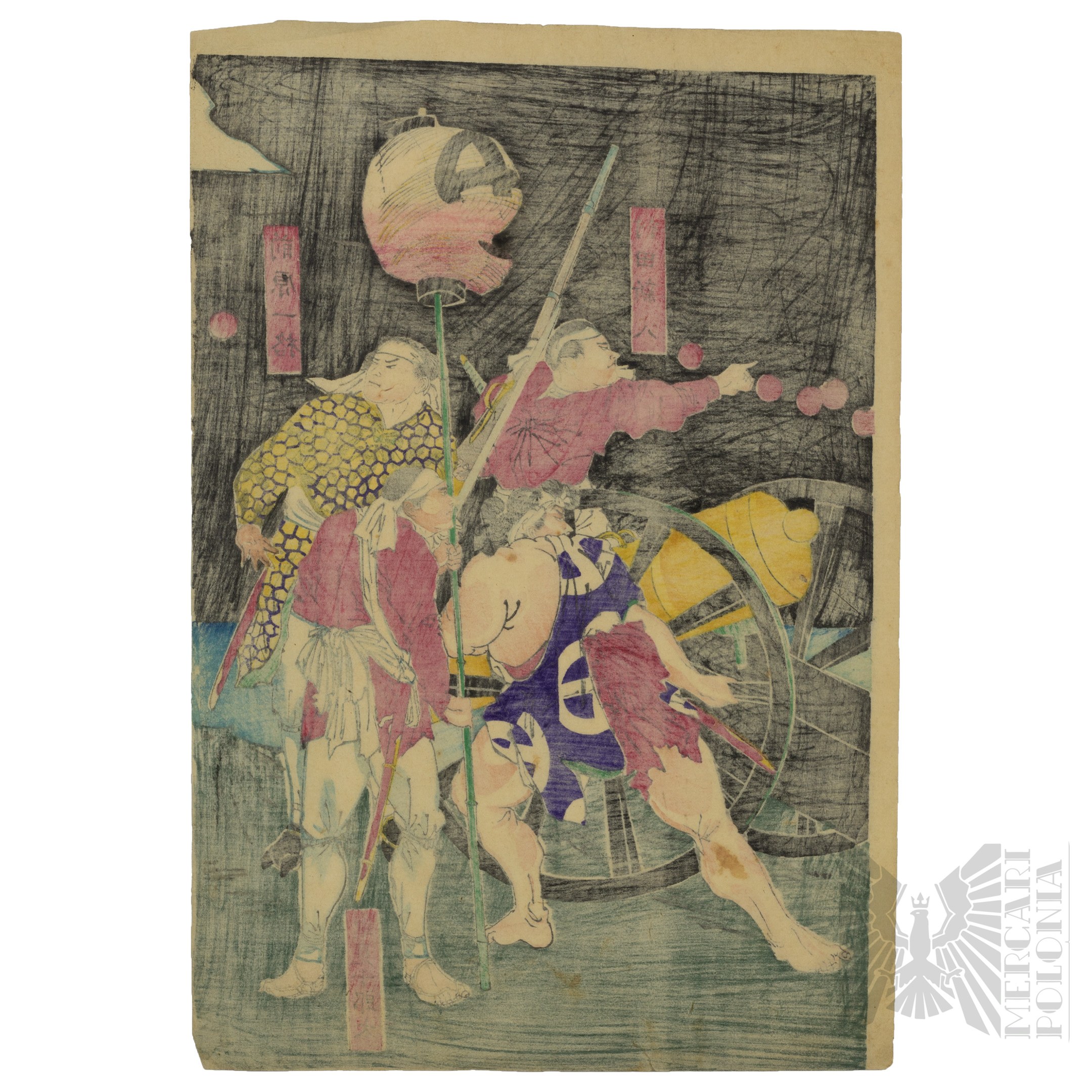
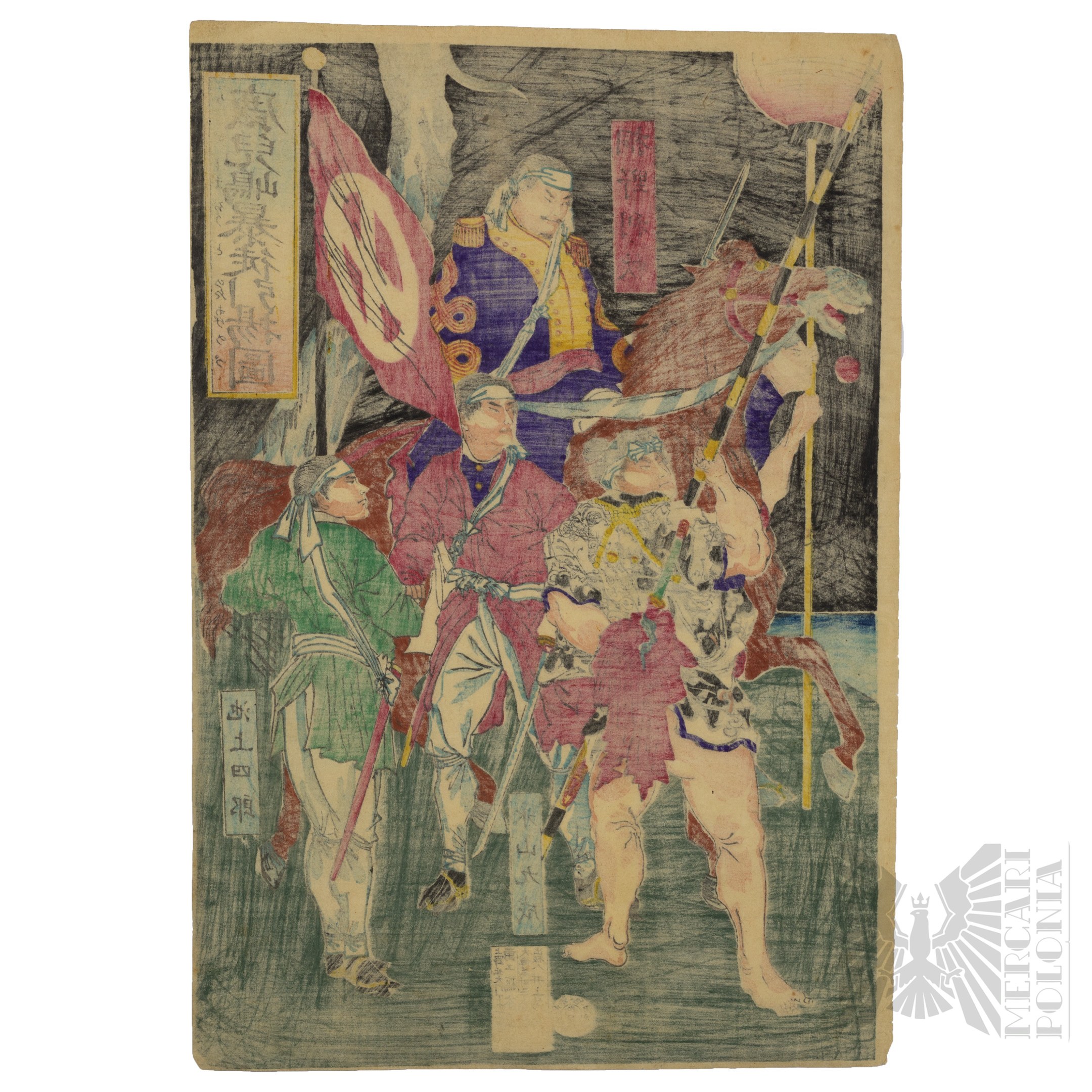
Composer: Utagawa Yoshitora, working under the name and pseudonym Nagashima Mōsai. Publisher: Yamazakiya Seishichi, Sanseidō publishing house in Edo/Tokyo; publisher’s mark “Yama-kiyo” (山清). Explanatory text: Torashige (乕重). Signature: “Nagashima Mōsai ga” – “drawn by Nagashima Mōsai.” On the right panel is a vertical title cartouche reading “鹿児島暴徒激戦之図” and red cartouches with the names of the depicted figures. Print submitted for publication: April 6, 1877.
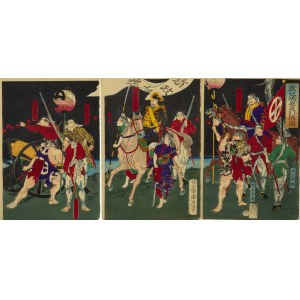
An elaborate battle scene depicting the Seinan War, also known as the Satsuma Rebellion, fought in 1877 between the forces of the imperial Meiji government and the rebellious samurai of Kagoshima, led by Saigō Takamori. The artist did not depict a specific episode of the campaign in a documentary style, but rather created a heroic vision of the rebellion’s leaders and warriors.
The right panel features the leaders and soldiers of the Satsuma army. Red cartouches identify Kirino Toshiaki, Murata Sansuke, and Saigō Kohei. The figures are depicted in varied attire, combining traditional samurai clothing with elements of Western military uniforms. The warriors are armed with swords, spears, and firearms. Some wear white headbands and are barefoot, which underscores the irregular nature of the formation depicted.
In the upper right portion of the panel, Kirino Toshiaki is depicted on horseback, facing the other participants in the event. A red-and-white banner flutters behind him. Below, warriors are gathered in a variety of poses and gestures: one of them raises a polearm, while others hold swords or rifles. The gathering of figures, weapons, and banners lends the scene the character of a solemn depiction of a march or preparations for battle.
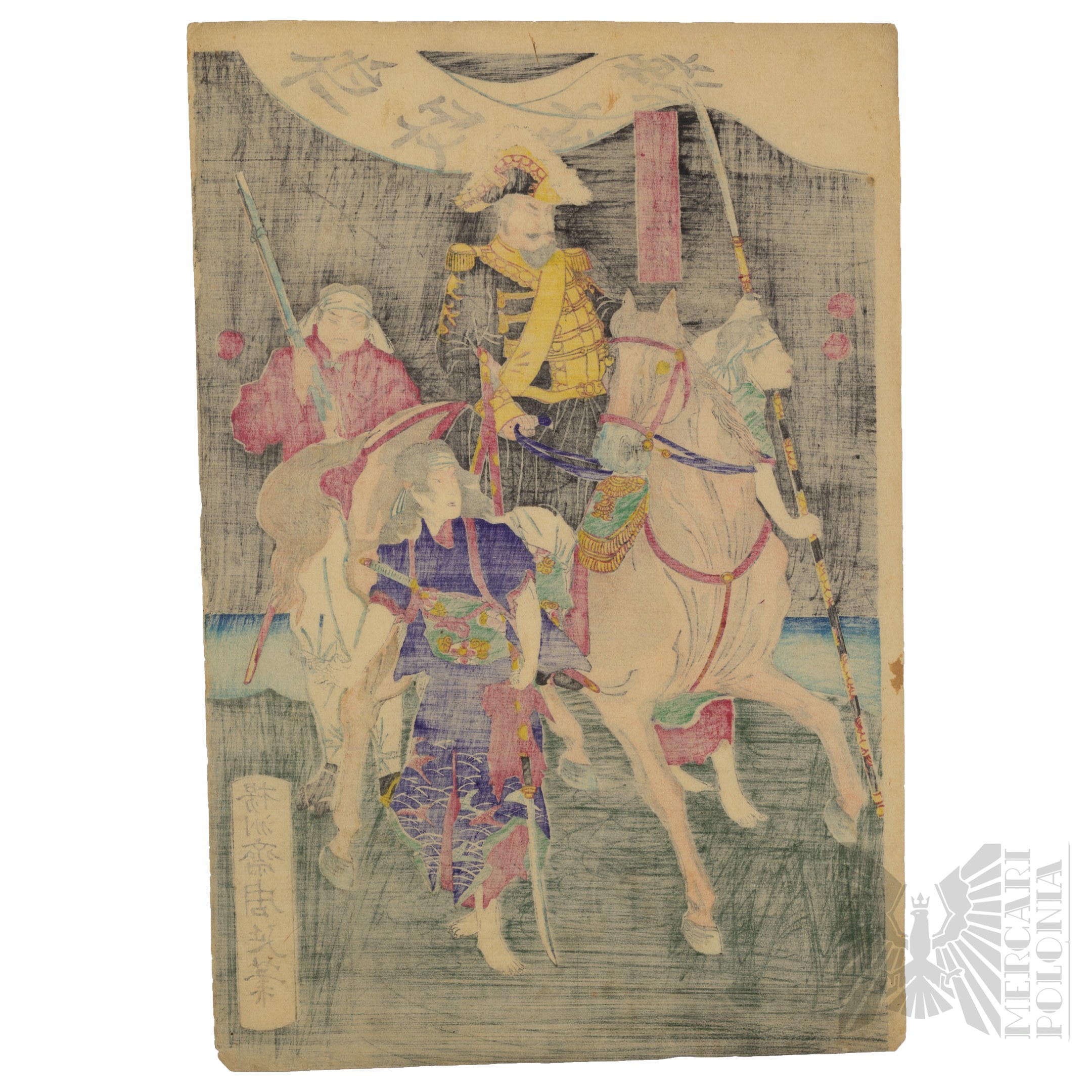
The center of the panel is occupied by the monumental figure of a mounted warrior identified as Maehara Ikkaku. The man sits on a light-colored horse. He is dressed in an outfit resembling a Western-style officer’s uniform. On his head is a decorative bicorne with a plume, while a wide, light-colored sash is draped across his chest.
Maehara is accompanied by foot soldiers armed with polearms and rifles. In front of the horse stands a figure in a purple outfit with a sword at his belt. A large white banner with calligraphic inscription is unfurled above the group. The central placement of the mounted commander, the animal’s light silhouette, and the vertical arrangement of the banners lend this part of the composition a ceremonial, almost monumental character.
The composition is distinguished by its intense color scheme based on reds, purples, greens, blues, and deep black. The dark, simplified background of the mountain landscape contrasts with the light silhouettes of the people and horses. The elaborate fabric patterns, decorative outlines, and bold color combinations remain rooted in the tradition of late ukiyo-e. At the same time, the presence of Western-style uniforms, rifles, and elements of modern military equipment reflects the rapid social and military transformations in Japan at the beginning of the Meiji era.
The artist employed a hierarchical scale of figures. Mounted commanders dominate the foot soldiers, and their figures are highlighted through color, the ornamentation of their attire, and the placement of cartouches. The figures are not depicted as exhausted participants in a real campaign, but as idealized warriors continuing the tradition of ancient samurai heroes. The scene combines a contemporary political event with the musha-e convention—depictions of famous warriors—established in Japanese printmaking.
The woodcut belongs to the sensō-e genre—popular war images that served simultaneously as press illustrations, propaganda commentary, and mass entertainment. The title term bōto means “rebels,” “insurgents,” or, literally, “participants in riots,” and reflects the imperial authorities’ official language regarding the supporters of Saigō Takamori.
The depiction is not a faithful account of a single battle. It brings together individuals who participated in various stages of the campaign, some of whom were already dead by the time the woodcut was submitted for publication. Murata Sansuke fell in March 1877, while Saigō Kohei died in February of that year. The fictional character Maehara Ikkaku is also included among the heroes. The work is therefore a symbolic panorama of the rebellion, constructed on the basis of press reports, rumors, and popular tales of samurai exploits.
Utagawa Yoshitora, also known as Nagashima Mōsai, was a Japanese painter and woodblock print designer active from around the 1830s to the second half of the 1880s. His real name was Nagashima Tatsugorō, also found in the variants Tatsunosuke and Tatsusaburō. He was a student of Utagawa Kuniyoshi, one of the most outstanding masters of nineteenth-century ukiyo-e. He used the pseudonyms Ichimōsai, Mōsai, and Kinchōrō, and during the Meiji period, he increasingly signed his works as Nagashima Mōsai.
He created depictions of warriors (musha-e), historical scenes, portraits of kabuki actors, images of beautiful women, illustrations of political events, and so-called Yokohama-e—pictures of foreigners and the changes taking place after Japan’s opening to the world. His compositions feature the dynamic poses, expressive outlines, intense color palette, and decorative treatment of costumes typical of the Utagawa school. Yoshitori’s work serves as a bridge between the classical ukiyo-e of the Edo period and the informational and press illustrations of the Meiji era. In the 1870s, he designed numerous woodblock prints devoted to internal conflicts, including the Seinan War.
Kirino Toshiaki (1838–1877), formerly known as Nakamura Hanjirō, was a samurai of the Satsuma domain and one of the most important commanders in Saigō Takamori’s army. In the period leading up to the Meiji Restoration, he acted as a supporter of the emperor and an opponent of the Tokugawa shogunate. He participated in the Boshin War, including the battles of Toba–Fushimi and the campaign against the northern domains that supported the shogunate.
After the Imperial Army was established, he attained the rank of major general. In 1873, following a dispute over a planned intervention in Korea, he resigned from service and returned to Kagoshima with Saigō Takamori. During the Satsuma Rebellion, he was one of the most important rebel commanders. He was killed on September 24, 1877, in the final battle of Shiroyama. In popular culture, he has become known as an outstanding swordsman and one of the iconic “last samurai.”
Murata Sansuke, whose real name was Murata Sansuke or Murata Sankai (1845–1877), was from Satsuma. He participated in the Boshin War as the commander of an artillery unit and subsequently served in the newly formed Imperial Army, rising to the rank of major. After Saigō Takamori left the government, he resigned from service and returned to Kagoshima.
In 1877, he assumed command of a subunit of the Satsuma Army. He fought, among other places, in the Ueki and Yamagi regions. Tradition associated with the Seinan War credits his unit with helping to rout the force commanded by Nogi Maresuke and capturing the standard of the 14th Infantry Regiment. He was killed in action in March 1877 during fighting in the Nabeta area.
Saigō Kohei, identified as Saigō Kobei (1847–1877), was Saigō Takamori’s youngest brother. He participated in the Boshin War, fighting, among other engagements, in the campaign in northeastern Japan. After the conflict ended, he held local administrative positions.
In 1877, he joined the Satsuma Army and became commander of a subunit of the first battalion. He was killed in action on February 27 during the Battle of Takase, one of the first major engagements of the rebellion. In war woodblock prints, his name was also written in the abbreviated form “Saigō Kohei.”
Maehara Ikkaku is a fictional character created by the press and the authors of war woodblock prints. He was portrayed as the younger brother of Maehara Issei, the leader of the 1876 Hagi rebellion. According to a popular tale, after his brother’s death, he fled to Satsuma and joined Saigō Takamori to avenge the defeat of the Hagi rebels. He was described as an exceptionally strong warrior who wielded an unusually long sword and fought at the head of the rebel troops.
The historical Maehara Issei, however, did not have a brother named Ikkaku, and his actual brothers were executed after the suppression of the Hagi rebellion. The presence of this fictional character in numerous compositions from 1877 demonstrates how quickly press rumors and literary tales found their way into nishiki-e iconography. In this triptych, he is depicted as the central figure of the scene—a mounted commander embodying the traits of a classic samurai hero.
Condition: as shown in the photos.











Последно разглеждани позиции
Влезте, за да се запознаете със списъка с артикулите
Любими
Влезте, за да се запознаете със списъка с артикулите