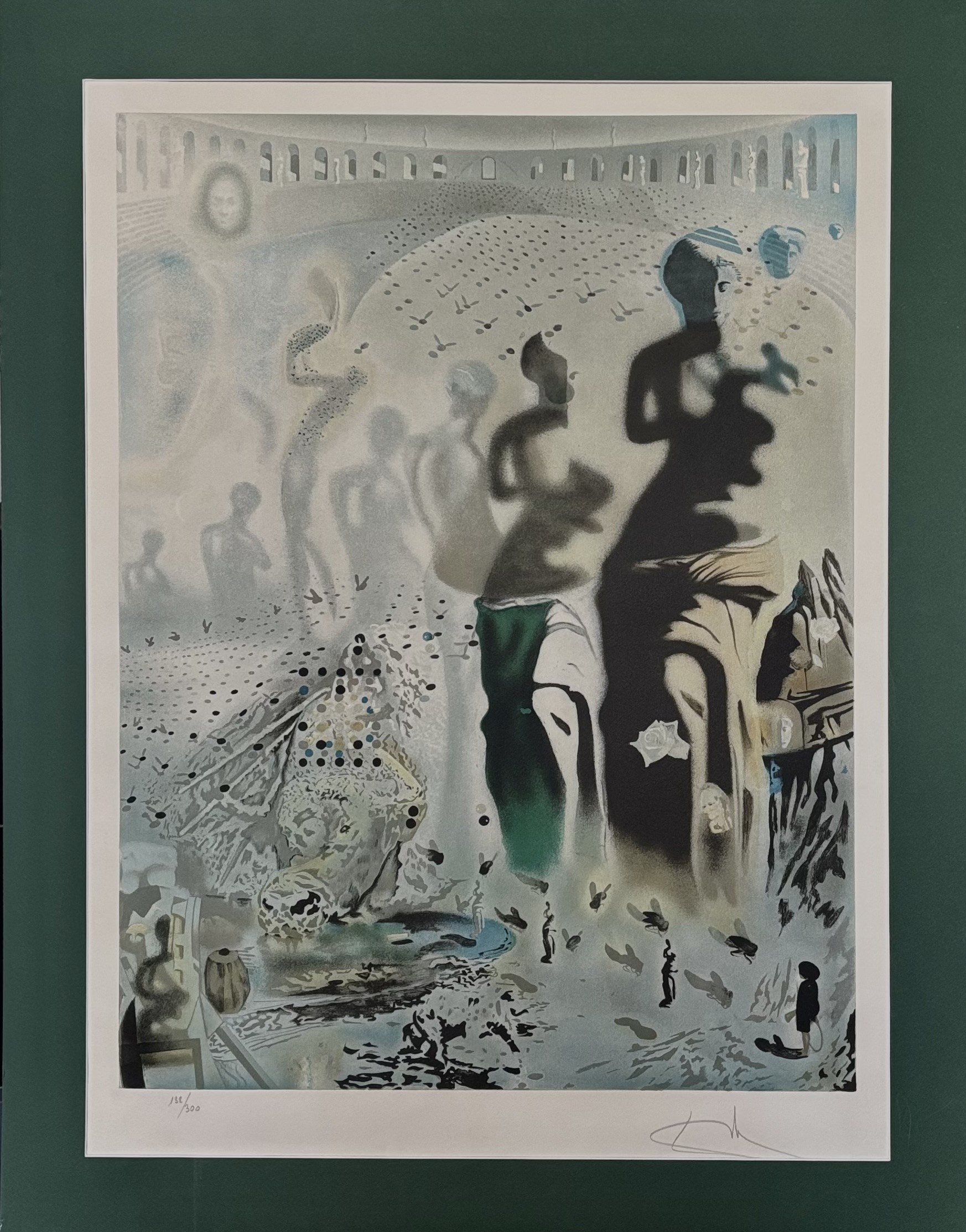
Color lithograph, paper 89 x 71 cm in light passe - partout 97 x 79 cm; signed in pencil (tied monogram) p.d. and numbered l.d. 132/300.
In The Hallucinogenic Toreador Dalí conveys his wife Gala's aversion to bullfighting , combining symbolism , optical illusions and foreign but familiar motifs . Dali used his paranoid-critical method to create his own visual language in the painting , and combined versatile images as an instructive example of his artistic ability and vision .
The entire scene takes place in a bullfighting arena, immersed under a hail of red and yellow tones, referring to the colors of the Spanish flag . In the upper left corner we see a portrait depicting his wife Gala, to whom the artist dedicated this work. Her serious, rigid expression shows her dislike of bullfighting. In the lower left corner is the shape of the head of a dying bull (probably Islero ), with blood and saliva dripping from its mouth. This pool of blood transforms into a sheltered creek, where a human figure appears on a yellow raft. The slaughtered bull slowly floats, becoming the landscape of Cap de Creus , around Dalí's place of residence.
An old anecdote lies behind the painter's desire to depict the sculpted figure of Venus de Milo , seen 28 times in the painting. Dalí decided to incorporate these particular silhouettes into his paintings after a visit to New York, where he bought a box of pencils with a reproduction of the goddess on the cover. Dalí uses negative spaces to create an image, alternating and complementary to Venus de Milo . This complementary image invites the eye to contemplate the painting in such a way as to introduce a quasi-hypnotic array of forms inhabiting the canvas. Viewed from a distance, the body of the second Venus reveals the face and torso of a toreador ( torreador, probably Manolete ). Her breasts are his nose, while her face transforms into his eye. Their long skirts form his white shirt and the Toreador's red scarf. A green layer forms his tie. His eye is located in the face of the other Venus. The soft white surface reveals a tear running down from his eye.
Salvador Dali's lithographs in editions of up to 300 copies were mainly created between 1957 and 1980 at Atelier Mourlot and were supervised and signed personally by Dali.
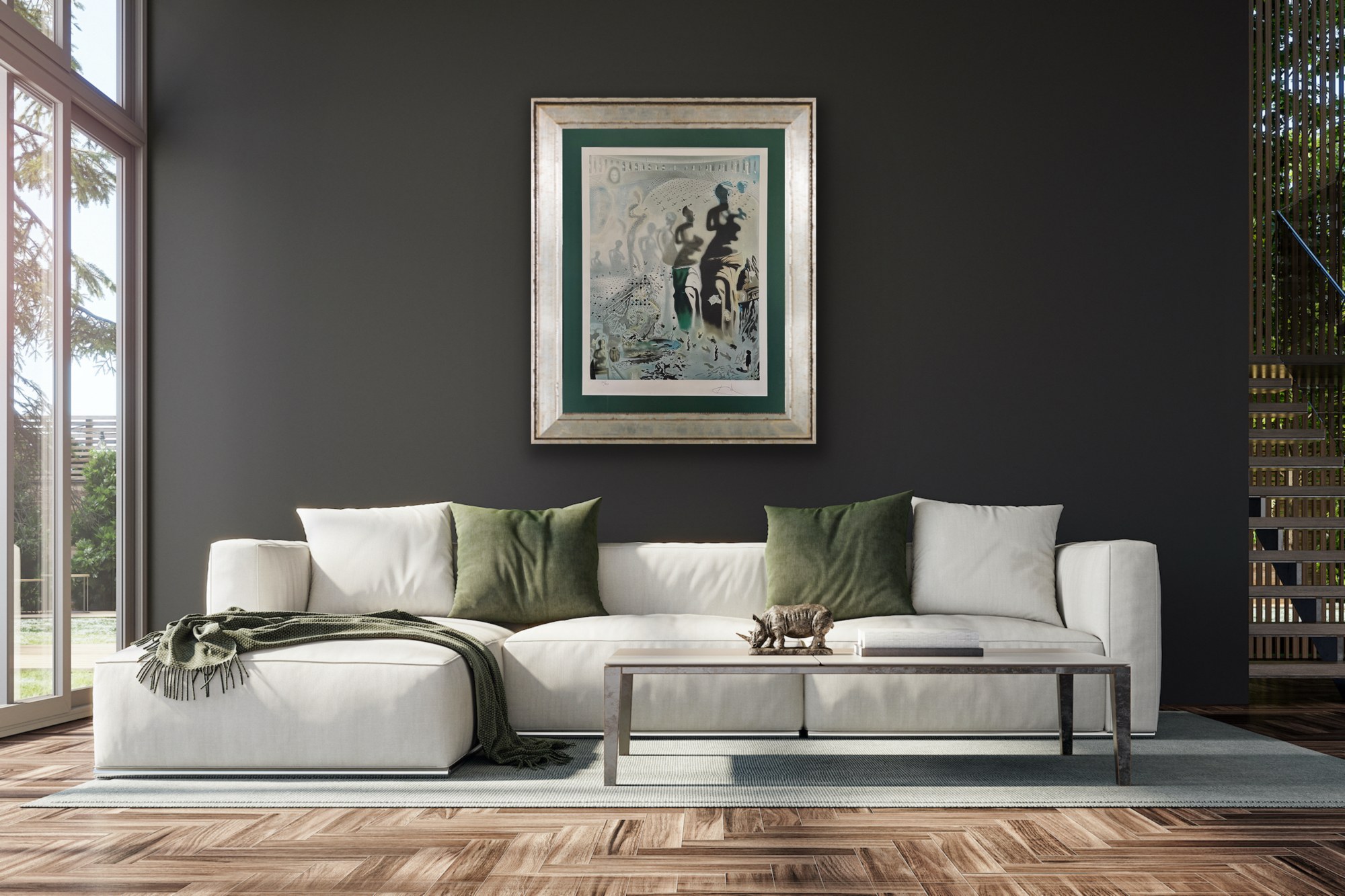
The binding shown in the visuals is for illustrative purposes only and does not constitute a commercial offer.