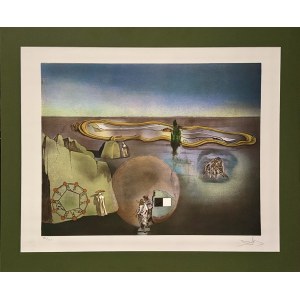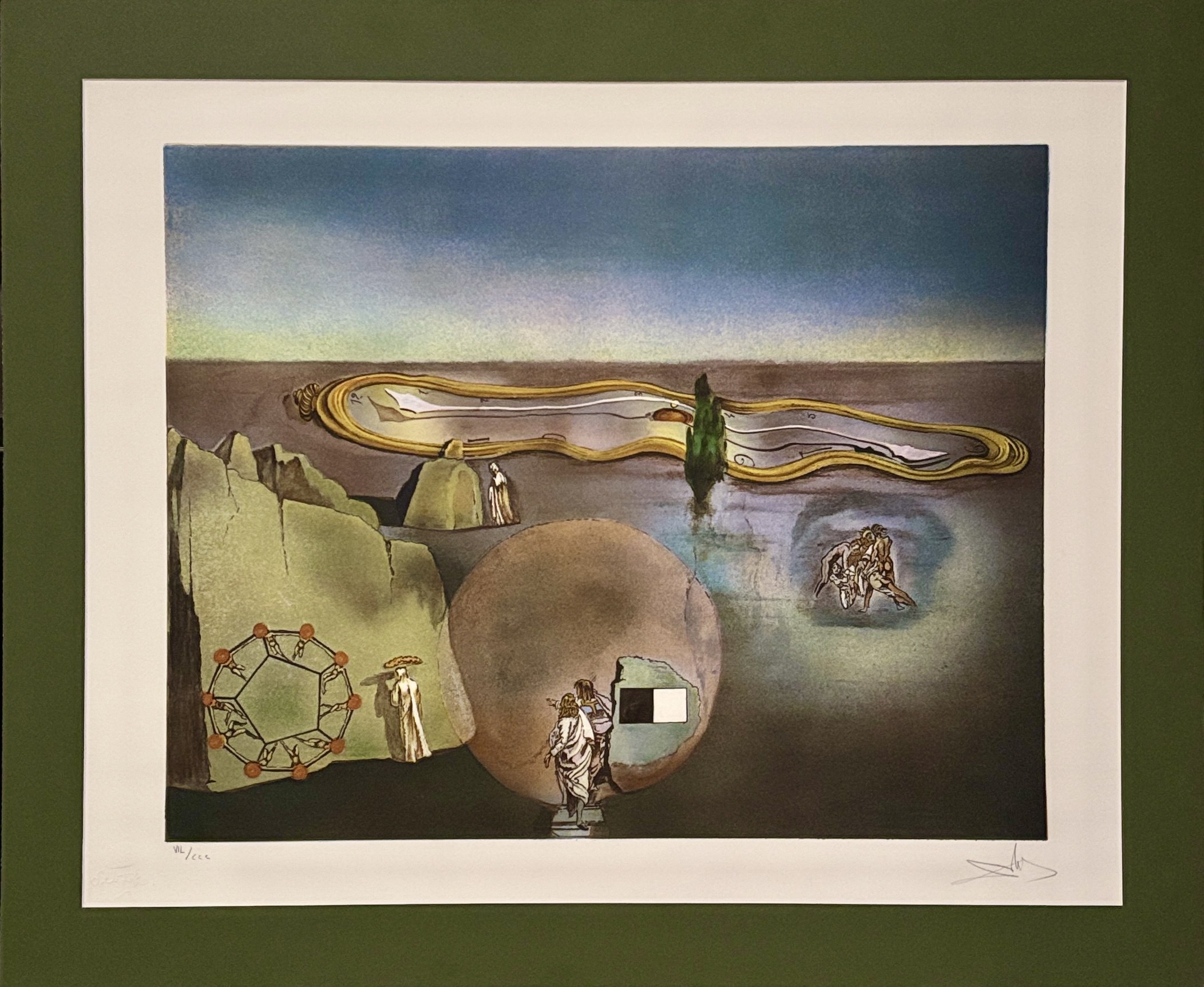
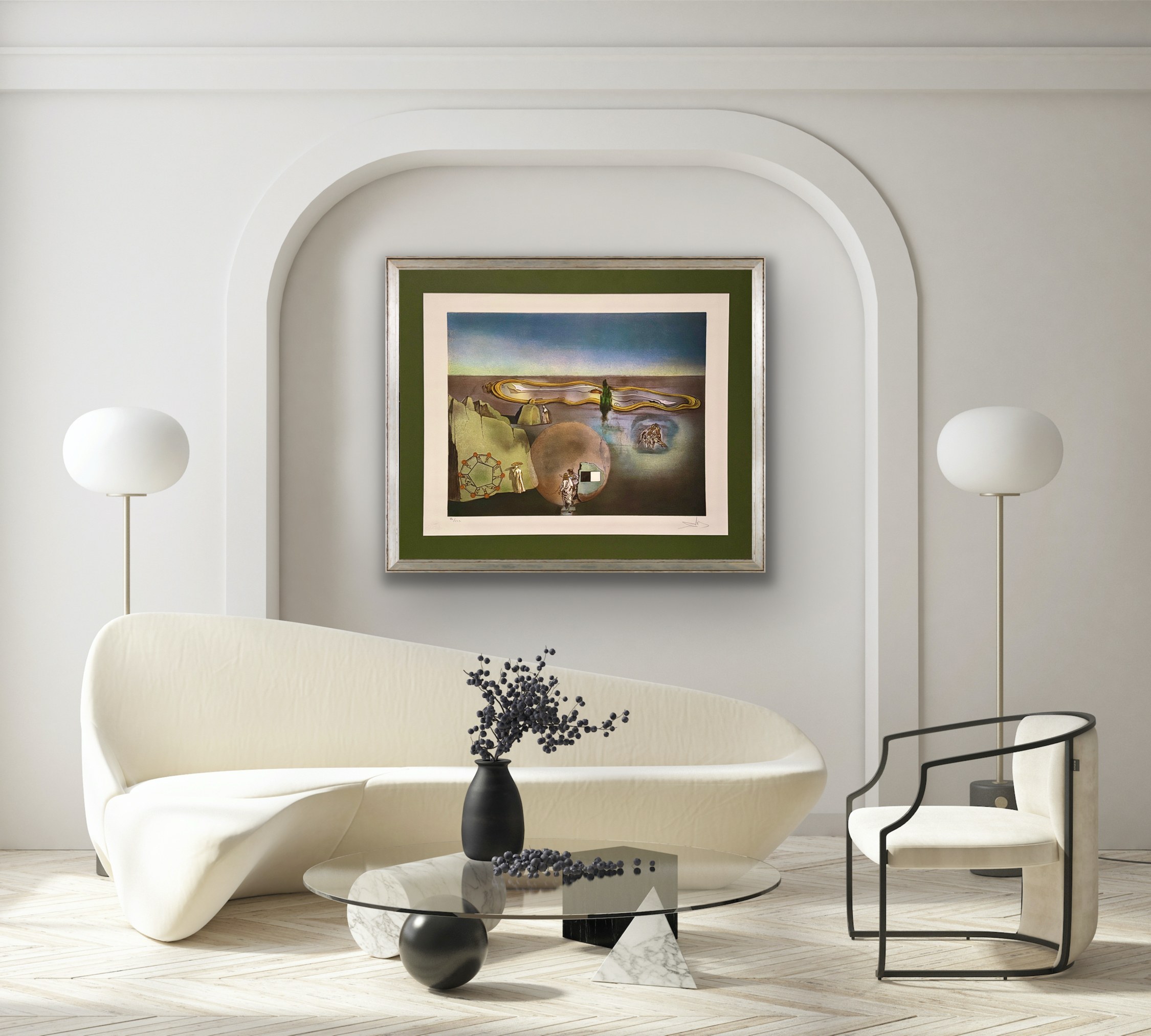
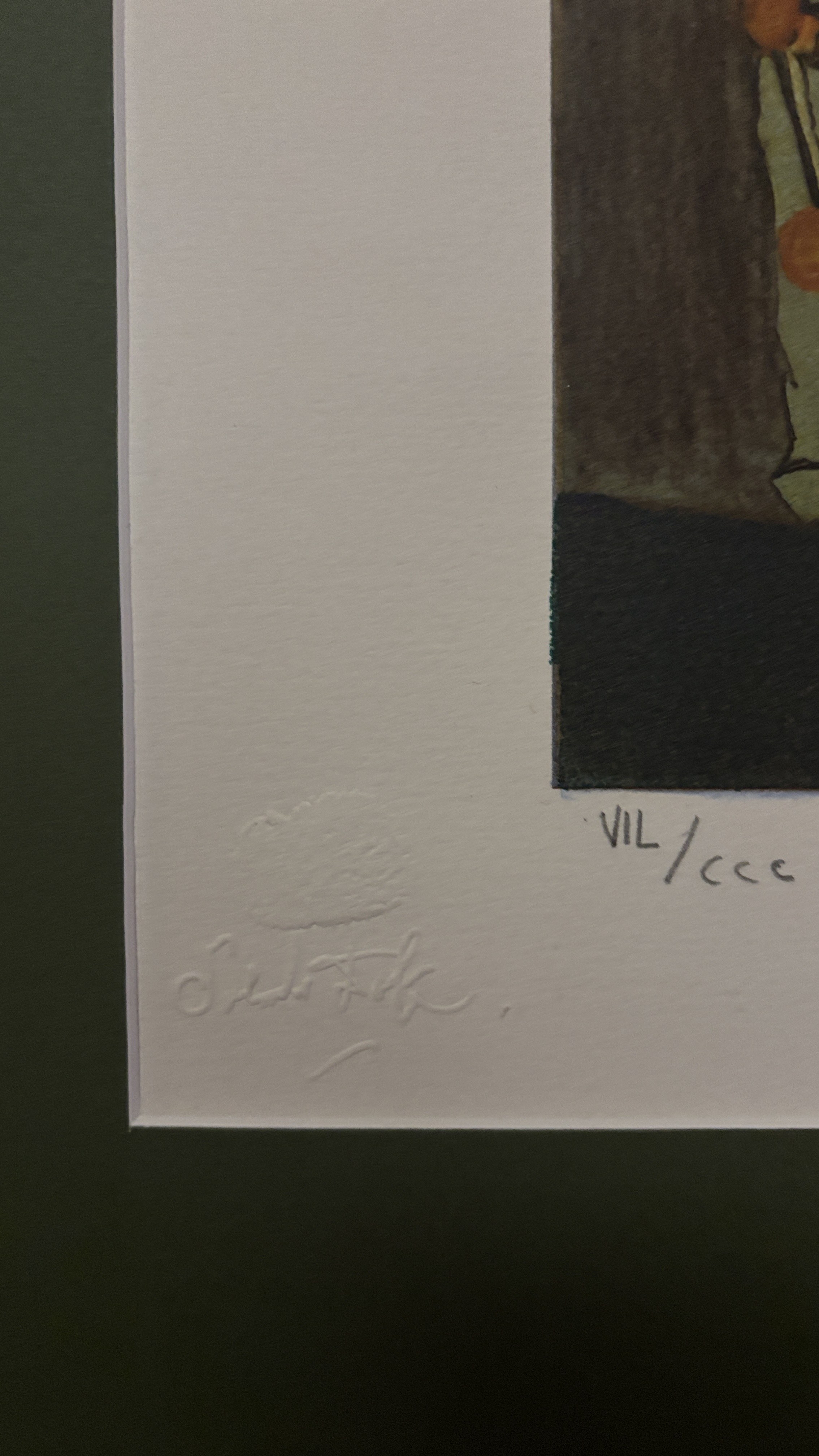
Color lithograph on Velin Arches paper; 54 x 68 cm in light of the 65 x 79 cm passe-partout, limited edition, numbered in pencil VIL/CCC l.d., signed by the Artist; Dry stamp "Salvador Dali and the tree" ( is the hallmark of the famous French printmaking workshop Ateliers Rigal (Fontenay-aux-Roses).
Pierre Rigal and his sons were one of the few master printmakers that Dalí fully trusted in the 1970s and 1980s. The tree mark on the paper is not only the workshop's logo, but a guarantee that the matrices were prepared and rebound under strict artistic supervision. Publisher : Editions de la Différence (an outhouse that worked closely with the Rigal family to produce Dali's luxury editions in the late 1970s and early 1980s).
This fascinating work is based on Salvador Dalí's famous painting titled. "In Search of the Fourth Dimension"(À la recherche de la quatrième dimension), originally painted in 1979.
The work comes from a late period of Dalí's work in which the artist abandoned pure surrealism in favor of "nuclear mysticism" and a fascination with mathematics, quantum physics and higher-order geometry.
Dali's characteristic motif of a soft, melting clock suggests that in the fourth dimension (space-time) time is not linear or rigid - it stretches and bends under the influence of gravity or human perception.
On the left, a structure resembling a polyhedron inscribed in a circle. For Dali, Platonic solids (especially the dodecahedron - dodecahedron) were a symbol of the perfection of the cosmos and divine order. This is an attempt to visualize the complex mathematical concepts that would explain the structure of the universe. The figures at the bottom appear to go deep into a sphere or hole in space. It's a metaphor for humanity trying to "move" to a higher level of understanding of reality. The background alludes to Dalí's native Catalonia (Port Lligat), but it is unreal, empty and metaphysical, emphasizing the intellectual isolation of the truth-seeker.
In the 1970s, Dalí was fascinated by the work of mathematician Thomas Banchoff, who was concerned with visualizing the fourth dimension. The artist believed that painting was a tool that allowed us to "see" what our eyesight could not grasp in three dimensions.