


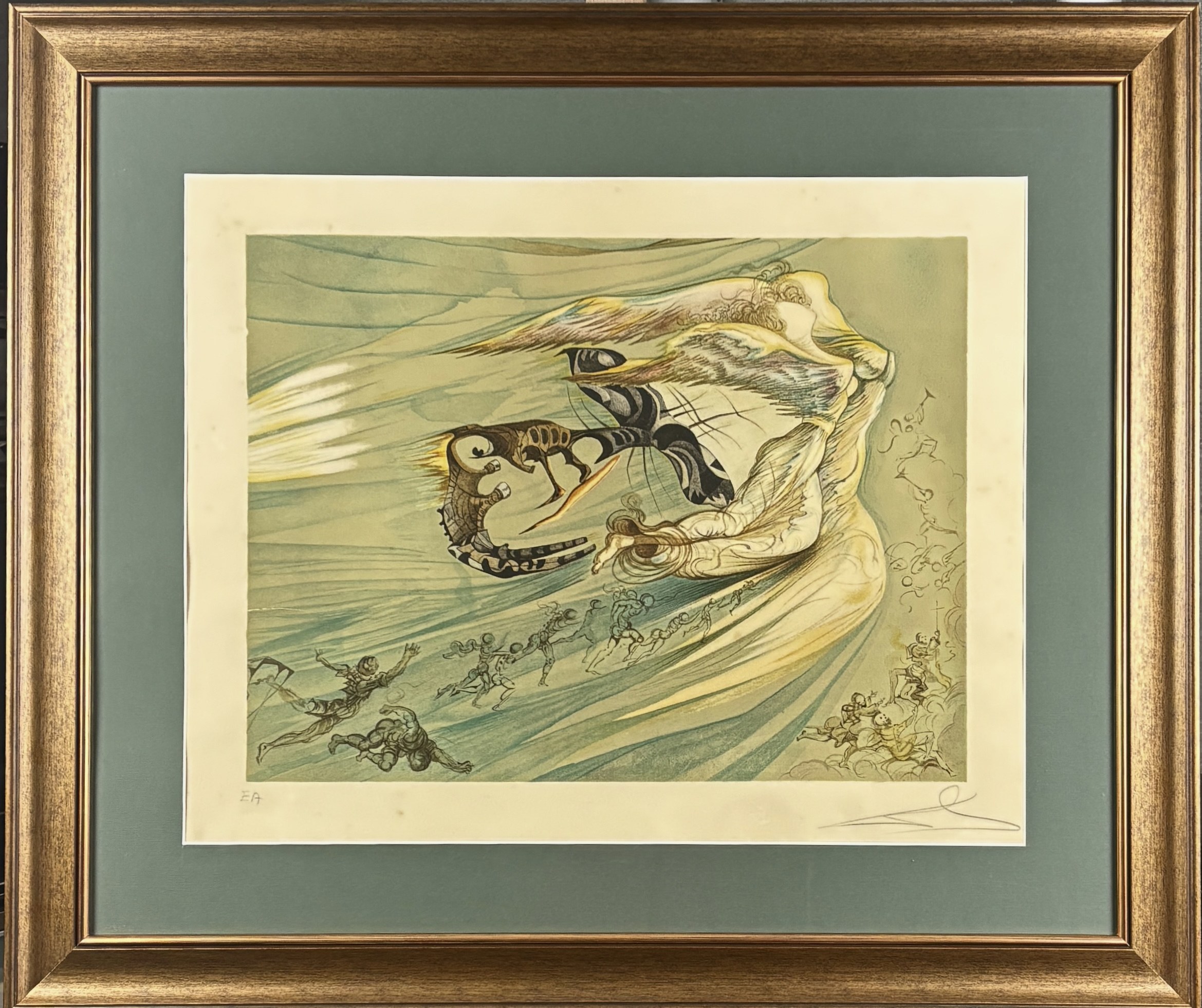
Color lithograph on Arches Velin paper, 45 x 67 cm (inner dimensions of the mat), framed in a 68 x 80 cm frame;
Limited edition of 150 pieces plus several E.A. (épreuve d'artiste—artist’s proof) pieces;
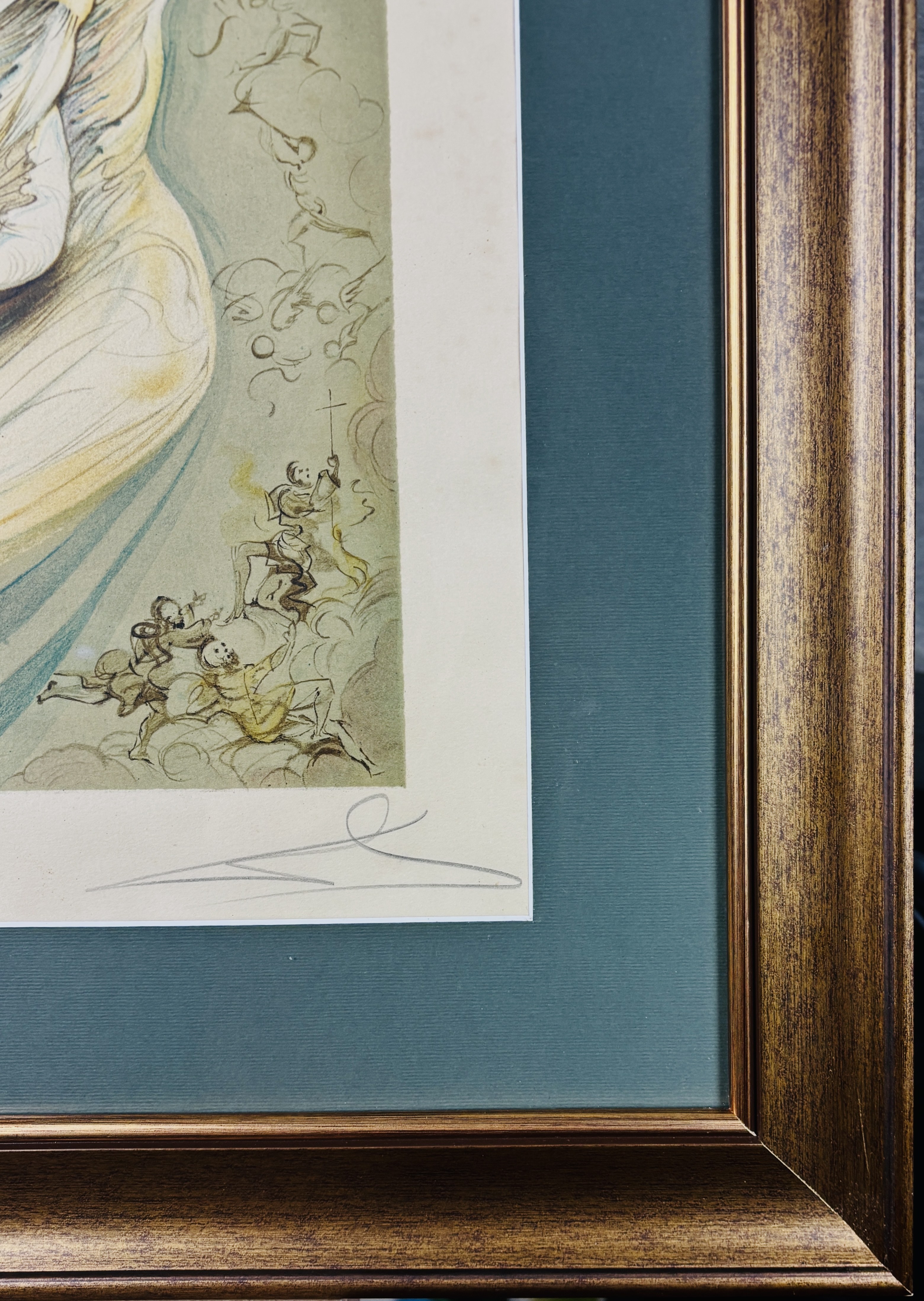
Signed in pencil by S. Dalí in the lower right corner;
Lithographed at Atelier Claude Jobin in Paris in collaboration with Atelier Rigal (documentation indicates that the various stages of production were divided between Atelier Rigal and Atelier Claude Jobin);
Provenance: private collection
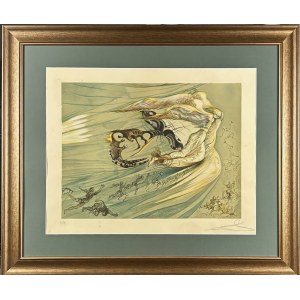
This work belongs to a particularly interesting strand of Dalí’s experiments with anamorphism and optical illusion—the artist constructed the image so that its meaning and recognizable motif would be revealed through a specific transformation of form and the viewer’s perspective.
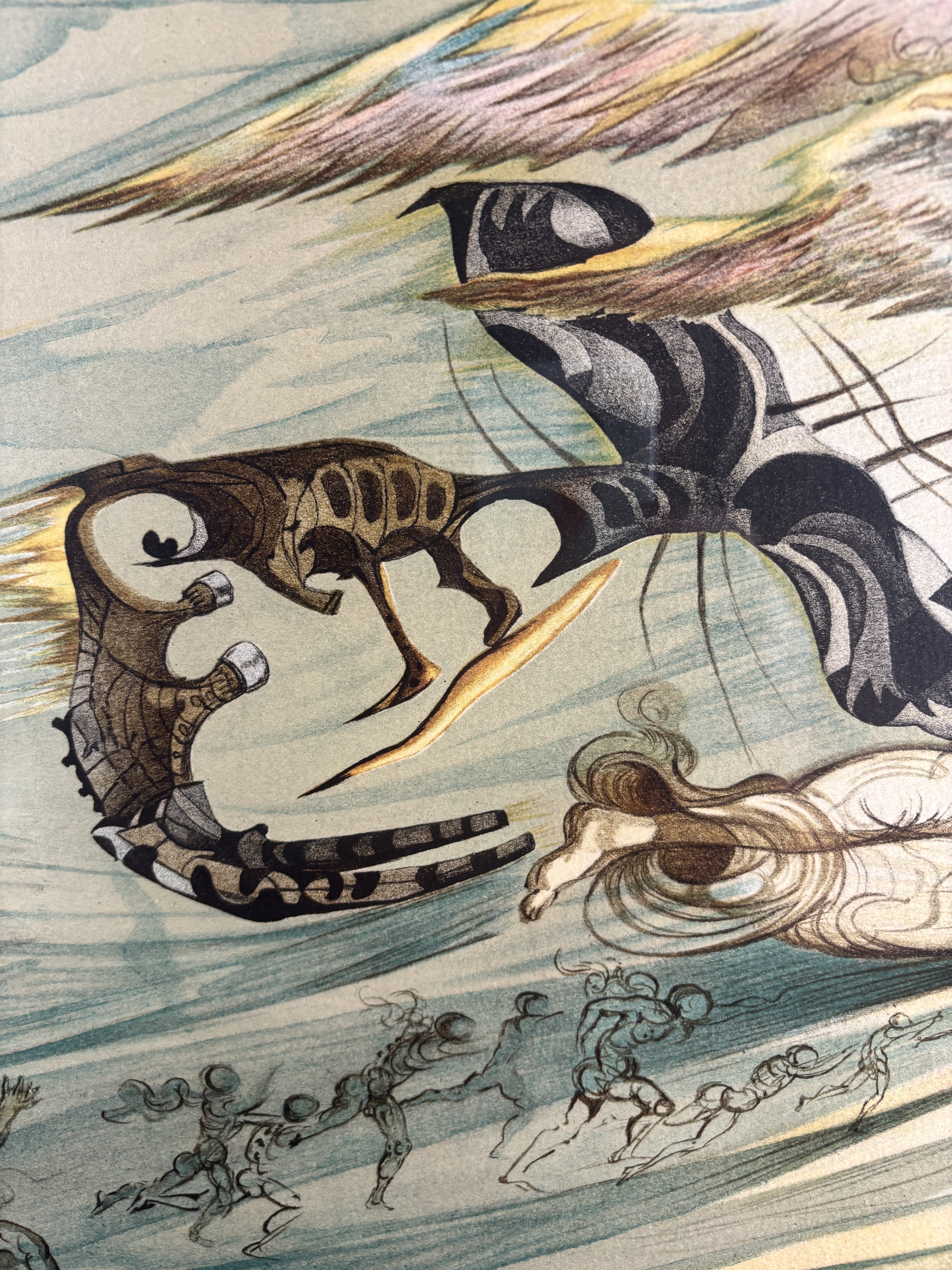
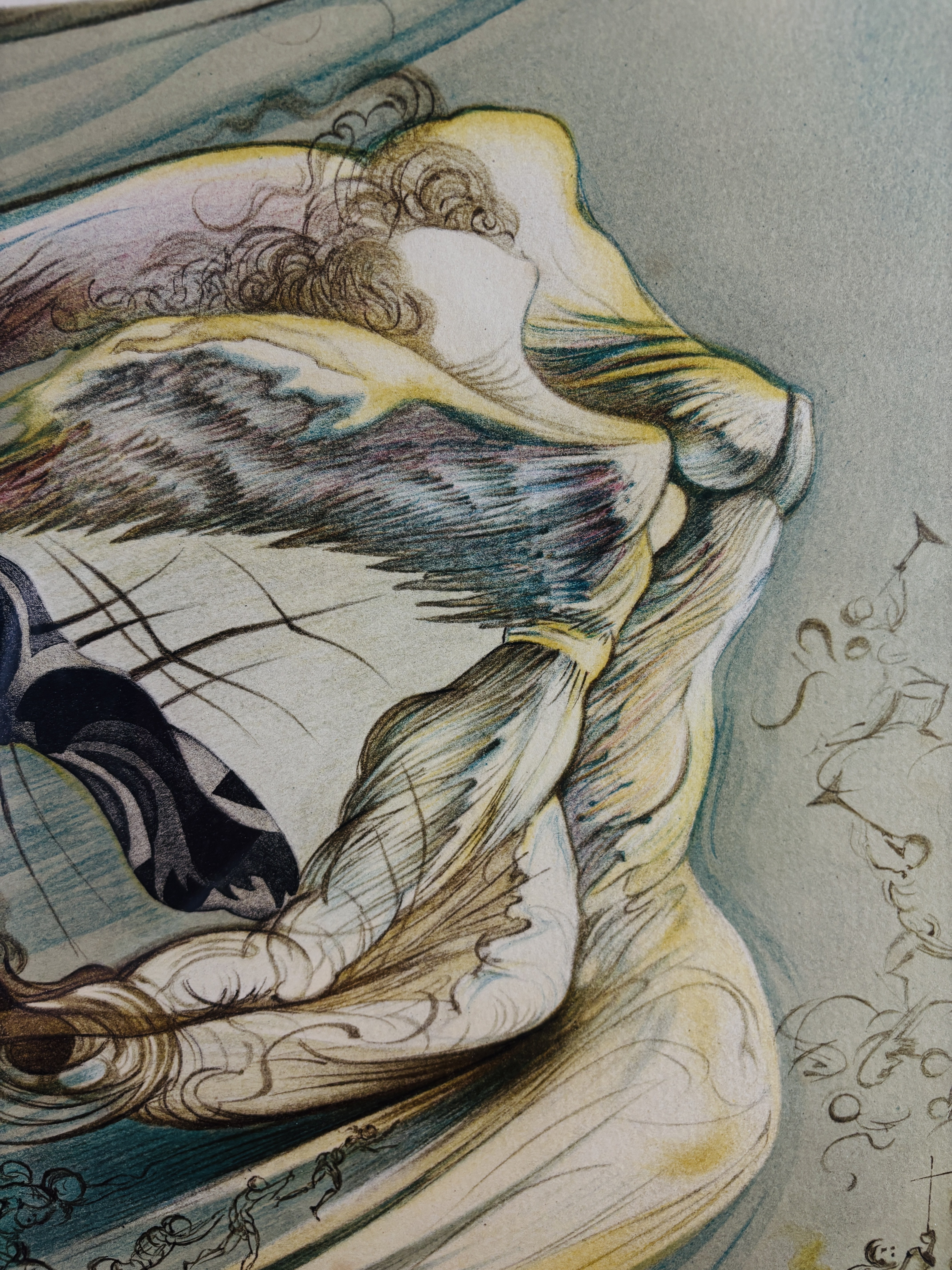
The most important element here is the contrast between the monumental, almost organic form in the foreground and the swarm of tiny creatures floating in space; Dalí employs his characteristic “double image” technique here. At first glance, we see a fantastical, dynamic composition: a huge, distorted figure or animal form, streaks of light, and whole rows of tiny, almost grotesque figures floating in space.
It is precisely this fluidity and distortion that are the essence of anamorphism. Dalí does not treat the painting as a static representation of reality—the image changes depending on how it is perceived. The motif of Lincoln is thus present not as a classical portrait, but as a hidden, transformed structure.
Dalí did not create a series of paintings glorifying Lincoln as the U.S. president, but he had been interested in his image even earlier. The turning point was an article by American scientist Leon D. Harmon titled “The Recognition of Faces,” published in *Scientific American* in November 1973. In it, Harmon presented the famous, highly simplified image of Abraham Lincoln’s face from the $5 bill. Despite the extreme simplification, the face remained recognizable. And it was from that moment on that Lincoln became an extremely important motif for him. For Dalí, Lincoln was a symbol of history, freedom, America, and a great political figure, but above all, a face whose distinctive features made it ideally suited for experiments in distortion. He was interested in something entirely different: Lincoln’s face was the perfect “tool” for experimenting with human vision.
The motif of tiny figures floating in the background is also very intriguing. Their small scale makes the central form appear gigantic, almost cosmic. The figures look as if they are being thrown, lifted, or swept away by a powerful whirlwind. Man is reduced to a tiny element in the face of a vast, incomprehensible reality, in a surreal storm.
The preserved EA print—an épreuve d’artiste—holds particular collector’s value, as it belongs to the artist’s own pieces outside the basic edition of 150 prints. The work is relatively rare on the market and is not included in the standard catalogs by Michler & Löpsinger and Field.










Последно разглеждани позиции
Влезте, за да се запознаете със списъка с артикулите
Любими
Влезте, за да се запознаете със списъка с артикулите