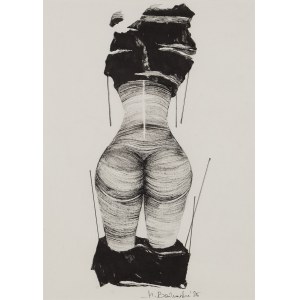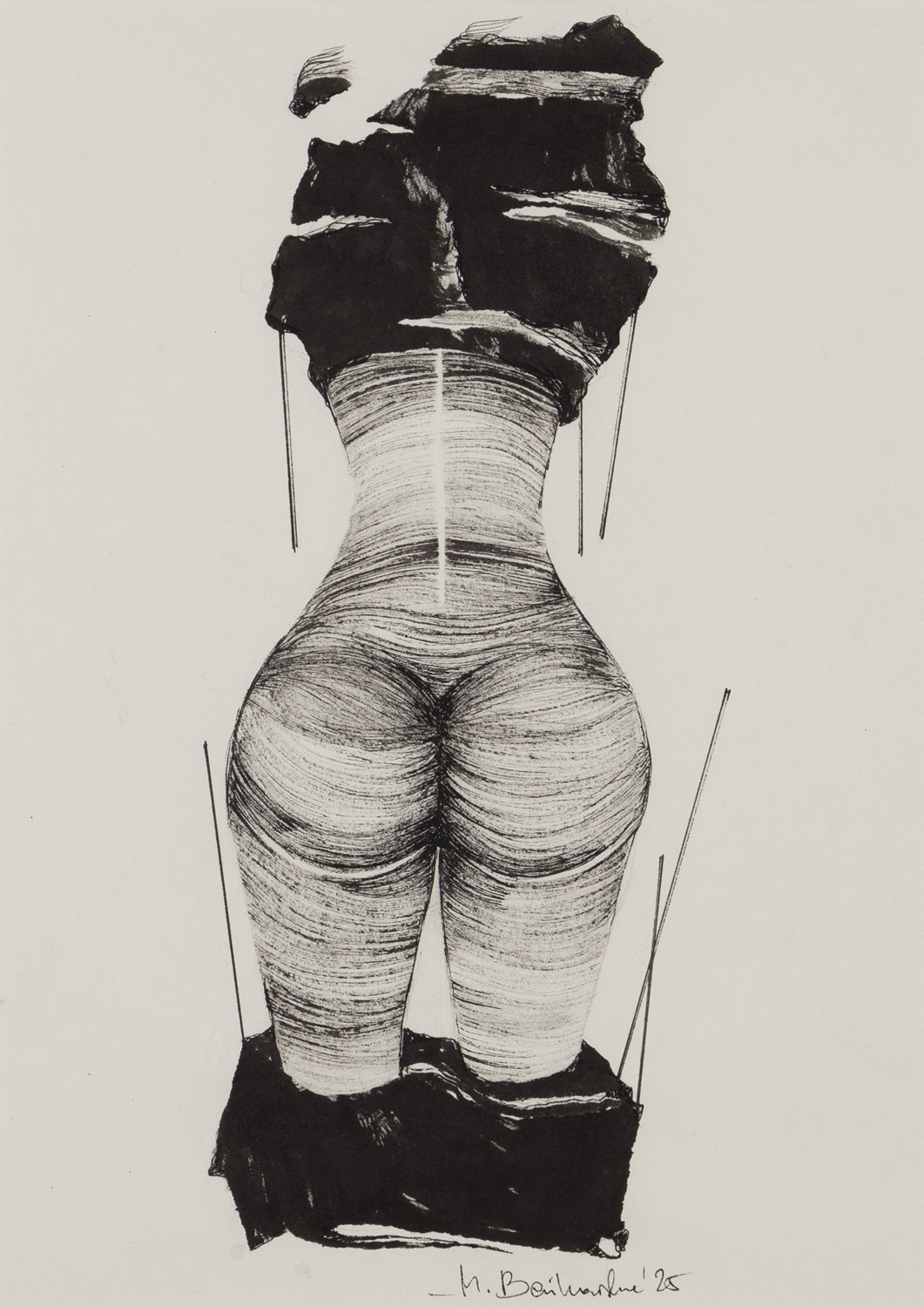
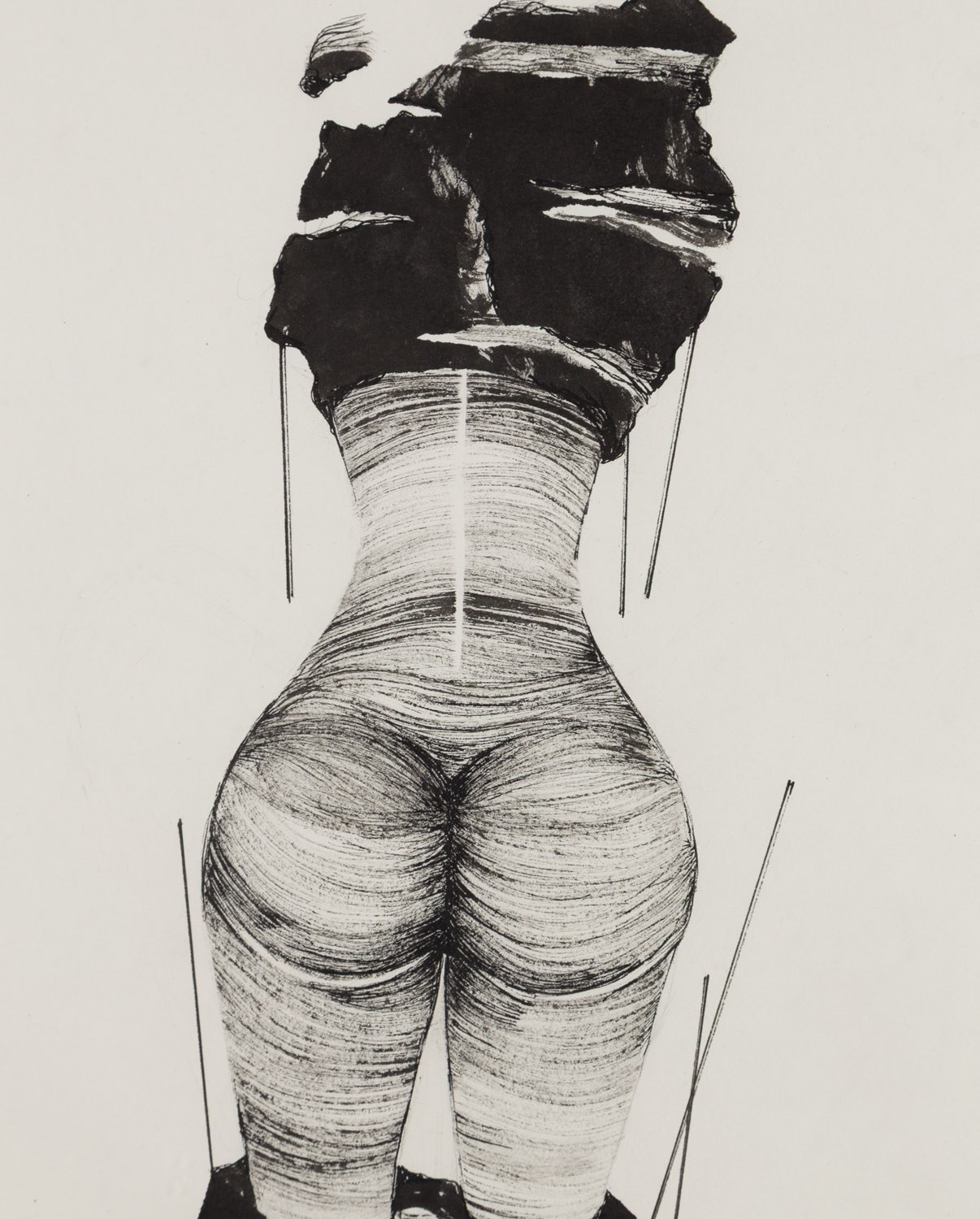
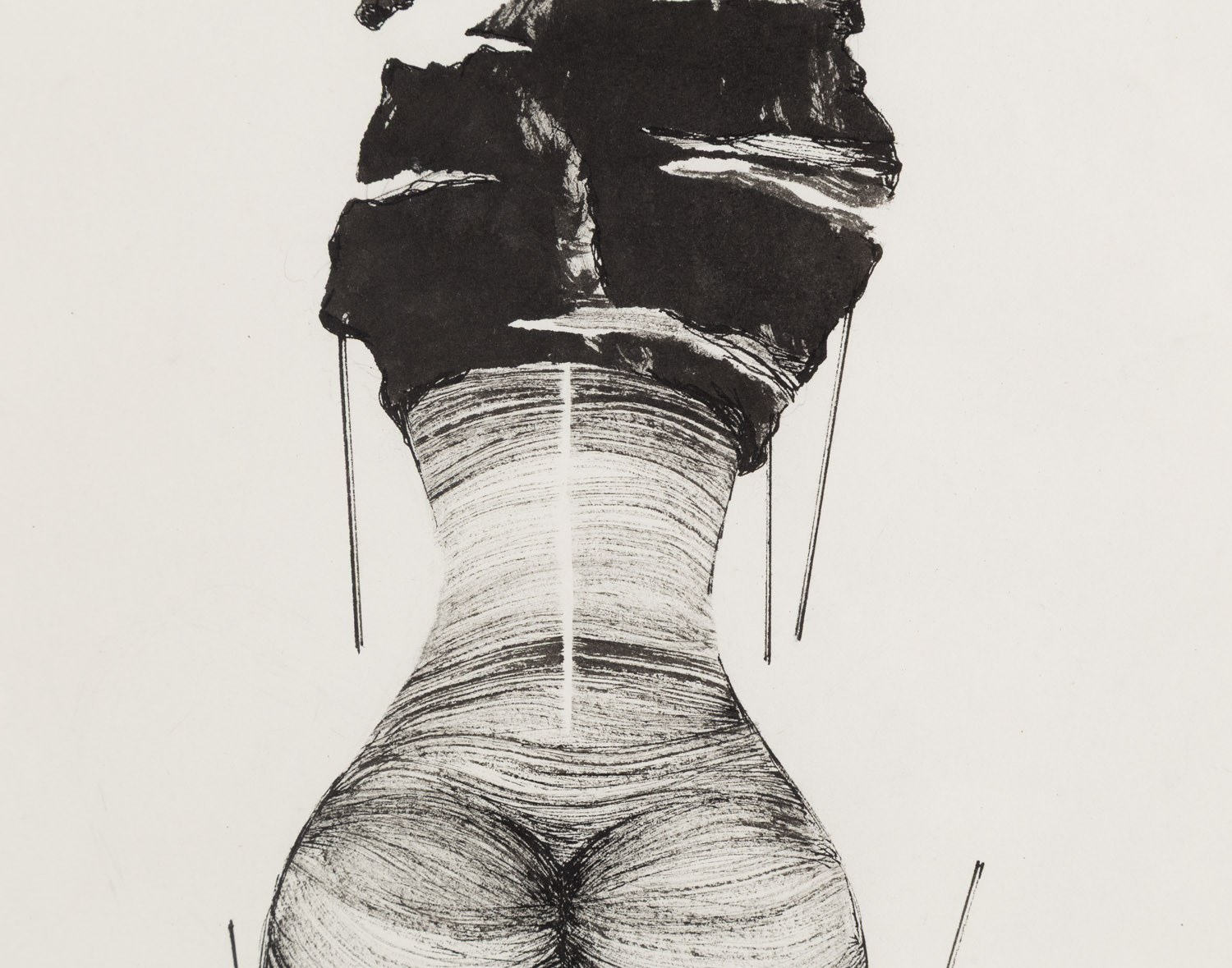
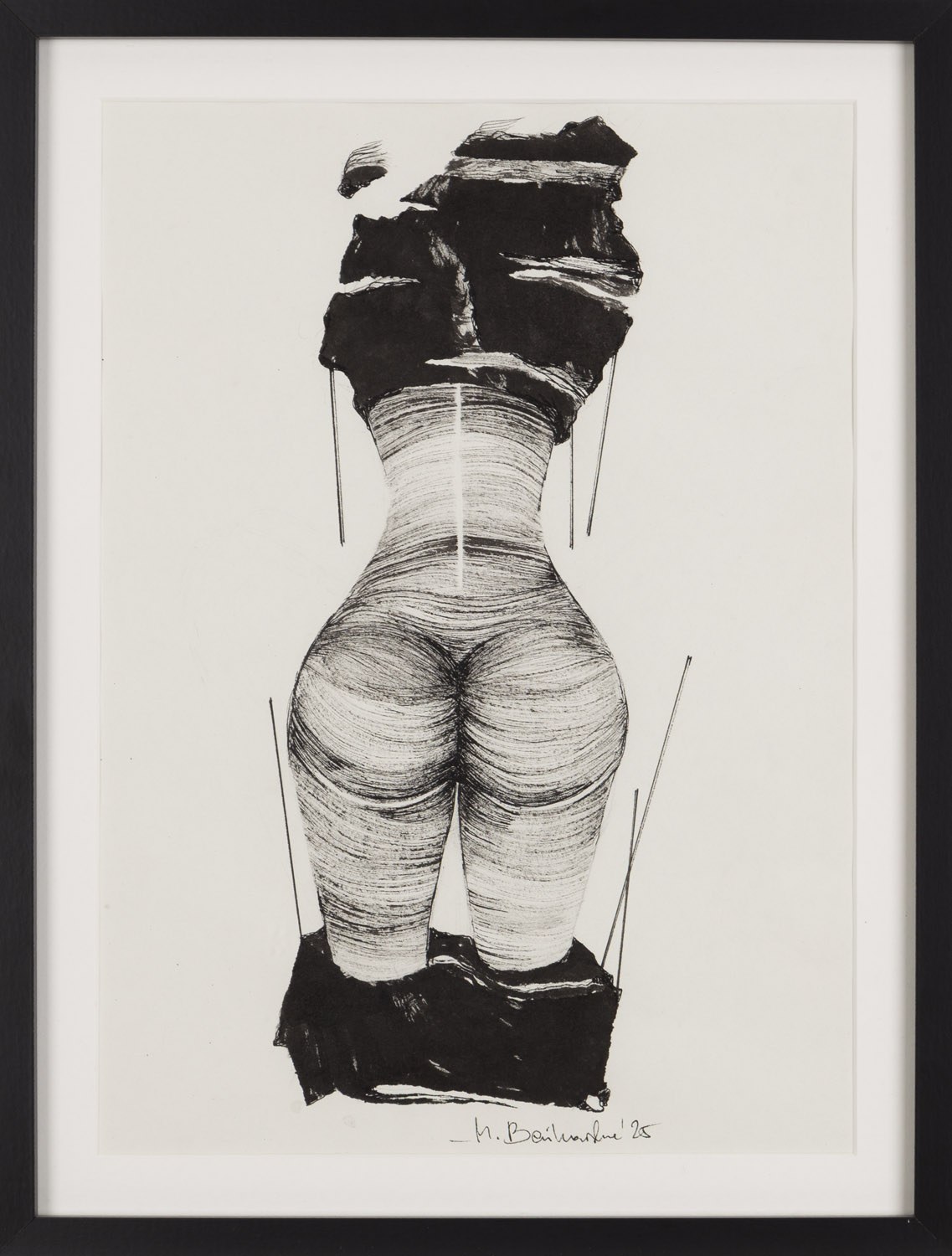
Dimensions: 40 x 29 cm
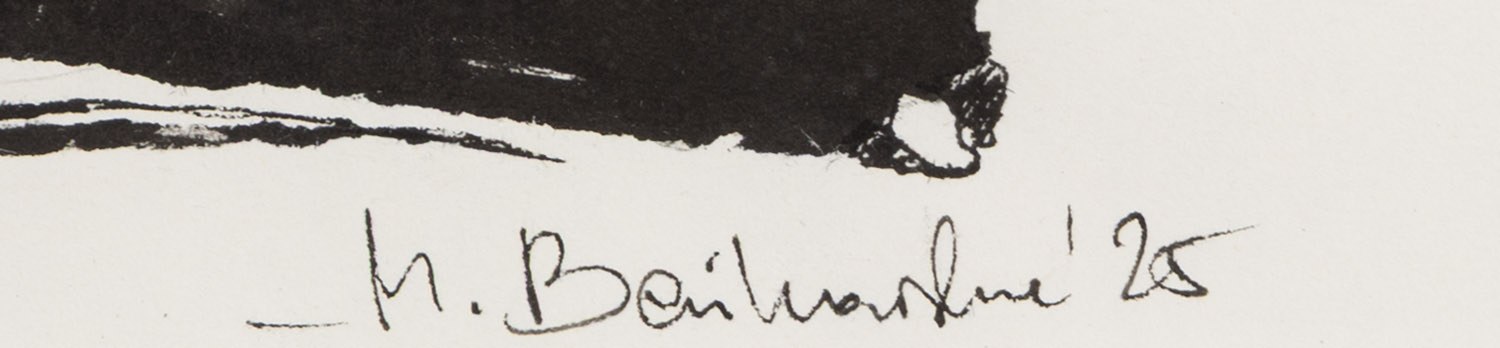
signed and dated at the bottom: 'M. Bańkowska '25'
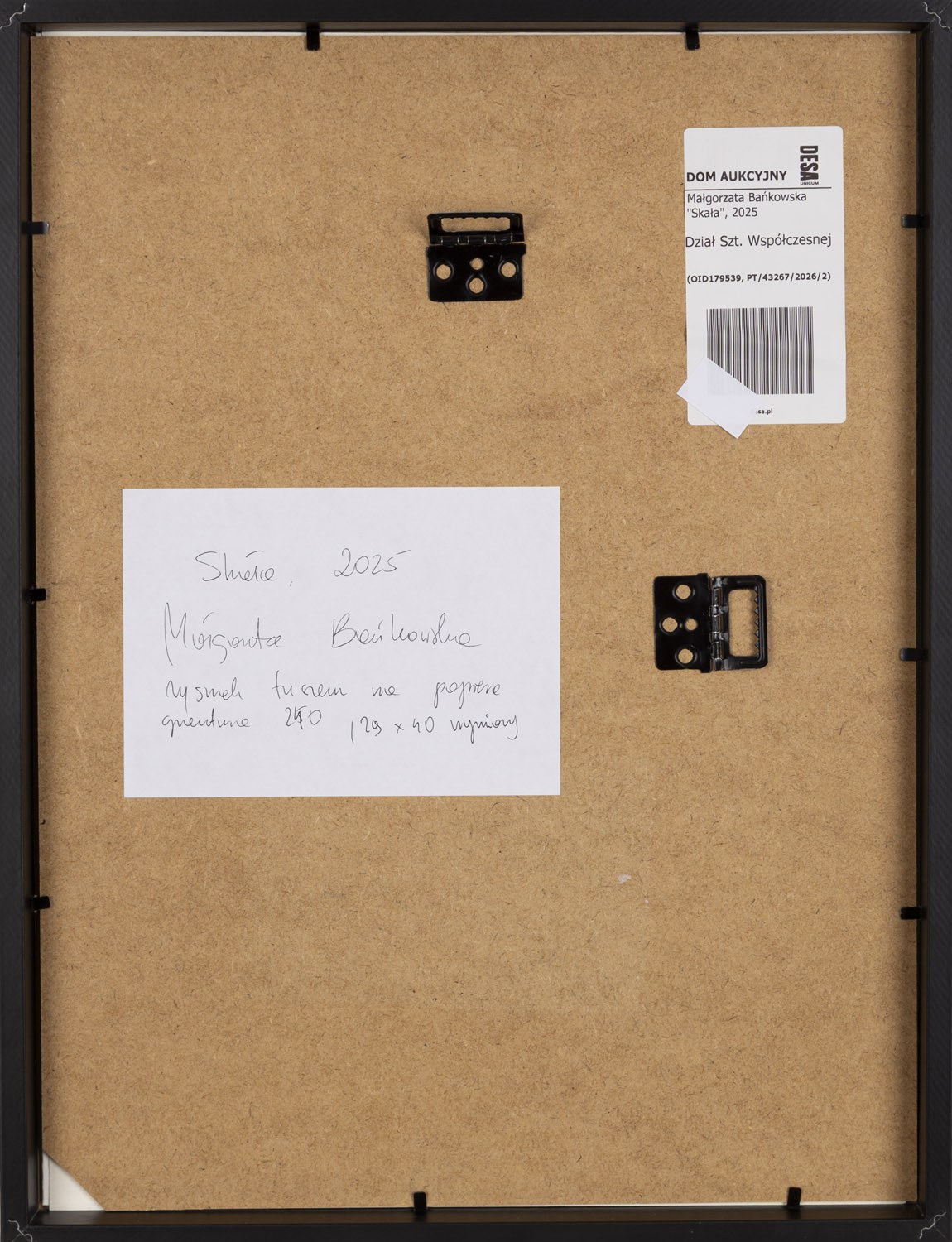
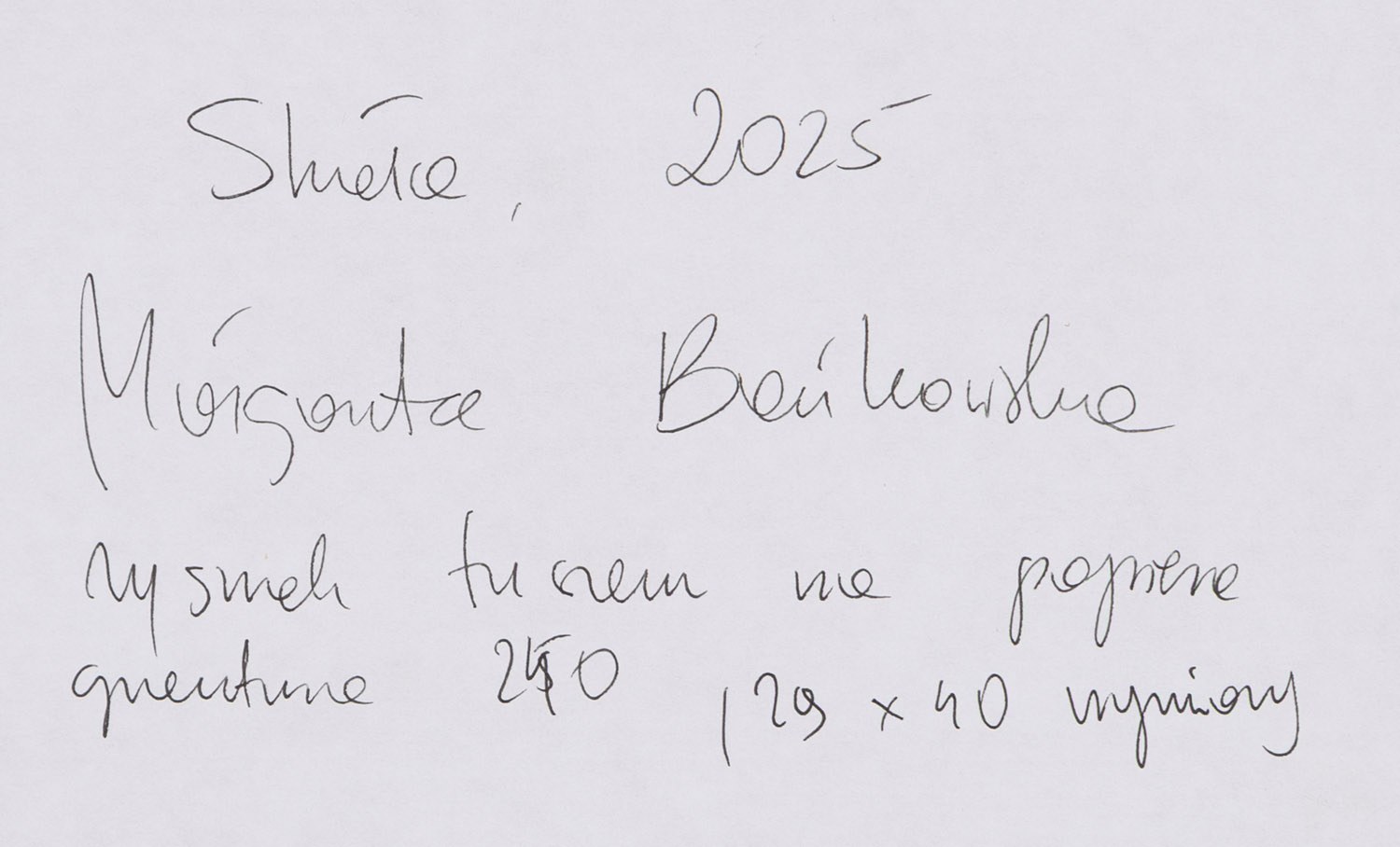
signed, dated, and labeled on the reverse: 'Skała 2025 | Małgorzata Bańkowska | ink drawing on paper | 240 gsm, 29 x 40 dimensions'
Condition
Work mounted
Biography
Małgorzata Bańkowska was born in 1976 in Milanówek. From birth, she was connected to Brwinów and Podkowa Leśna, living on the border between these two picturesque towns. It was here, while still a child, that she began creating art, and it was here that she held her first exhibitions under her maiden name.
Her marriage in 2006 marked a major turning point in Małgorzata’s life. She moved permanently to Warsaw, where she has lived and worked ever since, and took her husband’s surname. This marked the beginning of an artistic explosion, intensified by her pregnancy and the birth of her son Jacek in 2008.
During this period, Małgorzata’s work was dominated by eroticism and fetishism, interwoven with military motifs, biomechanics, and medical failure. It was then that she created a very large collection of drawings titled “The Red Gallery.” The works from this period mainly depict women. A woman as a machine, a woman who is beautiful even without arms or legs, is always very useful and creative. A psychedelic and somewhat bewildering world full of dolls.
Małgorzata is an interdisciplinary artist, though painting and drawing are the most important mediums in her work. Surrealism is her primary style, often rich in historical, mythical, or religious symbolism.
A cross-section of her paintings and drawings, along with the years in which they were created, reveals the evolution of the artist’s style. This evolution is also evident in the themes she explores and her incorporation of—and blending of—other styles. Here we see a spectrum ranging from minimalist darkness and mysterious, monumental figures to a Baroque style rich in gold and opulence, sometimes combined with elements of Pop Art. It is also a cross-section of the emotions and moods that determine the direction of the artist’s development.
Małgorzata is an artist who is constantly searching, and in doing so, she engages in rigorous intellectual work. This is where the creative process truly begins. She is constantly seeking new inspiration and new themes. This has led to the evolution of her work. Women continue to feature in her pieces. However, her work has evolved toward dystopian surrealism and post-apocalyptic fantasy. Male figures, depicted in a very dark light, have begun to appear in her paintings. History, power, domination, war, and the apocalypse—all of these themes intertwine in Małgorzata’s paintings. Recently, elements of pop art have also emerged. The format of her paintings has evolved as well; they are significantly larger than her earlier works.
It is a well-thought-out, detailed form of surrealism, yet without the inclusion of unnecessary symbols that add nothing to the subject. Looking at the artist’s works, it seems to us that in this play with logical order, everything has its own meaning and significance, while simultaneously offering a broad spectrum for interpretation.
The process begins with a single thought, an impulse. The artist then creates a “mental sketch” in her mind, which transforms into dozens of meticulously recorded notes. This mental sketch evolves, and the written notes serve as a guide. Generally, she does not create preliminary sketches of her paintings; she begins immediately with the underpainting, followed by what she considers the most important process: creating the so-called core of the painting and finding the right framing. Good framing and appropriate composition account for at least thirty percent of the success.
She then transfers the vision from her mind and her notes directly onto the canvas. This is a process during which the idea continues to evolve, and the vision of the painting matures as it is being created. Even in a very advanced stage of the creative process, when the painting seems almost finished, the artist is capable of making significant changes to achieve a perfect harmony of colors and composition.
The final stage involves finishing the painting with details, which the artist refers to as the “jewelry of the painting.” This is a very painstaking and labor-intensive stage, after which all that remains is to sign the work and seal it with varnish.
She never paints or focuses on just one piece. She works on two or three paintings at the same time. Which one she chooses to work on at any given moment depends on such mundane factors as her mood, the emotions stirring within her, the weather, or the music she happens to be listening to.
The artist describes her painting as a ceaseless journey into her own thoughts and life. It is an inspiring journey. Her vivid, galloping imagination has long been a gift, an escape from what is bad and unpleasant.
She finds it easy to lose herself in the creative process and to cut herself off from reality and pain. Małgosia has been suffering from a chronic rheumatic disease since she was 22. The illness has become one of the driving forces behind her art. This immersion in art serves as a form of therapy for her and an escape from pain. In some of her paintings, one can discern the specific nature of chronic illnesses. Illness complicates existence, impairs bodily functions, and has a profound impact on our psyche. Małgosia has developed a veritable hunger to create—indeed, she uses her art to numb the pain and discomfort.
That is why she does not like to talk about her paintings; for her, mystery is important—the dialogue between the image and the viewer’s imagination—because, after all, the artist engages in a dialogue through art. She believes that this “something” cannot be described or named. If language could be used, art would not be necessary. Everyone must interpret what they see for themselves. It is an attempt to capture the uncatchable. Creating an alternative reality, seeking symbolism and indirect meaning—that is freedom and independence.
A defining moment in Małgorzata’s career was the pandemic period, when—in a sense, in opposition to the prevailing mood and as a departure from her earlier works—her paintings began to feature very intense colors, gold, and a positive message, at times even grotesque. She created an entire series of pop-art-style paintings—highly expressive, painted on impulse, without any prior plans, notes, or deliberation. These positive emotions, during such a gloomy period, also served as a remedy for others; of the more than 20 works, the majority were sold while the pandemic was still ongoing.
Currently, after a long hiatus, the artist has returned to drawing, though the tools she uses have changed. This time, they are nibs and drafting ink.
“Drawing with black drafting ink is a completely new creative experience for me—a new tool. Above all, I’m searching for form and color, and I don’t dwell at all on content or detail. It’s an impulse, a moment, my first thoughts. The expression of pure form.”
Over the course of a year, she created about 200 works in four sketchbooks. This is a very prolific period, similar to when “Czerwona Galeria” was created in 2008.
For many years, Małgorzata’s works were sold directly or through galleries. They found their way to collectors on three continents and are now located in Asia, Europe, and North America. The largest private collection of Małgorzata’s works is in China.
Recent years have finally brought a revival to the Polish art market, opening up sales opportunities in her home market. For the past year, Małgorzata’s works have been available for purchase at auctions, primarily at the DESA Unicum auction house.
Małgorzata’s works have been featured in sixteen solo exhibitions and six group exhibitions.